
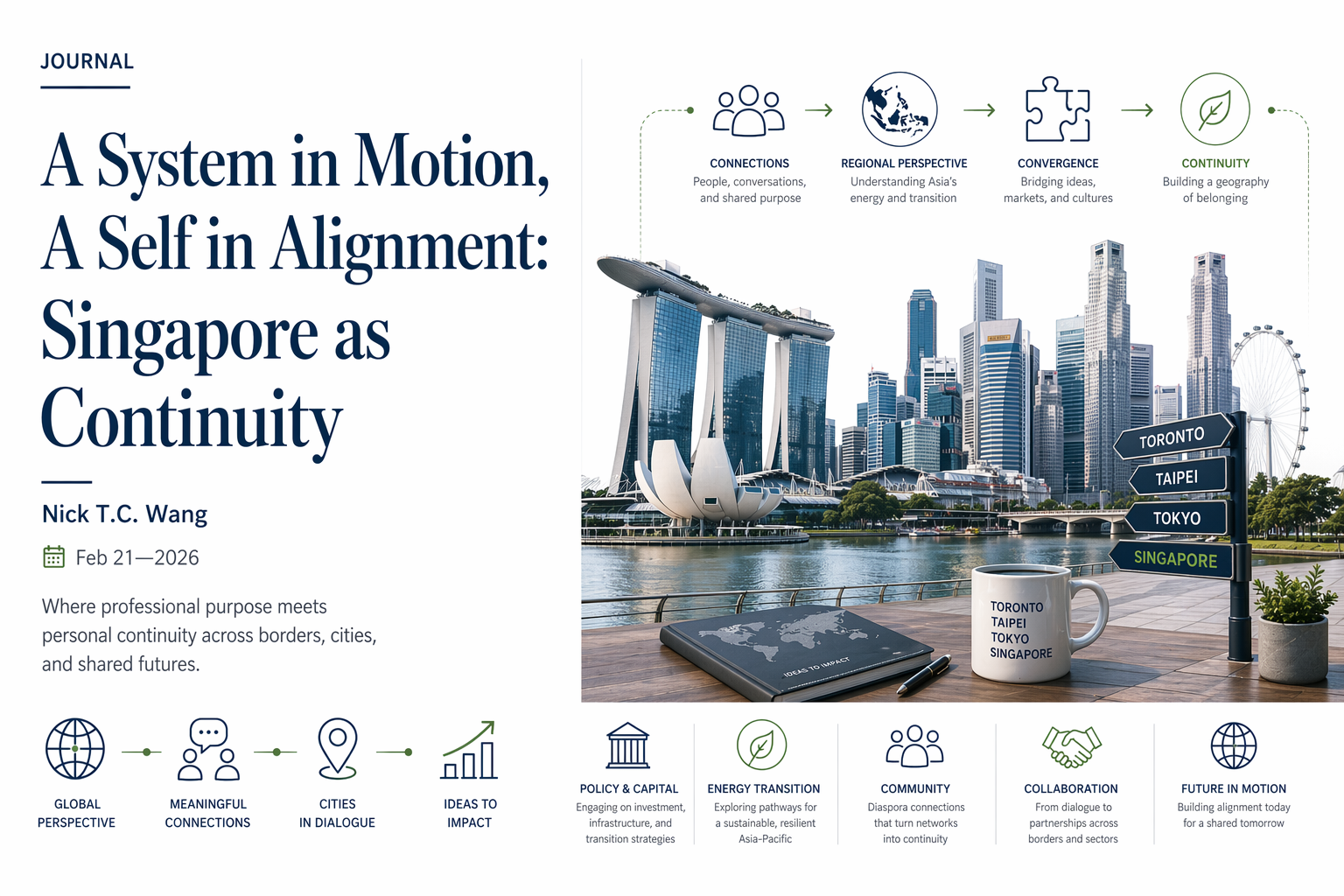
I arrived in Singapore with a calendar built like infrastructure, every hour allocated, every room mapped in advance, every conversation expected to contribute to a larger regional narrative about capital, energy, and transition. For months the Canada-in-Asia Conference had existed as the formal anchor of the trip, the reason movement across time zones could be justified within the logic of work. Yet the moment I stepped into the humid night outside Changi Airport, that structure loosened. The city did not feel like a destination but like a system already in motion, one I had been orbiting professionally for years. Trains moved with quiet certainty, glass towers held the afterglow of ongoing meetings, and the air carried the density of a place that understood its role in the world. It was my first visit, but it felt less like arrival and more like entry into a continuity that had already begun.
The conference mattered to me first as a responsibility. I had been sent as one of the Taiwan delegates on energy transition, representing the Canadian Chamber of Commerce in Taiwan, and that role shaped how I moved through the week. My work is focused on Taiwan, and being in Singapore allowed me to hear how the island is positioned within wider regional strategies rather than only analysing it from within its own context. Most of the time I listened. When I spoke, it was usually to bring Taiwan into conversations where it was not immediately visible, or to translate between Canadian institutional perspectives and regional realities. The experience was less about presenting views and more about carrying a position into a shared space and allowing it to evolve through exchange.

The first encounter that shifted the emotional scale of the week was seeing someone I had met only once before in Tokyo in 2024, during the startup hackathon I hosted. That version of my life had been defined by building communities at speed, believing momentum itself could generate continuity. Our interaction then had been brief and almost peripheral, yet she remained in my memory with unusual clarity. Meeting again in Singapore transformed that single moment into a timeline. The conversation unfolded calmly across different days, but it carried a temporal depth that resisted coincidence. Some people enter your life through repetition. Others do so through resonance. Admiration that once existed at a distance began to orient itself toward the future, suggesting not intensity but the possibility of sustained parallel movement across cities and years.
There was a grounded coherence in the way she connected thought and action that made me aware of how rarely those dimensions align so naturally in professional environments. My own trajectory has been defined by transition, moving from Toronto to Taipei, from entrepreneurship to consulting to research, and discontinuity has often felt structural rather than accidental. With her, that assumption briefly dissolved. I began to imagine continuity that did not depend on geography or frequency but on shared direction. The city around us, built on convergence and reinvention, seemed to hold that possibility in place. In a schedule otherwise defined by formal engagements, those conversations became a quiet axis around which the emotional meaning of the trip slowly rotated, giving the week a centre that had nothing to do with conference rooms.
A new friendship formed with the speed that only transient cities allow. She lives in Washington, a place I had always associated with policy rather than daily life, and through her Singapore opened at walking pace. We moved without itinerary, leaving conference venues for neighbourhood streets and allowing conversation to determine direction. Meals stretched into late evenings and time lost its segmented structure. The boundary between professional and personal dissolved without effort. In those hours the city stopped being a backdrop for meetings and became a shared experience unfolding in real time. What might have been a sequence of scheduled interactions turned into a continuous narrative shaped by curiosity, coincidence, and the simple decision to keep walking instead of returning to the hotel.
Through her and through the local friends who gradually included us in their routines, the scale of Singapore changed. We were no longer visitors moving between landmarks but people being introduced to favourite food stalls, familiar tables, and stories of arrival and staying. The shift was subtle but permanent. The moment there are people who expect to see you again, a city acquires memory. I realised that belonging is not created through duration but through recognition. Singapore began to feel less like a point on a travel schedule and more like a place that now contains relationships extending beyond the week itself. The analytical map in my head was replaced by a personal geography defined by names, conversations, and the certainty of future returns.
One evening the convergence took on a different form through a Lunar New Year gathering with Canadian university alumni living in Singapore. The room carried a familiarity that did not belong to the city but to a shared past shaped by lecture halls, winter streets, and the openness of our formative years. We spoke about where life had taken us and how Toronto continued to exist as a reference point even as our work moved across regions. In that space the Canada–Asia corridor stopped being an analytical construct and became a living community shaped by memory and movement. The celebration itself was simple, but the emotional resonance was not. It reminded me that the networks formed during those years are a form of long-duration social capital that reappear in unexpected cities and make distance feel temporary.

Seeing a Bloomberg colleague in person for the first time came later in the week and carried a different kind of significance. Our interaction before this had been occasional and mostly task-based, and even online we had not spoken frequently. Sitting across the same table in Singapore changed that immediately. We spoke about the ASEAN grid and the uneven development of the APAC carbon market, and I found myself approaching those themes through the lens I work with every day, which is Taiwan and how it connects to the wider region. The discussion was not about reaching conclusions but about comparing how different markets are positioned within the same transition. It was a reminder that covering Taiwan from within APAC is not only about data and policy, but about continuously situating it within a network of regional perspectives.
Time behaved differently during that week. In Taipei my days accumulate through routine and discipline. In Singapore a single day contained multiple emotional and intellectual layers. Mornings began with discussions about capital deployment and regional infrastructure, while evenings ended with conversations about identity, memory, and future intersections in other cities. For the first time in a long while those layers were not sequential. They existed simultaneously and reinforced each other. The convergence I had come to observe externally began to take place internally. Professional purpose and personal continuity stopped competing for space and instead formed a single narrative that made movement between geographies feel coherent rather than fragmented.
One afternoon I walked alone through the city without a destination and became aware of how much had shifted in a few days. For years I have described my life as a sequence of transitions, each role and country a separate chapter. In Singapore those chapters aligned. The people I met there knew different versions of me, the community builder in Tokyo, the consultant navigating corporate structures, the analyst working on Taiwan’s place within the regional energy transition. In their presence those identities did not compete. They formed a continuous line. The city itself, built through layers of reinvention and convergence, mirrored that realisation back to me and made it feel less like an observation and more like a lived condition.
By the final evening the skyline along Marina Bay no longer felt like an image but like a container for the week. The conference that had provided the structural frame, the reconnection that carried temporal depth, the friendship that compressed time, the diaspora gathering that reactivated memory, and the intellectual exchange that placed Taiwan within a wider regional conversation were not separate experiences. They were expressions of the same convergence. Each added a layer that did not exist when I arrived. The city had shifted from abstraction to continuity, from a node in a regional system to a place that now holds part of my personal map.

Airports usually mark clean endings but this departure felt porous. Messages about future meetings in different cities were already being exchanged and plans existed in a state of emotional certainty even without dates. As the plane lifted, I realised that the corridor I had come to observe was no longer external to me. It exists in the relationships that now structure my movement across regions. The systems I analyse during the day, capital flows, infrastructure, and energy transition, are inseparable from the people who carry them. What had once been an analytical framework has become a lived geography defined by continuity rather than distance.
Singapore did not give me conclusions. It gave me alignment that had been forming across years of movement. I am no longer travelling between cities as separate episodes. I am building a geography of belonging that exists simultaneously in Toronto, Taipei, Tokyo, and now Singapore. Each place holds a different version of my life, yet all are connected through the people who make return inevitable. The conference provided the structure, but the meaning came from individuals who now occupy that corridor with me. In that realisation the professional and the personal became indistinguishable, and the trip stopped being a visit and became part of an ongoing trajectory.
Leave a Reply