
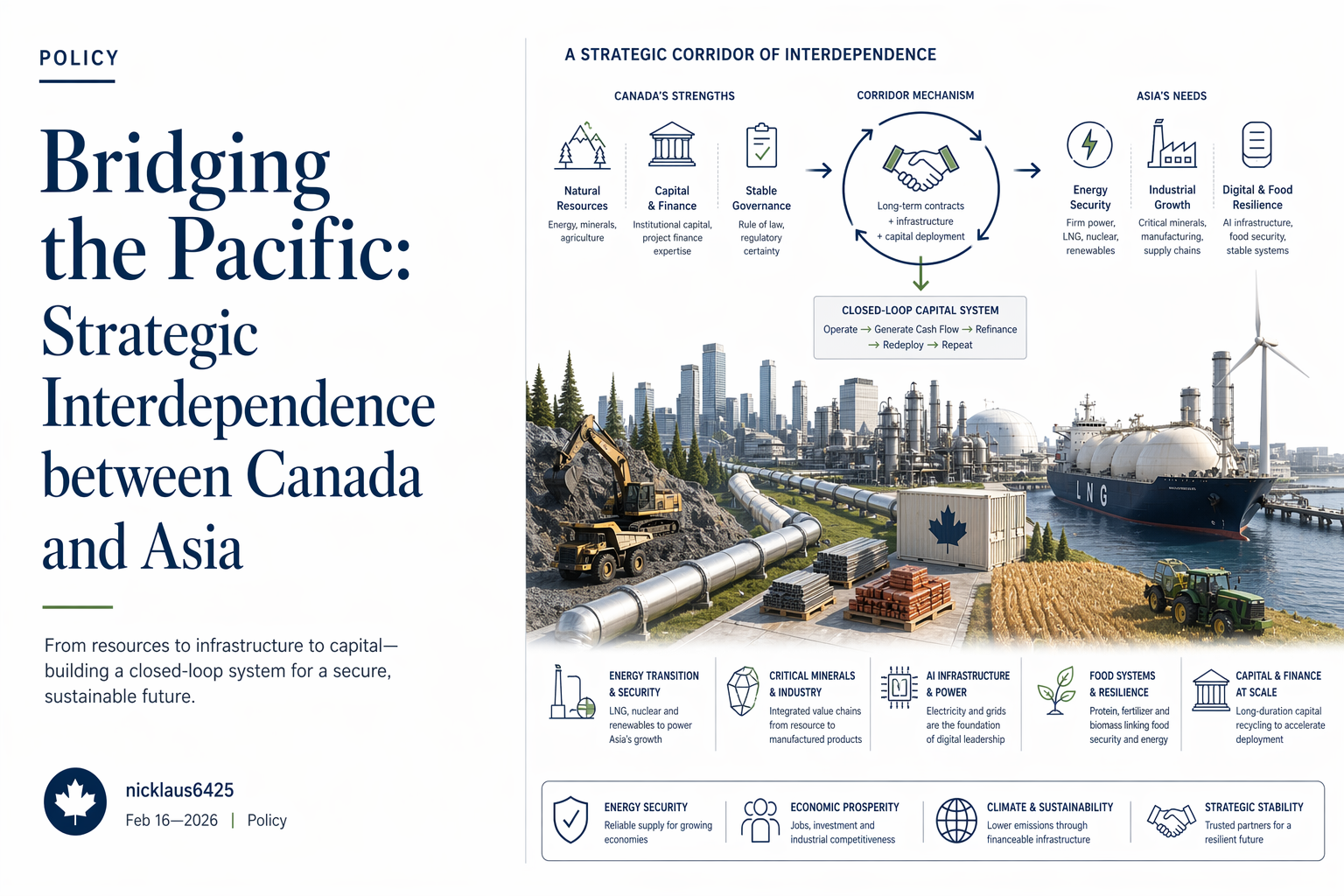
Last week in Singapore, what stood out was not a single panel or headline. It was the convergence. Energy security was no longer discussed in isolation from capital markets. Critical minerals were framed alongside industrial policy and defence supply chains. AI infrastructure quickly became a conversation about electricity, land, and long-duration financing. Food systems were positioned as structural stabilisers in a resource-constrained region. What is emerging across the Canada–Asia corridor is not simply deeper trade, but a shift toward strategic interdependence built on infrastructure, long-term contracts, and capital deployment. The transition is no longer defined by technology cost curves alone. The real differentiator is which projects can reach financial close under current market conditions and which remain in development pipelines.
The energy transition in Asia is now constrained by firm power and the cost of capital, not by technology availability.
From an energy-transition perspective, the most consistent message was that firm power has become the binding constraint across Asia’s growth model. Electricity demand is expanding simultaneously across industry, transport, cooling, and digital infrastructure, and this load is not flexible. That is why LNG remains central to coal-to-gas switching in the near term and why nuclear has re-entered national planning despite long development timelines. What matters in both cases is not only the technology, but the ability to structure long-duration, investment-grade revenue. In a higher-interest-rate environment, the cost and availability of capital determine deployment speed. Assets that can demonstrate contracted cash flow and clear risk allocation are moving ahead, while others remain policy priorities without becoming physical infrastructure.

The Canada–Asia corridor becomes strategic when it functions as a closed-loop capital system rather than a trade route.
This is where the relationship shifts from commercial to financial integration. Canada combines deep pools of institutional capital, a mature project-finance ecosystem, and resource endowments that are directly required by Asian economies. Asia combines long-term demand, industrial integration, and an urgent need for bankable infrastructure at scale. When long-term offtake agreements in Asia anchor upstream and midstream investment in Canada, the result is not a commodity trade but a repeatable financing cycle. Operational assets generate stable cash flow, are refinanced by long-duration investors, and release development capital for the next wave of projects. Over time, this recycling mechanism lowers the cost of capital and turns bilateral cooperation into a continuous infrastructure platform.
In minerals, the limiting factor in bringing new supply to market is not geology but financing. New mines and processing facilities require multibillion-dollar upfront investment, long timelines, and stable demand over decades. That is why downstream industrial players are moving upstream as equity partners and long-term offtakers. Their participation converts commodity exposure into infrastructure-like revenue visibility, which is what lenders and institutional investors require. This creates a natural complementarity between Canadian mining finance and governance frameworks and Southeast Asia’s resource base and manufacturing demand. The corridor model allows entire value chains to be financed together, reducing risk and increasing the number of projects that can reach financial close.
AI infrastructure is turning electricity and grid finance into the primary determinants of digital competitiveness.
Data centres can be deployed in two years, but power generation, transmission, and grid reinforcement require close to a decade. Electricity is therefore becoming the primary determinant of where compute is located. This shifts AI from a software narrative to an industrial one in which access to reliable, financeable power is a strategic advantage. Middle powers will not dominate entire value chains, but they can control critical layers. In this context, control over long-duration capital and the ability to originate bankable infrastructure becomes as important as control over physical resources. Interdependence emerges when these layers are integrated across trusted partners through long-term contracts and shared investment.
Food systems are part of the same capital logic. Asia holds the majority of global population but a minority of arable land and freshwater, while Canada has the inverse profile. The next phase is not bulk commodity trade but value-added protein, fertiliser integration, and biomass-to-energy systems that connect food security to power generation and rural infrastructure. These are capital-intensive, long-life assets that benefit from the same financing architecture as energy projects. When viewed through a corridor lens, agricultural trade, energy systems, and industrial decarbonisation become financially linked rather than sectorally separate.
Sovereignty in the transition will be determined by which jurisdictions can consistently move projects from concept to financial close.


Canada consistently generates world-class early-stage innovation, but the challenge is scale. Projects stall not because demand is absent or technology is unviable, but because development capital is insufficiently patient and long-term capital enters too late. Aligning innovation policy, public finance, and institutional investment is therefore a security priority as much as an economic one. Public capital plays its most effective role when it absorbs early-stage risk that private lenders cannot price, enabling commercial banks and pension funds to enter at lower required returns. This sequencing determines whether ambition translates into operational infrastructure.
What made the week particularly meaningful for me was seeing how this financial architecture is being built through people as much as through policy. Developers, utilities, institutional investors, and governments are no longer engaging on a project-by-project basis. They are assembling platforms with visible pipelines, standardised risk structures, and co-investment pathways. Convening institutions are functioning as pre-financial infrastructure, bringing together the counterparties required for bankable structures before formal transactions begin. What appears as dialogue is, in reality, market formation.
Institutional alignment is now the primary driver of corridor execution.
A recurring theme in my bilateral conversations was that the constraint is no longer strategic intent but transaction readiness. In discussions with the Philippines’ Undersecretary of Energy, the focus was not only on fuel supply but on how to structure long-term, bankable power systems that can support demand growth while maintaining affordability and reliability. That shifts the conversation from procurement to financing architecture. Similarly, exchanges with the Agent General of Ontario highlighted how subnational platforms are increasingly acting as the operational interface for corridor development, particularly in nuclear supply chains, regulatory governance, and technology commercialisation. These are not parallel tracks. They are the institutional mechanisms through which projects move from cooperation frameworks to financial close.

Engagements with the Asia Pacific Foundation of Canada and Canadian High Commissioners based across the region reinforced how corridor economics requires visible pipelines rather than one-off transactions. Institutional investors do not allocate to individual assets. They allocate to platforms with standardised risk structures and repeatable financing models. What is changing is the role of diplomatic and convening institutions. They are no longer only facilitating dialogue. They are assembling the counterparties required for capital stacking: long-term buyers, developers, public finance, and institutional investors. When these actors are aligned early, development timelines compress, perceived risk declines, and more projects reach FID. That is the point at which strategic alignment becomes an investable asset class.
Capital recycling will determine the speed and scale of the next deployment cycle.
The framework for deeper integration already exists. Long-term Asian demand can anchor Canadian supply infrastructure. Operational assets can be refinanced into global infrastructure portfolios. Released capital can be redeployed into new bilateral projects. As this cycle repeats, financing costs fall and deployment accelerates. LNG and critical-mineral processing are moving first not because they represent the end state of the transition, but because they are financeable today and create the balance-sheet capacity for lower-carbon technologies to follow.
The next phase will be defined by project-level execution, permitting speed, contract velocity, and the standardisation of financing structures. In a world of supply-chain fragmentation, energy security will be determined less by control over molecules and more by the ability to finance infrastructure at scale. Canada and Asia are not optional partners in that system. They are structurally complementary, and the willingness to move from dialogue to deal flow is clearly growing.
Full report to come before the end of February, stay tuned.
Leave a Reply