
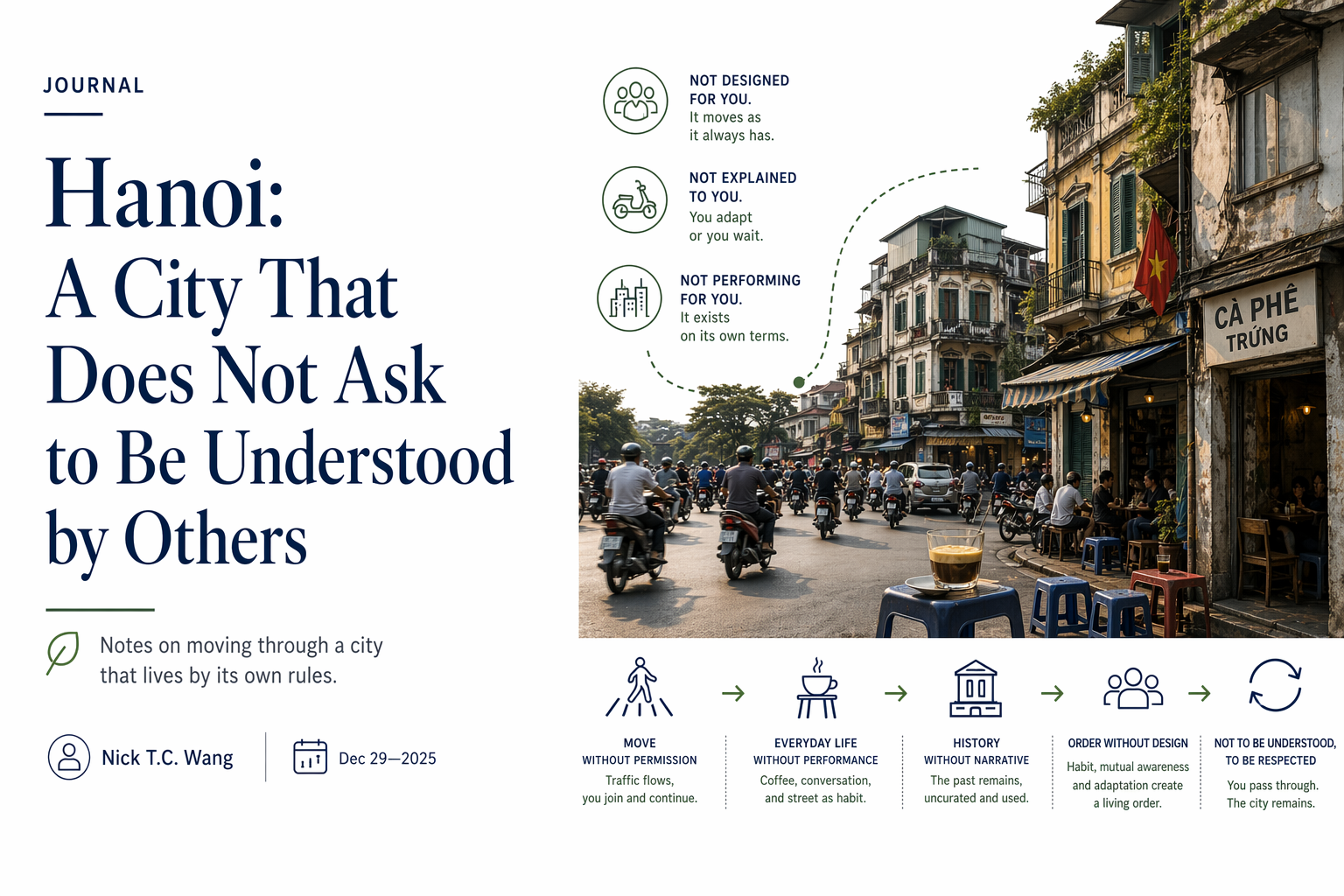
I realised it the first time I tried to cross the street, standing at the edge of the road longer than necessary, rehearsing rules that did not apply. Not at an intersection with lights and countdown timers, but on an ordinary street where motorbikes flowed endlessly, like a river that had never learned the concept of pause. I waited for a signal that never came: eye contact, a slowing engine, some acknowledgement that I was there. Instead, scooters passed inches from my knees, cars edged forward with calm indifference, horns punctuated the air not as warnings but as declarations of presence. Waiting felt increasingly theatrical, as though I were performing caution for an audience that had not agreed to watch. Eventually, I stepped forward. The traffic did not stop. It adjusted. The flow bent just enough to let me pass through, without drama, without irritation, without recognition. No one thanked me for crossing correctly. No one scolded me for crossing incorrectly. I was briefly absorbed into the system and then released on the other side. That was the moment Hanoi made itself clear, paradoxically by refusing clarity. The city does not pause for explanation. It does not reward hesitation. It does not ask whether you understand what is happening. It moves as it always has, and you either learn to move with it, imperfectly and without entitlement, or you remain standing at the curb, waiting for a permission that was never part of the design.

Learning to Move Without Permission
Most cities I know are generous to those who try to understand them. They reward observation. They invite interpretation. If you pay attention long enough, patterns reveal themselves. You learn where to stand, when to speak, how to move without drawing attention. Over time, this fluency becomes a form of comfort, even a quiet authority. You feel that you belong, or at least that you have earned the right to occupy space without friction. Hanoi offers no such reassurance. It functions independently of your comprehension, and it makes no effort to include you in its logic. Streets, sidewalks, shops, homes, and cafés bleed into one another without apology. The distinctions I am used to leaning on – public and private, formal and informal, movement and rest – are present, but fluid, negotiated moment by moment rather than enforced. The city does not explain where one ends and the other begins. For someone accustomed to places that reward understanding, this can feel destabilising. You keep looking for the underlying system that will make everything make sense, only to realise that the system is not interested in being named. Hanoi does not test you, nor does it welcome you. It simply continues. Once you accept that understanding is optional, something loosens. You stop trying to decode every interaction. You stop treating confusion as failure. You begin to move, not confidently, but attentively, which turns out to be enough.
I felt my analytical instincts surface almost immediately. Years of studying cities, systems, and sustainability have trained me to search for structure beneath apparent disorder. I wanted to know why this worked. I wanted to trace behaviour back to incentives, to identify the informal rules that held everything together. In other places, this instinct has served me well. You can usually map outcomes to decisions, patterns to planning, chaos to governance gaps. Naming the system gives you the comforting sense that, given enough time, you could intervene, optimise, improve. Hanoi resisted that impulse at every turn. The traffic did not follow a hierarchy I could articulate. The sidewalk economy did not conform to categories I recognised. Even time felt different, stretching and compressing without regard for efficiency or schedules. Each attempt to impose a framework felt increasingly intrusive, as though I were insisting the city justify itself to me. Eventually, it became clear that the problem was not a lack of structure, but my narrow definition of what structure looks like. Hanoi operates through accumulated habit, mutual awareness, and constant micro-adjustments. These are not codified. They are not scalable. They are lived. And because they are lived, they do not slow down to explain themselves. The city does not resist analysis aggressively. It simply outpaces it.
When Order Refuses to Announce Itself
Coffee was where this realisation settled most clearly. In many cities I spend time in, coffee has become an extension of identity. The space is curated, the language precise, the experience designed to signal taste, values, and belonging. Cafés are places where people are seen as much as they sit. In Hanoi, coffee is something quieter and more embedded. Egg coffee arrives thick and almost absurdly rich, without introduction or story. Plastic stools spill onto sidewalks. People sit low to the ground, facing traffic, conversations unfolding without urgency or performance. There is no pressure to linger attractively, nor to leave efficiently. The café does not present itself as a destination. It exists as part of the street, inseparable from the noise, the movement, the heat. Trying to describe this as authentic or traditional feels beside the point. These practices persist not because they are protected, but because they work. They are not asking to be admired. They are asking to be used. No one seems concerned with how this looks from the outside. There is a confidence in that indifference that I found disarming. Coffee here is not an aesthetic statement. It is an infrastructure of daily life. It holds space for rest, conversation, and routine without demanding interpretation. You drink it, you sit, you leave. Meaning is not extracted. It is optional.

History in Hanoi occupies a similarly unperformed position. Colonial buildings remain, not as carefully restored statements but as functional containers. Offices operate behind faded facades. Cafés sit beneath peeling paint and exposed wiring. The past is present, but it is not curated. There are no dramatic gestures inviting reflection, no insistence that you feel a certain way about what came before. War, politics, and generational change are folded into daily life with minimal commentary. This can feel unsettling if you are used to cities that guide your emotional response to history. Elsewhere, memory is framed for you, annotated and contextualised. In Hanoi, there is no such scaffolding. Meaning is not presented. It accumulates quietly, if you stay long enough to notice it. Walking past these buildings, it becomes clear that history here is not something to be consumed. It is something to be lived alongside. The city does not ask you to remember. It remembers on its own terms. This refusal to narrate itself can feel like neglect, but it can also feel honest. The past has not been smoothed into something legible or comforting. It remains uneven, unresolved, and integrated into the present without ceremony.
At night, particularly in the Old Quarter, the city thickens. Sound layers itself without hierarchy. Smells compete rather than blend. Light reflects unevenly off metal, water, and stone. It is overwhelming at first, especially if you are accustomed to cities that carefully manage sensory input. Here, nothing is filtered. The city does not soften itself for comfort. And yet, there is a rhythm to it that does not require your participation. People move with purpose, but not urgency. Social life unfolds in public without self-consciousness. The city does not feel as though it is performing for an audience. It exists whether or not you are paying attention. There is relief in that. When a place does not ask to be understood or documented, you are freed from the obligation to translate it into something shareable. You stop narrating your experience in real time. You stop comparing it to other cities you know. Instead, you notice smaller things: how space is occupied without apology, how conversations stretch without needing justification, how public life does not require validation. The noise remains. The chaos persists. But beneath it is a sense of continuity that does not need your approval to hold.
None of this is to suggest that Hanoi is gentle. It is not. The noise rarely recedes. Infrastructure frays visibly at the edges. Inequality is present and unhidden. There is nothing idealised about the city’s challenges. What Hanoi offers instead is a kind of honesty. It does not pretend to be efficient. It does not market itself as resilient or sustainable, even when resilience and adaptation are clearly visible in practice. There are no slogans here, no carefully constructed urban identities, no insistence on being seen a certain way. The city does not care whether you find it charming or exhausting. That indifference can feel uncomfortable, especially for those of us used to environments that constantly explain themselves. But it can also feel like respect. By not adjusting its pace or logic for the visitor, Hanoi preserves its internal coherence. It does not dilute itself into a version that is easier to consume. It allows you to be present without promising belonging. You are not invited to master the city. You are allowed to pass through it, to adapt, and then to leave without resolution.
An Order Without Design

It was only after leaving Hanoi that I found myself thinking about Order without Design, and realising how closely the city aligned with its central argument. Bertaud writes that cities are not objects to be shaped, but labour markets to be enabled and systems that function precisely because they are allowed to adapt faster than planners can prescribe. Hanoi feels like a lived expression of that idea. Nothing here looks optimised in a conventional sense. Streets are not visually ordered, land uses are not neatly separated, and movement is not choreographed through explicit rules. And yet, people get to work. Goods move. Daily life continues with remarkable continuity. What appears chaotic is, in practice, highly responsive. Space is negotiated moment by moment. Behaviour adjusts in real time. The city does not wait for design to authorise function. It allows function to generate its own order. In that sense, Hanoi is not under-designed. It is simply uninterested in announcing its logic.
This reframing helped me understand why the city had felt so resistant to interpretation. What I had mistaken for disorder was not a lack of structure, but a lack of narrative. Hanoi does not present itself as a case study. It does not package its efficiencies or justify its compromises. Bertaud warns against mistaking visual order for economic or social effectiveness, and Hanoi makes that warning tangible. The traffic that looks ungovernable moves people efficiently. The sidewalks that appear informal sustain livelihoods. The mixed-use buildings that defy zoning logic reduce distance between work, home, and daily necessity. None of this is elegant. None of it is easily exportable. But it works because it responds directly to constraint rather than ideology. Seen this way, the city stopped feeling illegible and started feeling precise in its own way — an order without design, lived rather than explained.
There were moments when this unsettled me more than I expected. In professional spaces, understanding is currency. Insight signals competence. The ability to articulate a system implies authority over it. In Hanoi, that reflex was useless. There was nothing to optimise, nothing to summarise cleanly, nothing to turn into a conclusion. The city slipped out of my usual mental maps. And in that slipping, something softened. I realised how often I move through places with an unspoken agenda: to learn them, to place them, to make them legible within what I already know. Hanoi refused placement. It remained stubbornly itself. This refusal was not confrontational. It was passive, almost indifferent. The city simply continued doing what it had always done, unconcerned with my attempts to make sense of it. Accepting that required humility. It meant letting go of the need to arrive at clarity. It meant recognising that not every place exists to be understood on my terms, and that insisting otherwise is a form of control masquerading as curiosity.
When I left Hanoi, I did not feel fluent. I could not articulate a clean thesis about its urban logic or cultural rhythm. What I carried instead was a series of impressions that refused to align neatly. And that felt right. Some cities leave you with insights. Others leave you with nostalgia. Hanoi leaves you with a reminder. Understanding is not a prerequisite for engagement. Legibility is not a measure of value. In a world increasingly obsessed with explanation, metrics, and narrative control, there is something quietly instructive about a city that does not ask to be understood. It exists, adapts, and persists without waiting for recognition. Perhaps that is what stayed with me most. Not a lesson to replicate, not a model to export, but a recalibration. A reminder that some systems work not because they are transparent, but because they are lived. And sometimes, the most respectful response is not to understand, but to accept that you do not need to.
Leave a Reply