
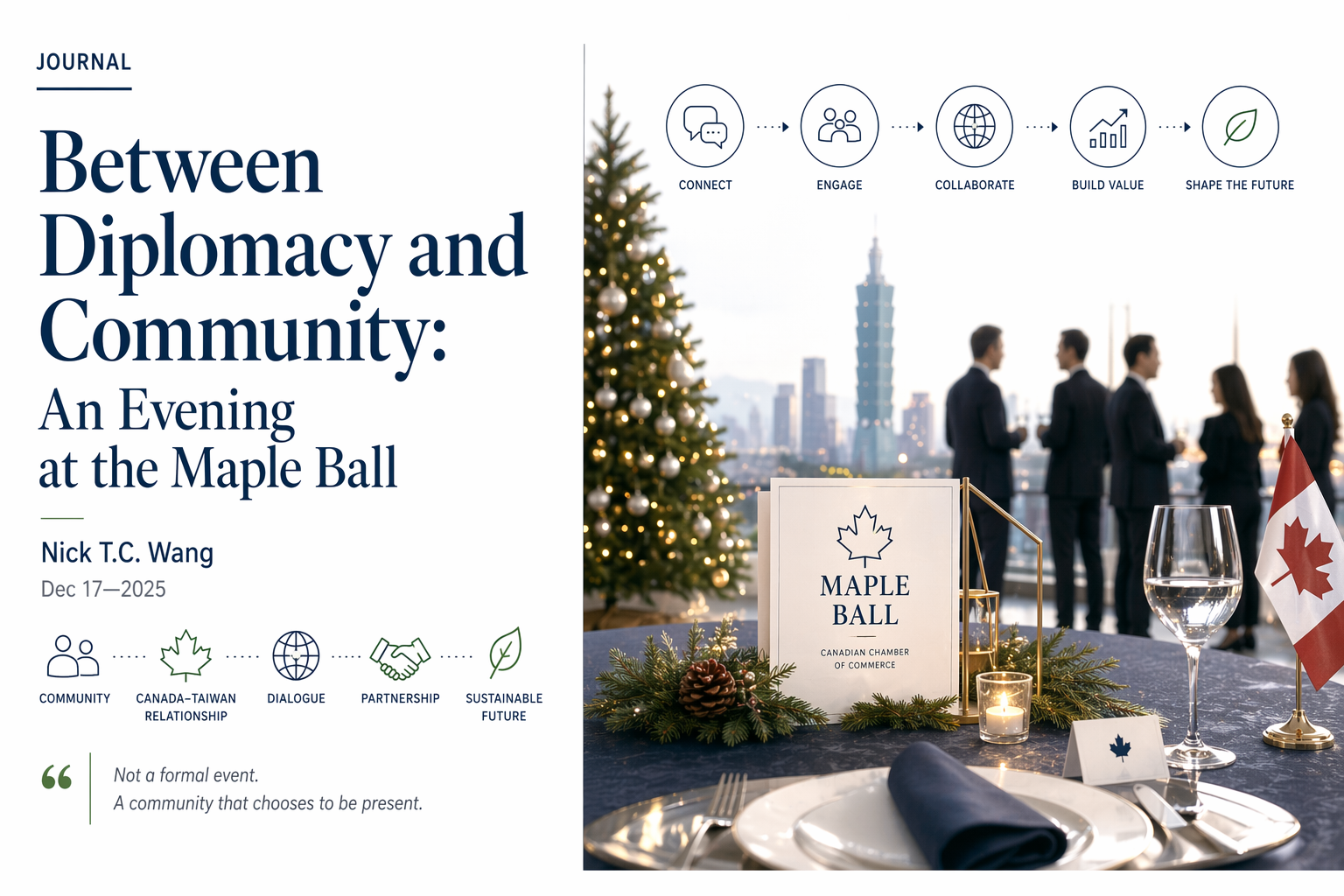
The Maple Ball has always been easier to understand once you are inside the room. On paper, it is the Canadian Chamber of Commerce’s annual flagship event. In reality, it feels far less formal than that description suggests. It is an evening where people happen to be dressed well, but where conversations are unforced, laughter travels easily, and professional titles gradually loosen their grip as the night goes on. What makes the Maple Ball special is not structure, but timing. It arrives once a year as a pause. A moment when a community that usually moves quickly, across meetings, flights, and overlapping responsibilities, slows down enough to simply be present together.


No one is rushing to the next agenda item. No one is trying too hard to impress. People talk, drift, reconnect, and sometimes just sit with a drink and observe. That compression of time creates its own kind of clarity. Conversations that normally happen in fragments suddenly sit side by side. When that happens, patterns emerge naturally. Not just who shows up, but how people speak when they are no longer performing a role. What they care about. What they are quietly thinking about, but do not always say out loud. This year, the room felt especially relaxed. Not celebratory in a loud way, but comfortable. Familiar. There was a sense that people knew why they were there, and did not need the evening to prove anything. The Maple Ball felt less like an event and more like a gathering that had grown into itself.


From within the Chamber, that ease does not happen by accident. It is the result of many small choices made over time. The goal has never been to create something overly polished or rigid. It has been to create a space where people feel welcome to stay, to talk, and to move between conversations without pressure. When it works, the structure fades into the background. What I appreciated most was how wide the conversations had become. Business was there, of course. Trade, investment, partnerships. But they were not the only things people wanted to talk about. Energy transition came up naturally. So did sustainability, supply chains, talent, and the way global uncertainty is quietly shaping everyday decisions. These conversations did not feel heavy. They felt honest.
That shift felt earned. As Canada and Taiwan’s relationship deepens, the questions people bring into the room are changing. They are no longer just transactional. They are about direction, resilience, and what kind of future people are actually working toward.


The people I met that evening reflected that range. A conversation with the chairman of First Commercial Bank felt grounded and practical, rooted in the realities of Taiwan’s financial system and the long view required to navigate transition. Speaking with a board member of J.P. Morgan widened the lens, touching on how global capital sees Taiwan within a much bigger picture.


Seeing Ambassador-at-Large 簡又新 felt quietly reassuring. For many in Taiwan’s sustainability space, he represents a kind of moral continuity. Long before sustainability became a corporate trend, he spoke about it as responsibility. His presence was not loud, but it carried weight.
Running into former Minister of Health and Welfare 陳時中 brought back a collective memory many of us still carry. The pandemic years shaped how people think about leadership, trust, and calm under pressure. Seeing him in such a relaxed setting was a reminder that those experiences are still close, even if life has moved on.


What tied these encounters together was how unforced they were. No one was trying to dominate the room. Conversations flowed in and out, sometimes deep, sometimes light. That is what made the evening feel human rather than institutional. For me, the Maple Ball also quietly bridged different parts of my own life. My work in energy transition and my role within the Chamber often feel like separate lanes. That night, they blended naturally. The same themes I spend my days analysing showed up casually in conversation, grounded in lived experience rather than theory.


There is also something to be said about who you bring with you. Large gatherings tend to magnify small moments, the pauses between conversations, the walk from one group to another, the quiet spaces in between. Experiencing the evening with Alex as my plus one subtly changed my pace. We did not rush. Sometimes we joined conversations, sometimes we stepped back. There was no need to define the evening or explain it. Just moving through the space together felt enough. Comfortable. Uncomplicated. What stayed with me was the balance. The Maple Ball allowed both engagement and distance. Being with someone who was equally at ease with conversation and silence made that balance feel natural. It reminded me that connection does not always need to be articulated. Sometimes it simply exists.
As the night wound down, what lingered was not a highlight or a formal moment, but a feeling. A sense of continuity. Events like the Maple Ball matter not because they are grand, but because they create space. Space to reconnect, to reflect, and to remember that communities are built slowly, through repeated moments like this. Leaving that evening, I was reminded that community building is not about scale or spectacle. It is about presence. About showing up, year after year, and allowing relationships to deepen at their own pace.
The Maple Ball, at its best, is not formal.
It is familiar.
And in a time of constant movement, that familiarity is what gives it meaning.
Leave a Reply