
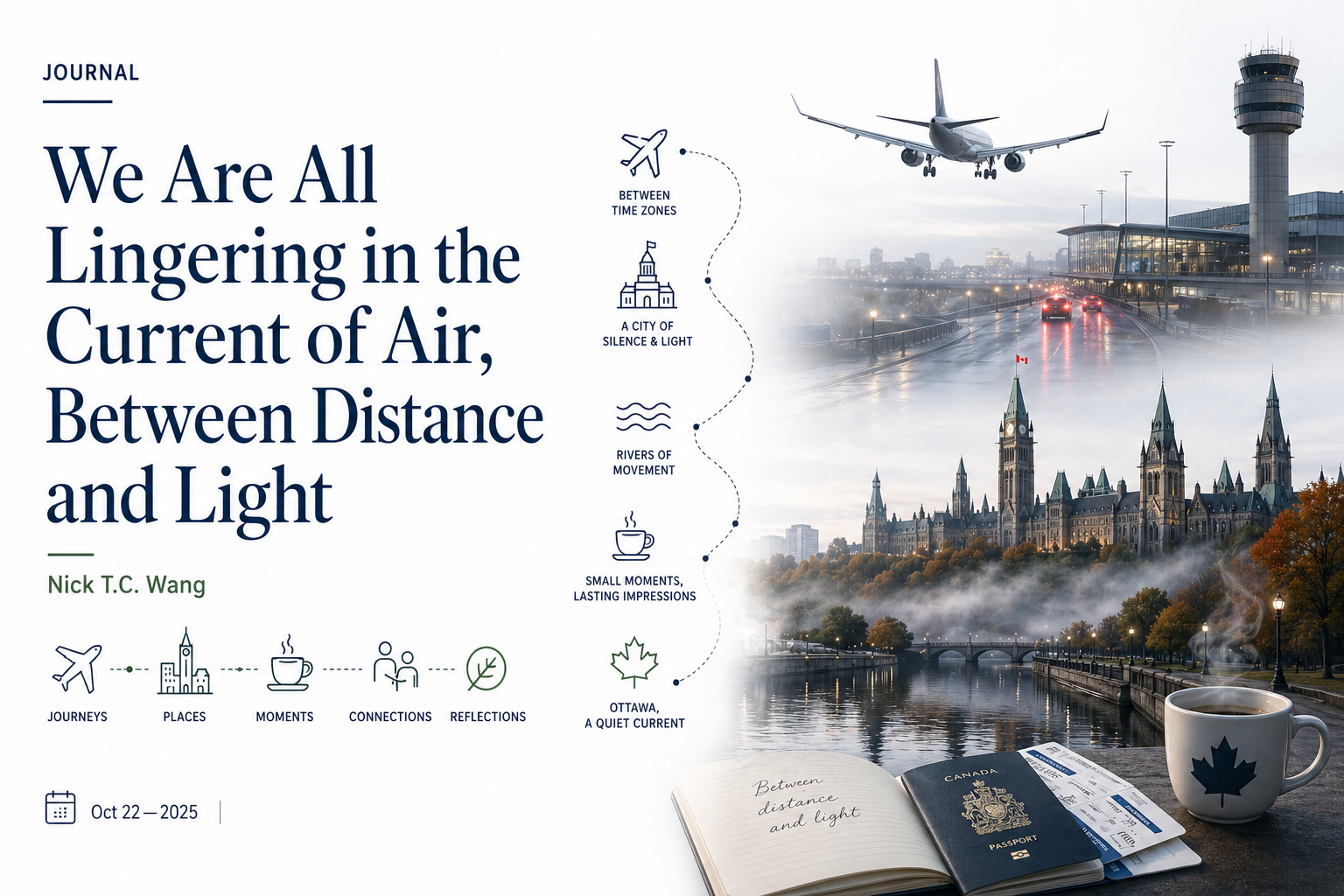
The plane moved through the night, and Ottawa appeared below like a lake that had forgotten how to move. The lights shimmered faintly through the mist – cold, deliberate, yet carrying an almost human warmth. When the wheels touched the ground, a small tremor passed through the cabin, quiet as a heartbeat. I had arrived, though part of me was still somewhere between time zones. The airport doors opened and the wind rushed in. It was thin, sharp, and strangely clean. It brushed past my skin and left behind the faint scent of distance. The air here felt lighter than memory; I drew a long breath and felt time stretch through my chest.
The car left the airport and slipped into the empty road. Streetlights grew farther apart, and red reflections stretched across the wet pavement before breaking into pieces. The city felt fragile in its silence. When we entered downtown, fog rose from the river, softening every line into shadow. Then, from the side of the road, a man stepped out and stood before the car. He lifted his hands, then lowered them again, saying nothing. The driver did not slow. For a second the headlights caught his face, and then he vanished back into the dark. In that moment, I saw a different Ottawa – the one that stayed awake beneath the quiet.
The hotel room was still and bright, almost sterile. The air-conditioner hummed gently, blending with the sound of tyres cutting through the wet street outside. Half-drawn curtains shifted with the air, scattering the light into fragments on the wall. A passport lay open beside a notebook and a few loose tickets – small pieces of movement waiting for meaning. I lay on the bed and watched the ceiling. Sleep refused to come. Outside, King Edward Avenue breathed in red and white, car lights flowing like slow rivers beneath the fog.
Morning arrived without notice. The sky was pale and undecided, hovering between blue and grey. The hum of the air-conditioner faded into the rhythm of footsteps and distant engines. I put on my coatand stepped outside. The air had that early-hour clarity that made every sound distinct – the click of a closing door, the low rumble of a bus, the scrape of shoes against stone.
The walk to the office took half an hour. ByWard Market was still asleep, its stalls closed, the ground damp with rain. A few early risers passed by, their footsteps echoing across the cobblestones. When I reached the cathedral, I looked up. The bells were silent, but I could almost hear them – the sound they might make if time itself decided to breathe again. As I walked on, the fog began to lift. The outline of Parliament Hill emerged through the haze, familiar yet distant, as if drawn from an old photograph. The air smelled faintly of frost and coffee. Ottawa was waking slowly, without hurry or noise.
At the café below the office, I ordered a cortado and took the seat by the window. Outside, people moved at an even pace – neither fast nor slow, each step measured. The steam rising from the cup blurred the view on the glass. I thought of the three years I had spent in Taiwan, living in heat that clung to the air, a kind of warmth that refused to leave. Here, the cold felt clean. Every breath felt deliberate, and for a while, my thoughts found the same still rhythm as the city.
The Bloomberg office occupied an old building near the river. Inside, the light was flat and steady. There were ten desks, two occupied, and a quietness that seemed almost studied. The blinds split the sunlight into thin bands that moved slowly across the wall. I spoke briefly with the bureau chief and a data editor – small talk about policy, energy, and the city’s pace. The conversation felt natural, balanced, unhurried, like the air outside.
Later that morning I finally caught up with a colleague in New York. We had been trying for months to find a time when our schedules aligned, and now, sitting in the same daylight, we did. After that came another call with an analyst who had just moved from Hong Kong to Amsterdam. Between the time zones we talked about hydrogen and future fuels, tracing numbers that crossed oceans. Then a message arrived from a researcher at Johns Hopkins – a brief note about our latest report. In that moment I realised how the world breathes through invisible lines, each breath translated somewhere into words, charts, and thought. Ottawa was one of those small points on the map where everything passed through quietly.
By noon the sky had not changed. The light remained pale and even; making it easy to lose track of time. When I noticed it was already past the lunch appointment time. I closed my laptop and left the office for lunch appointment with a friend. The restaurant on Sussex Drive was modern and spare, all wood and white walls. A few NATO officers sat nearby, their conversation low and careful. The world, I thought, always finds its way into the smallest spaces. After lunch we walked toward Rideau Centre. The air inside was warm, carrying the mixed scent of coffee and perfume. We didn’t buy anything. We simply walked. There was a strange kind of comfort in not having anywhere to be.
At sunset, I met my brother and his girlfriend at their apartment on a small island between Ottawa and Gatineau. The room was modest, the kind that still felt temporary. A few plants lined the window; the air smelled faintly of coffee and wood. “The sunsets here are different,” he said, pointing outside. I nodded. His expression carried a quiet steadiness that felt new to me. That evening we had wanted Persian food, but the restaurant was full. We ended up in a Turkish one instead. The walls were covered with woven rugs and brass lamps; the air was heavy with cumin and charcoal. We shared hummus, kebabs, and laughter that drifted softly into the night. It wasn’t the meal that stayed with me, but the warmth that came from being still, together, inside a moment that asked for nothing.
The next morning he drove me to the National Research Council. The building was pale yellow, framed by cypress trees. Inside, the corridors were long and quiet. He walked ahead of me, showing the rooms where he worked, his voice calm and certain. I watched him move through the space and realised that time had already settled on him. He was no longer the boy who needed direction; he had found his own. We went next to Rideau Hall. The garden was covered in red leaves, their movement slow and light, like the last breath of autumn. We walked through patches of sun and shade, speaking of family, of change, of how easily years could fold into one another. Down by the river, the city’s reflection trembled against the water. For a while, time felt still enough to touch. When he left to meet a guest, I visited the Royal Canadian Mint. It had become a ritual of mine – to buy a silver and a gold coin, not as an investment but as a way to mark the passing of a visit. Then I went to the National Gallery. The light through the glass roof was clear, almost weightless. Time seemed to slow between the walls of metal and canvas.
Later that afternoon, I met a friend at an Irish pub. The air smelled of malt and wood, the floor carried the soft echo of years. I ordered a Guinness, then a Mill Street – a glass that symbolises Canada in a glass. We talked about afternoons like this, the kind that I missed in Taiwan, where distance existed without coldness, and strangers still left room for warmth. Perhaps what I missed was not a country but a rhythm – a way of being quietly alive. When we stepped back into the street, the city sky was covered in gold. Streetlights stretched along the wet road, and the buildings softened against the night. Everything seemed to exhale. Later, I joined my brother and his girlfriend at a small bar. At first the place was crowded and loud, but when the voices faded, the silence returned easily. I sat there with the last of my drink, feeling the night settle. Time was passing, but gently, like light moving across glass.
The next day was my last in Ottawa. The clouds hung low, the air still sharp with cold. I walked a little longer, trying to remember the way the city breathed in my head – the footsteps of morning, the quiet of afternoon, the slow flicker of lights appearing one by one at dusk. By evening we had burgers and ice cream at his favourite place. The light outside turned gold, and people walked past the window unhurried. For a while, I forgot to think about leaving. Back at the hotel, I packed my suitcase. Outside, King Edward Avenue glowed again – red, white, orange – light crossing light like rivers that never met. It was the shape of time, moving forward without sound.
At dawn, the city was wrapped in mist. The car moved toward the airport. Ottawa looked almost motionless, yet alive beneath the fog. It was a city that never rushed, never insisted – one that let you listen. The plane rose above the clouds. New light entered through the window. The next stop was Prince Edward Island, where the wind would teach me another shape of calm.
When the plane lifted, rivers and streets folded into a single line. The air still held the warmth of the night before, and slowly, Ottawa began to fade. Perhaps we all linger in time, learning, in silence, how to move with its current.
Leave a Reply