
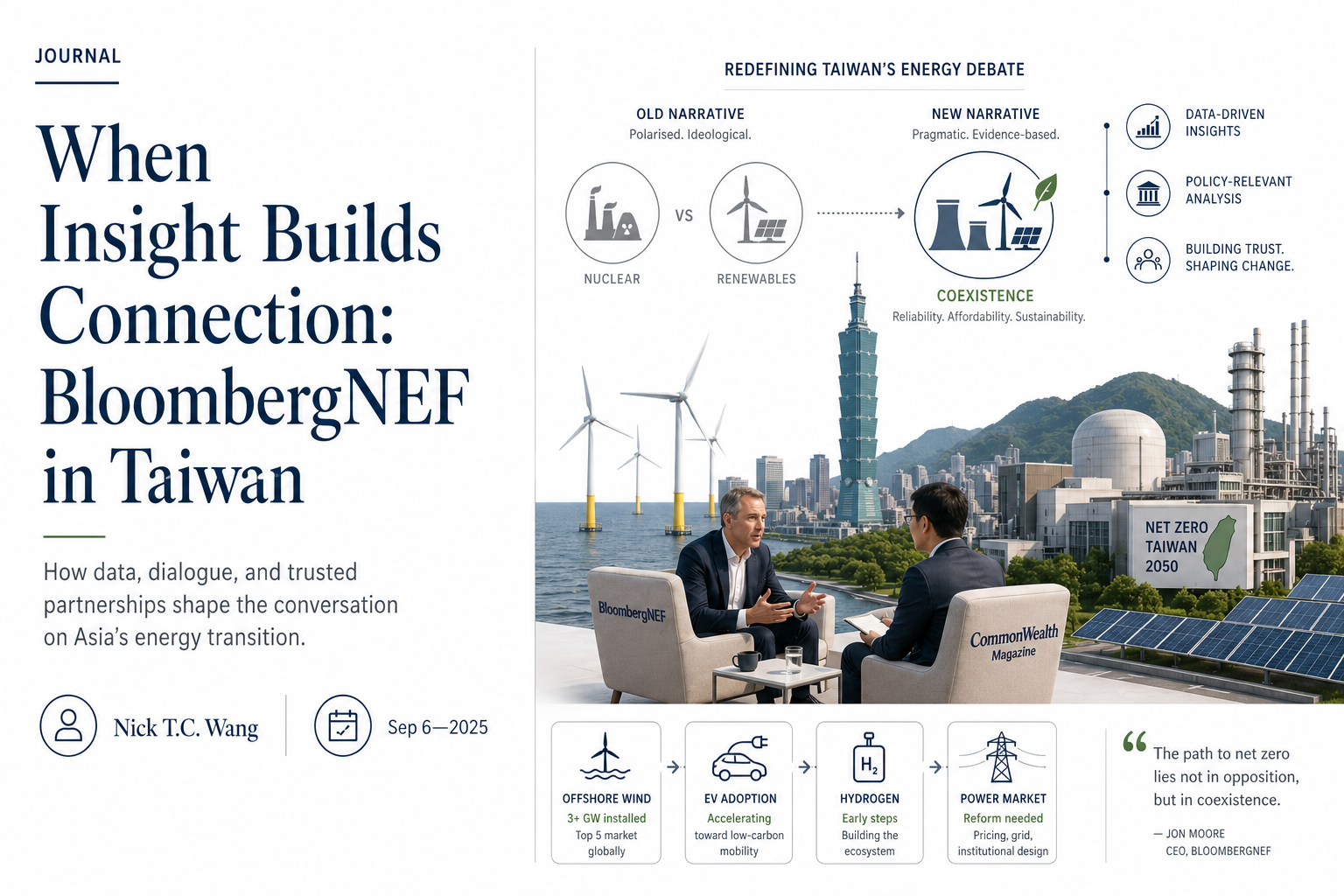
When BloombergNEF’s global CEO Jon Moore visited Taipei, the moment carried significance far beyond corporate formality. It marked the first time since he took leadership in 2014 that he had set foot in Taiwan—a symbolic and strategic acknowledgment of the island’s growing role in Asia’s energy transition. For our team in the Japan, Korea, and Taiwan research cluster, it was an opportunity to demonstrate that analysis, when connected to context, can shape policy and market understanding in equal measure.
For months, we had been mapping Taiwan’s evolving energy landscape: the acceleration of offshore wind, the momentum in electric-vehicle adoption, the early steps toward hydrogen development, and the structural pressures within the power market. But the narrative surrounding Taiwan’s transition had grown increasingly polarised. Public debate was trapped in a binary framing—nuclear or renewables, safety or ambition, ideology or pragmatism. It was clear that the conversation needed to shift from rhetoric to reason. That was when I decided to use the network I had built—across sustainability, policy, and media circles — to make something meaningful happen.
Choosing the Right Voice
Taiwan’s traditional media environment is often shaped by political alignment and reactive commentary. Among the noise, only a few outlets consistently uphold analytical independence and editorial integrity. CommonWealth Magazine is one of them. For four decades, it has been a trusted bridge between government, business, and academia, known for in-depth reporting and data-driven analysis. In Taiwan, being featured by CommonWealth means more than exposure; it means credibility. I had long maintained a professional rapport with several of their editors through sustainability dialogues and cross-sector events. When I learned of the CEO’s confirmed itinerary, I reached out to propose an exclusive interview.
The pitch was straightforward yet strategic: to elevate BloombergNEF’s insights on Taiwan’s energy transition through a platform capable of translating technical complexity into public understanding. Within days, the proposal gained traction. Both sides recognised the alignment — CommonWealth sought rigorous, globally grounded perspectives; BloombergNEF sought to communicate analytical neutrality in a landscape often dominated by ideology. Coordinating across London, Singapore, and Taipei, I worked with both our global communications team and the editorial board to align purpose, tone, and timing. Every detail mattered—from framing the questions to ensuring the nuance of BNEF’s data was preserved in translation.
The Interview that Redefined the Debate
The interview took place in early September under tight scheduling and considerable attention. What unfolded was not just a media appearance but a reframing of Taiwan’s national dialogue on energy transition. Moore brought to the table the objectivity that defines BNEF’s work — evidence before opinion, systems thinking before slogans. He reminded readers that energy transition is not a competition between nuclear and renewables but a coexistence of both. “Renewables will remain the cornerstone,” he said, “but low-carbon baseload sources such as nuclear can provide reliability and cost stability.”
He also identified the heart of Taiwan’s challenge: not technology but structure. Electricity pricing that fails to reflect real costs, a state utility burdened by both grid expansion and financial constraint, and complex permitting frameworks that delay renewable rollout. These are not failures of ambition, he noted, but symptoms of institutional inertia. In BNEF’s view, Taiwan’s problem lies in market design, not in motivation. CommonWealth’s coverage mirrored that clarity. The resulting feature, “Taiwan’s Path to Net Zero Lies Not in Opposition, but Coexistence,” presented the essence of BNEF’s global thinking in a distinctly local language: pragmatic, nuanced, and balanced. It became one of the few major media pieces in Taiwan to discuss the nuclear question without political bias.
From Analysis to Engagement
For BloombergNEF, this collaboration was a demonstration of how data and diplomacy can converge to shape understanding. In a world saturated with forecasts, credibility is what differentiates information from influence. Through CommonWealth, BNEF’s analytical voice reached a broader ecosystem — not just policymakers and investors, but the industries that will actually implement the transition. In the weeks following publication, the feature circulated widely among Taiwan’s energy and financial sectors. It was cited and discussed in industry panels, and referenced in think-tank newsletters.
For our Taiwan research team, it underscored a vital truth: rigorous analysis gains traction only when it is embedded in trusted local narratives. At the organisational level, the success of this engagement validated a broader principle of BloombergNEF’s strategy in Asia: localisation with integrity. As the region’s energy transition accelerates, our role is not to dictate direction but to illuminate possibilities. In that sense, the CommonWealth feature was both a milestone and a model—it showed how analytical neutrality, communicated through credible partners, can elevate the quality of national discourse.
Why Connections Matter
Behind the scenes, this achievement was built on years of relationship-building. My involvement with the Canadian Chamber of Commerce in Taiwan, industry forums, and cross-sector ESG collaborations had cultivated trust with senior editors, business leaders, and policymakers. When the opportunity arose, those relationships enabled swift coordination and mutual confidence. Arranging an exclusive interview between a global CEO and Taiwan’s most reputable business magazine required more than logistical efficiency — it required credibility. The editors needed assurance that this was not another corporate promotion but an exchange of ideas worth amplifying. Our communications team needed confidence that the outlet would respect BNEF’s independence and avoid political spin. My role was to bridge both sides — to translate intent, align tone, and ensure that the dialogue would preserve the analytical rigour that defines our brand. That bridge became the foundation of success. It demonstrated how personal networks, when guided by purpose and professionalism, can multiply institutional impact.
Insights That Resonate
Beyond the headlines, what stood out from Moore’s conversation was how he reframed Taiwan’s energy dilemma within a global perspective. He acknowledged that renewable energy development faces universal headwinds: limited land, community resistance, and escalating costs are not unique to Taiwan. Yet he praised Taiwan’s offshore wind achievements — over three gigawatts of capacity already installed, placing the island among the world’s top five markets. “From zero to full-scale commercialisation within a decade — that’s an accomplishment few others in Asia have matched,” he observed.
At the same time, he highlighted that structural reform must accompany technical progress. The design of electricity tariffs, the dual mandate of Taipower to both operate and finance grid expansion, and the absence of cost-reflective pricing are not peripheral issues; they are the core determinants of transition speed. Moore’s remarks on nuclear energy drew particular attention. He did not advocate ideology but analysis. “Countries that shut down nuclear plants without securing new low-carbon capacity often face reliability risks,” he noted. The message was pragmatic: if Taiwan wants to accelerate decarbonisation without compromising stability, it should consider nuclear as part of a balanced portfolio. In an era when public opinion is often divided by emotion rather than evidence, such measured reasoning felt refreshing—and CommonWealth amplified that tone faithfully.
Shifting the Narrative
The significance of this collaboration goes beyond the article itself. It showcased how global insight, when translated through local trust, can influence how societies think about complex transitions. For Taiwan, where the energy debate has long been overshadowed by ideology, the CommonWealth interview represented a step toward intellectual maturity—from confrontation to coexistence. For BloombergNEF, it reaffirmed our role not only as data providers but as interpreters of change. The energy transition is, by definition, interdisciplinary, spanning economics, technology, and policy. Communicating it requires a similar intersection of expertise and empathy. And for me personally, it was a lesson in the power of connection. Influence in sustainability is rarely about visibility; it is about resonance—ensuring that insights reach the right audiences through the right channels. The ability to navigate networks, bridge institutions, and align intentions is what turns research into relevance.
Lessons for Future Engagement
This experience distilled several enduring lessons for our work in emerging markets.
- Localisation amplifies impact. Global frameworks such as BNEF’s Economic Transition Scenario and Net-Zero Scenario gain real influence only when contextualised within local realities. Translating our global energy models into the language of Taiwan’s policy debates made them tangible.
- Credibility requires proximity. Trust is built not through sporadic interactions but through consistent engagement – participating in local dialogues, supporting community initiatives, and listening to the nuances that numbers alone can’t capture.
- Storytelling is strategy. Data persuades, but stories endure. The CommonWealth feature turned complex models into a narrative of pragmatic optimism – one that policymakers, business leaders, and investors could all relate to.
These principles will continue to guide how we operate in Taiwan and across the region. Whether it’s electric-vehicle adoption, hydrogen development, or power-market reform, our mission remains constant: to bring clarity where complexity prevails.
From Analysis to Meaning
In retrospect, the CEO’s visit to Taiwan was both a professional milestone and a personal reminder. It reaffirmed that insight travels through people before it travels through platforms. Institutions like BloombergNEF thrive when analysis connects with empathy—when data informs not only strategy but also understanding. The collaboration with CommonWealth Magazine proved that neutrality can itself be transformative. Amid a polarised media landscape, two organisations from different worlds — one global and data-driven, one local and narrative-oriented—found common ground in evidence, balance, and respect.
As Taiwan advances toward its net-zero future, this dialogue will remain a reference point. It demonstrated that energy transition is not about choosing sides but about finding synergies between nuclear and renewables, between markets and policy, between global vision and local connection. For me, it was also a quiet affirmation of something I have long believed: in sustainability, the most meaningful influence often begins not with grand gestures but with a well-placed conversation.
Leave a Reply