
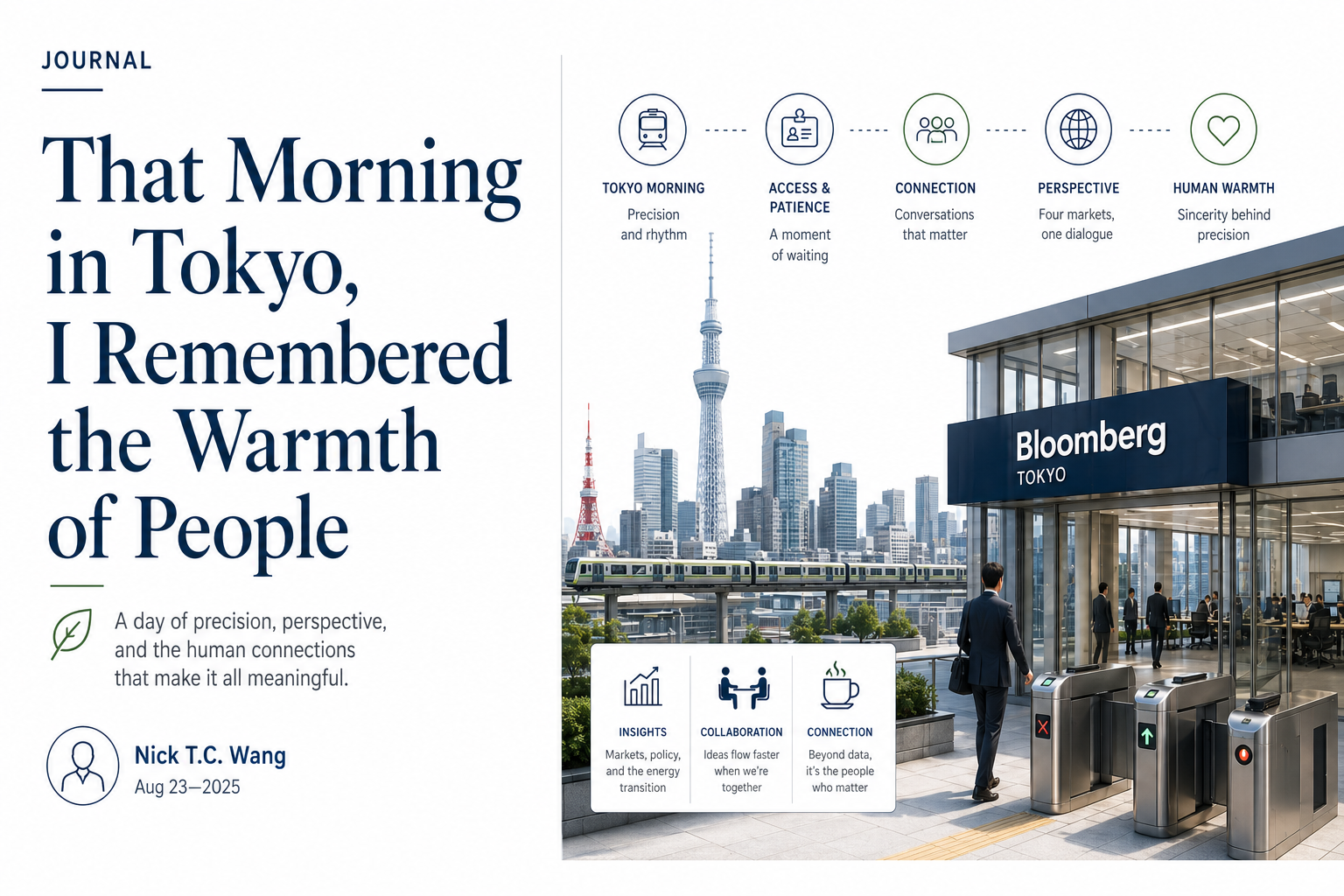
Tokyo moved like a clock. Trains arrived to the second, commuters flowed in silence, and the city breathed through glass and steel. I left my hotel in Ueno with coffee in one hand and my laptop bag on my shoulder, carried along by the morning current of heels, engines, and screens. It felt familiar, almost like midtown Manhattan at dawn: precise, restrained, perfectly timed.
The entry to the building was smooth. Security nodded, the gates opened, and I stepped inside. The air was cool, the lighting calm. After checking in at reception, I walked toward the tunnel that led to Bloomberg’s Tokyo office. When I tapped my badge, the light stayed red. I tried again. Still nothing. The staff smiled politely and asked me to wait. For the next half hour, I stood just outside the tunnel, watching people flow past. I couldn’t see the office, but I could feel its rhythm through their footsteps – the quiet urgency of a space already alive.
When clearance finally came through and the gate unlocked, the long tunnel stretched before me, glowing faintly under soft white light. I walked through and entered the pulse of the day. Inside, colleagues from the research and commercial teams welcomed me with warmth and ease. Some showed me around the workspace, others spoke about markets, policy, and the energy transition. Even though we came from different cities, our rhythm felt the same: focused, curious, and calm within motion.
Later that morning came the Northeast Asia weekly catch-up, my first time joining from Tokyo instead of Taipei. Faces from Japan, Korea, Taiwan, and Hong Kong filled the screen, each framed by a different morning light. Four markets, one conversation. Seeing the call from Tokyo changed my perspective. The dialogue felt wider, the tone sharper. I realised that distance can deepen understanding – that viewing the same discussion from another city reveals how connected we truly are. After the meeting, a manager mentioned that a teammate had recently left. Her tone was even, almost procedural, but when the call ended she paused. Her voice softened as she admitted she hadn’t meant to sound detached. She was simply trying to stay composed. That quiet moment stayed with me. Even in a world defined by precision, there is room for sincerity.
Not long after, I saw two colleagues – one from Korea, another from Pakistan – gathered around a research draft. I joined them. The conversation flowed easily between numbers, insights, and laughter. It was spontaneous and fast, an exchange of ideas that built momentum on its own. Back in Taipei, our smaller setup rarely allows such face-to-face collaboration. That discussion reminded me that speed is not only about efficiency. It is also about how quickly thoughts can meet and grow.
We worked for a while longer before heading out for lunch together. The pace softened. The conversation drifted between markets, food, and travel. Laughter replaced the sound of keyboards. The transition from data to dialogue felt effortless, the kind of connection that reminds you why people matter most. By the time we returned, the afternoon light stretched across the desks. The office hummed at its steady rhythm again. I looked around and thought about how we move so quickly across screens, cities, and time zones, yet what gives motion its meaning is not the data itself. It is the people who turn speed into purpose and direction into connection.
When I stepped back outside, Tokyo’s light had shifted. The crowd flowed with intent, trains roared beneath the streets, and I walked with them, carried by the same pulse that keeps the world turning.
Leave a Reply