
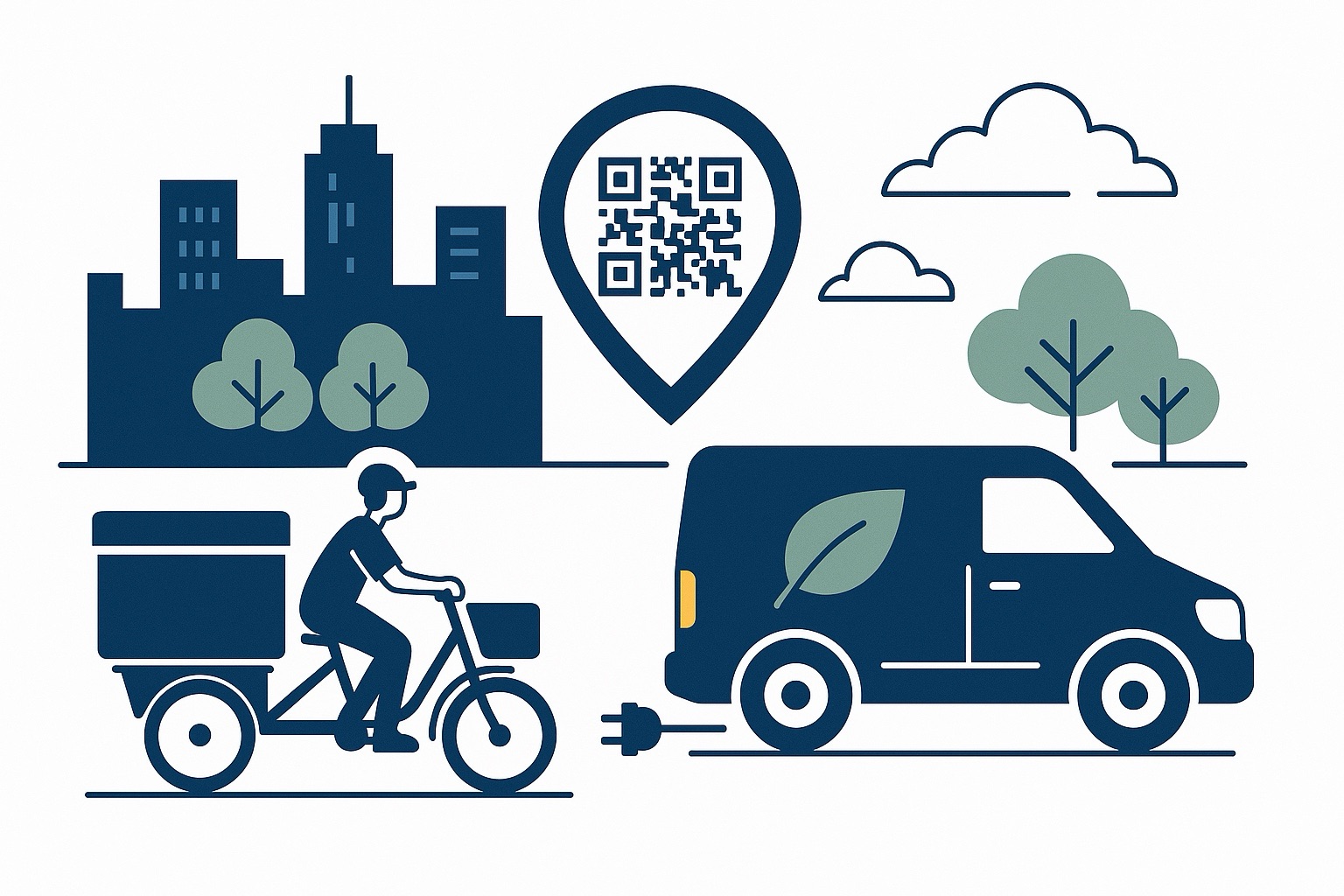
When a delivery van idles outside a downtown flat, the pollution released feels negligible. Multiply that scene across millions of doorsteps and the last mile becomes one of urban logistics’ dirtiest secrets. According to the City of Toronto, commercial vehicles already account for more than a quarter of metropolitan road emissions, a share that rises every time a “buy now” button is pressed. In Tokyo’s dense wards, parcel volumes have surged so steeply that kerb-side congestion is threatening the city’s prized punctuality. Faced with similar challenges but divergent urban fabrics, both cities have embarked on a quiet revolution to green the last mile—and their experiments hold lessons for every mayor balancing climate targets with consumer expectations.
Toronto’s pivot began in earnest when council adopted its Micromobility Strategy in May 2024. The blueprint legitimised cargo e-bikes, sanctioned logistics “mini-hubs” and rewrote parking bylaws so that a 250-kilogram trike could legally occupy kerb space once reserved for a diesel van. Building on a provincial pilot launched three years earlier, the city now hosts more than forty designated micro-hubs where parcels are trans-loaded from lorries to pedal-assist bikes for the final three kilometres. Early data show a 34 per cent cut in CO₂ per parcel and a 20 per cent reduction in delivery-window variability—a statistic sure to sway retailers wary of jeopardising customer satisfaction.
Tokyo’s geography could not be more different. Land scarcity makes large consolidation depots prohibitively expensive, so the capital has embraced a distributed model. Current zoning rules allow small “delivery stations” in residential districts, enabling operators to lease storefront-sized units where packages are sorted for hand-carts, e-scooters or cargo bikes. In Suginami Ward, a 2024 pilot supplied municipal staff with three-wheeled e-cargo bikes to shuttle library books and administrative documents between offices, reducing fleet fuel use by 58 per cent over nine months. The initiative’s sensors captured granular trip data that the ward has since shared openly, inviting start-ups to overlay AI route-planning tools that further shrink dwell time at loading bays.
Technology supplies the connective tissue. Both cities mandate digital “delivery passports”, QR codes that encode parcel ID, scheduled time slots and vehicle type. Couriers scanning into or out of a mini-hub trigger automated kerb-space reservations, replacing the first-come-first-served chaos that once forced vans to circle the block. In Toronto, open APIs let third-party platforms visualise real-time loading-zone occupancy, helping ride-hail drivers and waste-collection trucks avoid clashes. Tokyo’s equivalent, backed by the national Ministry of Land, Infrastructure and Transport, feeds anonymised flow data to a public dashboard that residents can query before complaining about blocked pavements.
Economics, not altruism, underwrite the shift. Global sales of electric cargo bikes hit USD 1.1 billion in 2024 and are projected to grow nearly ten per cent annually this decade. Behind those figures lies a cold financial truth: in a congested core, an e-cargo trike can make more drops per hour than a van while slashing fuel and parking fines. Parcel giant Yamato estimates that switching just ten per cent of its urban fleet to e-cargo bikes could save ¥1.3 billion in annual operating costs, a calculation that catches investors’ eyes faster than any CSR report.
Policy still matters. Toronto subsidises hub retrofits through a revolving Green Municipal Fund that fronts capital for solar canopies, battery-swap lockers and cold-iron connections so delivery bots can recharge without diesel generators. Grants step down as operators meet emissions-reduction milestones, de-risking early adoption without creating permanent dependency. Tokyo leans on sticks as well as carrots. Operators exceeding noise or idling thresholds face escalating fines, while those sharing telemetry with city planners earn fast-track permits for new micro-depots. The dual approach echoes McKinsey’s finding that consensus-based regulation accelerates logistics innovation when paired with clear performance metrics.
Equity considerations surface quickly whenever kerb-side real estate is reallocated. Toronto’s mini-hubs sit overwhelmingly in the downtown core, prompting criticism that outer-ring suburbs shoulder the diesel burden. In response, the city’s most recent budget earmarks micro-hub seed funding for Scarborough and North York, with community land trusts invited to co-own facilities and channel rent dividends into local cycling infrastructure. Tokyo confronts a different tension: elderly residents rely on home-delivery services for groceries, yet smaller vehicles have limited cold-chain capacity. Pilot projects now pair cargo-bike couriers with communal refrigerated lockers installed at senior-housing complexes, a hybrid model that preserves service quality while shrinking van mileage.
Sceptics ask whether piecemeal pilots can dent global emissions. The numbers suggest they can. If Tokyo converts just a quarter of its 330 million annual parcel deliveries to zero-emission modes, the avoided CO₂ would equal the yearly footprint of 90,000 petrol cars. Meanwhile, Toronto’s target of shifting 80 per cent of downtown shipments to micromobility by 2030 would yield savings of roughly 120,000 tonnes of CO₂—equivalent to taking every taxi in the city off the road for three years. These projections, though ambitious, align with the C40 coalition’s modelling for megacities seeking to meet 1.5 °C-compatible trajectories.
Scaling remains the final frontier. Toronto’s freight-bike corridors depend on winterised cycle tracks and priority signalling, infrastructure that taxpayers may baulk at funding city-wide. Tokyo’s micro-hubs compete with convenience stores and cafés for scarce ground-floor leases, driving up costs. Yet both cities are betting on network effects: as parcel density increases, unit economics improve, attracting more operators and justifying further public investment. Investors, too, are lining up. A Toronto-based impact fund recently closed CAD 75 million for a “last-mile green logistics” portfolio, citing triple-bottom-line returns driven by regulatory tailwinds and consumer demand.
For corporates weighing participation, the message is clear: go early, measure rigorously and integrate systems. Retailers that embed product-level emissions data into delivery-passport APIs can offer customers a choice of carbon-free shipping at checkout—a premium option that already commands higher conversion rates in European markets. Carriers that share routing algorithms with municipal traffic platforms secure not only goodwill but real-time congestion insights worth millions in efficiency gains. Urban planners, for their part, should treat kerb space as critical climate infrastructure, priced dynamically to reward vehicles that deliver social as well as commercial value.
In the end, the quiet streets tell the story better than dashboards. On a spring morning in Shinjuku, a courier glides past cherry blossoms on a bright-yellow trike, its cargo bay humming softly. Across the Pacific, a teal-coloured quadricycle threads through Kensington Market, its panniers stuffed with same-day groceries bought online the night before. Neither scene sacrifices convenience; both reclaim liveability. The last mile, once a dirty afterthought, is learning to pull its weight in the climate fight—one pedal stroke, one micro-hub, one kerb-space algorithm at a time.
Leave a Reply