
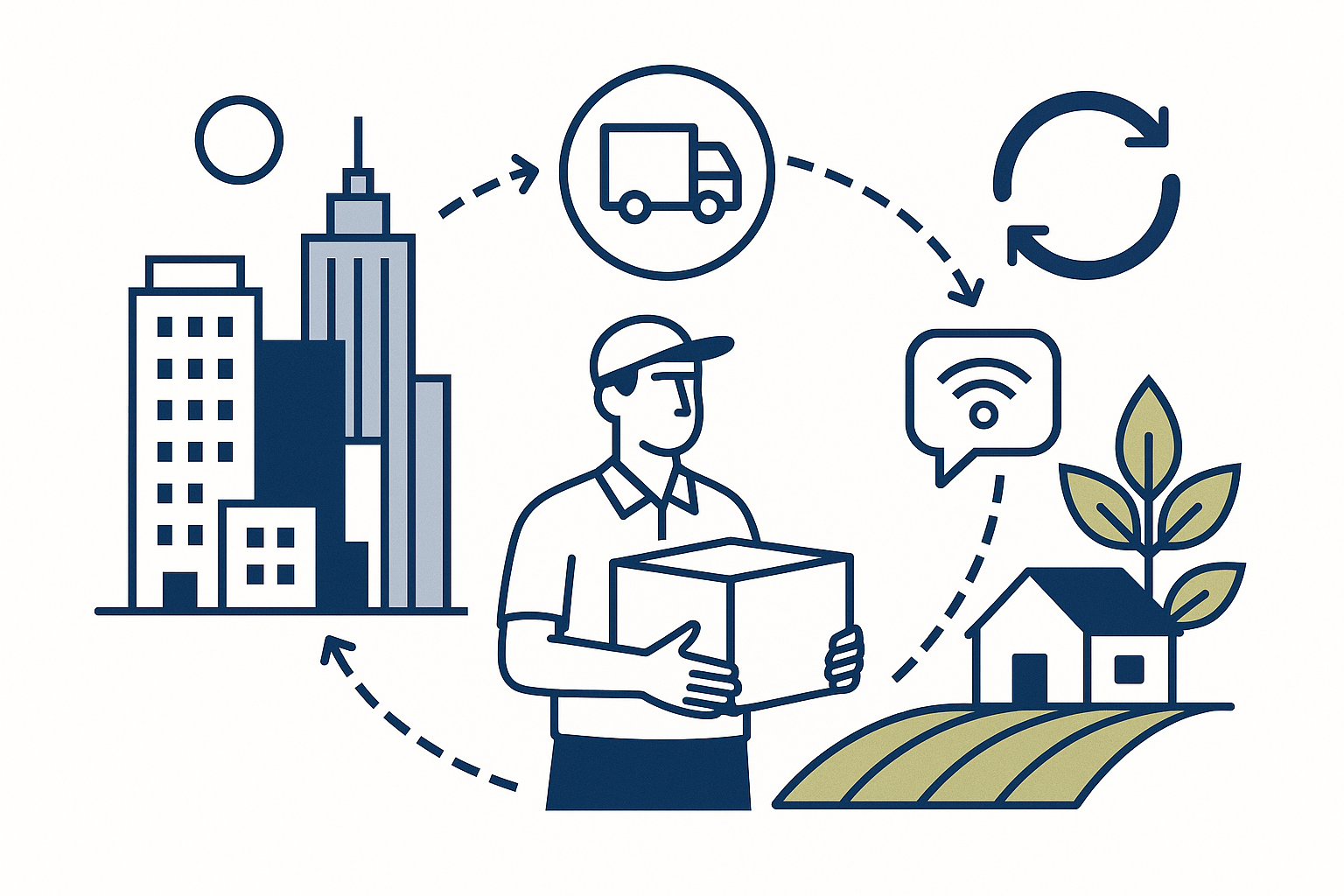
Cities have always been the combustion hubs of commerce, but for most of the past century they functioned as glamorous endpoints of sprawling, linear supply chains. Container ships disgorged pallets at remote ports; warehouses on the peri-urban fringe fed diesel trucks; high-street retailers sold finished goods and exported waste. The model delivered scale but at the hidden cost of carbon, congestion and fragile dependencies. The COVID-19 era laid those risks bare, from empty supermarket shelves in Toronto to stalled electronics assembly lines in Tokyo. Yet within that disruption lay a revelation: the proximity advantage of cities is not just a relic of pre-globalisation history but the cornerstone of a regenerative economic future.
A genuinely local supply chain is neither nostalgic farmers’ market romanticism nor self-sufficiency fantasy. It is a deliberately engineered network that leverages urban density, digital coordination and circular-economy thinking to keep materials and value looping within a metropolitan radius. In practice, this means food that travels minutes instead of days, textiles remanufactured in the district where they were sold, and repair hubs that transform end-of-life electronics into inputs for neighbourhood start-ups. Crucially, “local” is measured not only in kilometres but in data transparency, community participation and the share of economic surplus retained by residents.
Consider the humble cup of coffee. In a linear model, green beans arrive by ship, are roasted in an industrial park outside the city, sold in single-use cups, and the grounds end up in landfill. In a localised loop, beans are still imported—proximity can’t change geography—but everything that happens after docking is re-anchored in the city. Independent roasters in Toronto’s Port Lands share an electric roasting cooperative powered by rooftop solar. Spent grounds are collected by cargo bike and biodigested in a micro-anaerobic facility whose biogas drives the roaster’s afterburners, while the residual compost nourishes rooftop farms that supply herbs to nearby cafés. The same kilogram of beans now circulates value through energy, fertiliser and community agriculture cycles rather than exiting as waste. Multiply that logic across furniture, fashion and pharmaceuticals, and the planetary arithmetic shifts.
Local loops do more than abate carbon; they inoculate cities against systemic shocks. When the Suez Canal blockage of 2021 stranded East Asian auto parts en route to Europe, Kobe’s SMEs with diversified local micro-fabrication partners kept production running by reverse-engineering critical components on demand. The agility stemmed not from“just-in-time” inventory but from“just-nearby” capability embedded in the urban fabric—CNC machines in maker spaces, polymer printers in design schools, and a shared materials library catalogued on a blockchain ledger. Such redundancy appears inefficient on a spreadsheet that prizes scale, yet it is precisely the slack that converts disruption into opportunity.
Digital infrastructure is the quiet enabler. For the past two years, my work with Tenatch—a platform initially incubated in Toronto and refined through stakeholder sessions in Tokyo—has shown that a centimetre-accurate map of an item’s carbon footprint is only half the story. The real breakthrough lies in stitching those footprints together city-wide so that one merchant’s waste stream appears as an ingredient search result for another. Picture a real-time marketplace where a furniture store lists surplus sawdust, which a nearby mushroom farmer bids on as a growth medium, instantly generating a transport request to an electric van cooperative operating within a five-kilometre radius. Algorithms route multiple micro-shipments into consolidated loops that rival container efficiency without the ocean-scale distances.
Of course, local supply chains cannot escape global responsibility; they redefine it. Materials like cobalt, cacao or rare-earth metals originate continents away, and no amount of urban ingenuity will change their geology. What the city can change is the social contract governing those inputs. Transparent product passports allow a Kobe consumer to trace the aluminium casing of a refurbished laptop back to a smelter powered by hydropower in Québec, while simultaneously verifying that the device’s end-of-life processing is booked into a certified recycler in Saitama. By guaranteeing reciprocity—ethical sourcing balanced by responsible end-use handling—urban supply networks embed global justice into local transactions.
Financing the shift requires new metrics. Traditional ROI calculations undervalue avoided emissions, resilience dividends and community wealth creation. Impact-weighted accounting fills the gap. In Tokyo, a consortium of neighbourhood banks and pension funds has begun issuing “loop loans” whose interest rates step down as borrowers hit milestones on material recirculation and Scope 3 emissions reduction. Early evidence suggests default rates lower than conventional SME lending, thanks to diversified revenue streams from repair, refurbishment and service subscriptions. Finance, in other words, is discovering the compounding returns of circularity.
Policy makers hold the steering wheel. Zoning codes that once segregated manufacturing from retail can be rewritten to permit light fabrication on main streets, provided noise and particulate limits conform to urban-health standards. The City of Toronto recently piloted a “15-Minute Manufacturing Permit” that exempts low-impact, zero-emission workshops from lengthy planning approvals, catalysing a wave of micro-factories producing everything from solar-panel mounting brackets to bespoke bicycles. Procurement can accelerate demand: when Tokyo’s metropolitan government mandated that half of its school-lunch ingredients come from within a 100-kilometre foodshed, farmers invested in controlled-environment agriculture facilities inside disused warehouses, halving delivery miles and inspiring a curriculum around food literacy and carbon footprints.
Yet even the best-designed loops carry risks of exclusion. Urban land values rise when supply chains re-localise; without safeguards, the very communities that power the transition may be priced out of its benefits. Community land trusts, cooperative ownership structures and participatory budgeting offer counterweights. In Toronto’s Parkdale neighbourhood, a social-enterprise appliance-repair hub operates out of a building held in a community trust, ensuring rental stability while profits fund coding classes for local youth. Equity is thus baked into the supply chain narrative, not appended as CSR.
Critics argue that localising production sacrifices cost efficiency and consumer choice. The evidence tells a subtler story. As additive manufacturing and modular design mature, the price differential between mass-produced imports and locally fabricated goods narrows, particularly when carbon pricing and extended producer responsibility are factored in. Choice, meanwhile, evolves rather than shrinks: consumers trade endless variations of disposable products for customisable, upgradable items aligned with personal and planetary wellbeing. The shift mirrors the energy sector’s transition from centralised coal plants to distributed renewables—initially derided as niche, now recognised as the backbone of net-zero strategies.
Scaling remains the frontier challenge. Urban loops thrive on density, but density varies across regions. The solution lies in federated networks: cities share open standards for product passports, reverse-logistics APIs and impact accounting so that loops can interlock across metropolitan boundaries without reverting to linear sprawl. Imagine a garment designed in Kobe, stitched in Osaka from fibre grown on a vertical farm in Kyoto, sold in Tokyo, and eventually down-cycled in Nagoya—each node local to its community yet synchronised through common protocols. Such polycentric supply chains combine the intimacy of the neighbourhood with the reach of the megalopolis.
As we edge toward 2030, with global climate thresholds looming, the debate is no longer local versus global but linear fragility versus circular resilience. Cities occupy the hinge point of that choice. They possess the spatial density to close material loops, the policy levers to align incentives, and the cultural diversity to re-imagine consumption as collaboration. When the neighbor who fixes your shoes is also the shareholder in the rooftop-solar array that powers the workshop, supply chains cease to be invisible machinery and become civic relationships.
The urban advantage, then, is not merely logistical; it is relational and regenerative. Each kilometre shaved off delivery routes, each kilogram of waste recaptured, each kilowatt traded peer-to-peer is a building block in an alternative globalisation—one where value moves at the speed of trust rather than the speed of freight. From the cobblestones of Kensington Market to the neon alleys of Shibuya, local supply chains are proving that the shortest distance between two points can indeed change the world.
Leave a Reply