
Retail has long served as both barometer and catalyst of urban change. From London’s nineteenth-century arcades to Shibuya’s neon labyrinth, the way we buy has shaped the very streets we walk. Yet the tried-and-tested formulas that once seemed immutable—single-use packaging, just-in-time logistics powered by fossil fuels, annual clearance sales that encourage over-production—are unravelling under mounting ecological and social pressure. Global fashion alone accounts for roughly eight per cent of greenhouse-gas emissions, while last-kilometre freight now represents the fastest-growing contributor to city air pollution. Traditional commerce models, optimised for speed and volume, have pushed urban infrastructure to breaking point and strained community cohesion. A recalibration is not merely desirable; it is indispensable.
The push towards a sustainable commerce model is propelled by converging forces. Consumers, especially Generation Z and younger millennials, increasingly align purchasing decisions with ethical convictions, favouring brands that commit to net-zero targets, fair labour standards and minimal packaging. Tech-savvy municipalities, from Toronto to Copenhagen, are writing emission ceilings for logistics vehicles into tender documents, effectively turning procurement into a climate policy instrument. Meanwhile, institutional investors—mindful of stranded-asset risk—are recalibrating valuations to reflect Scope 3 footprints. Collectively, these actors form a powerful feedback loop: market demand shapes regulatory ambition, which in turn accelerates capital reallocation.
Yet cities have specific leverage that national governments often lack. They command zoning laws, street-level data and planning approval processes, all of which directly influence how retail ecosystems evolve. Consider Tokyo’s Marunouchi district, where green-lease requirements have nudged property owners to install renewable energy micro-grids that power storefronts and public areas. Or Toronto’s King-Spadina corridor, where pedestrian-first redesigns and consolidated freight hubs have shortened delivery routes by up to thirty per cent, slashing particulate pollution and giving local cafés room to reclaim the pavement. These examples demonstrate that urban authorities can translate abstract sustainability targets into tangible spatial interventions that make responsible commerce the path of least resistance.
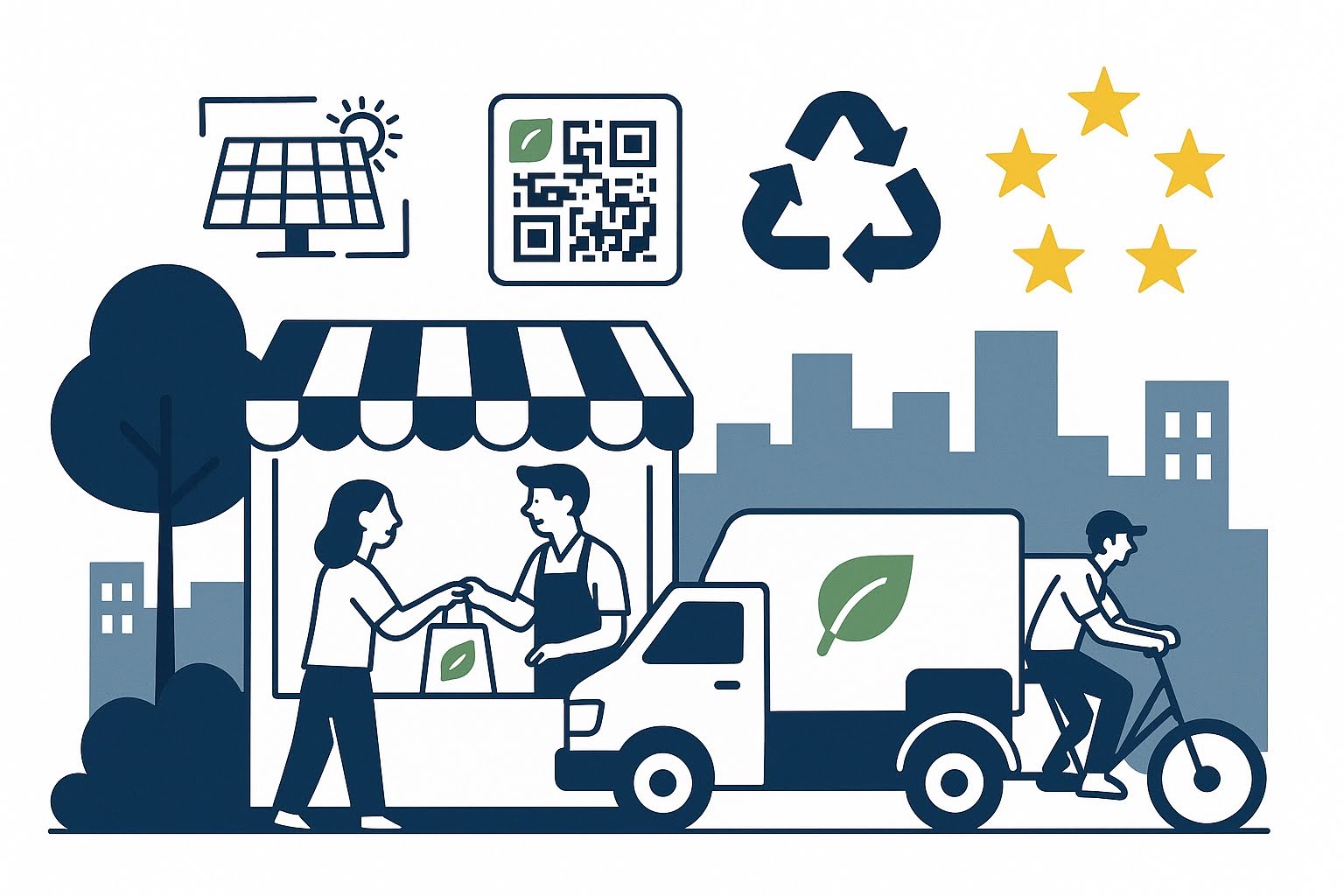
Still, policy instruments alone cannot deliver a revolution. Merchants, supply-chain partners and civic actors must rethink the very physics of commerce. Circular design principles—repair, reuse, remanufacture—offer an instructive starting point. Imagine a boutique electronics store that sells modular smartphones; customers assemble components in-store, return outdated modules for credit, and track the product’s carbon journey through a blockchain-verified QR code. The retailer, integrated with an urban reverse-logistics platform, moves returned parts to local refurbishers rather than overseas recyclers, creating skilled jobs and cutting freight emissions. By embedding reuse into the business model, the shop not only diversifies revenue streams but also cultivates customer loyalty rooted in shared values.
Digital infrastructure is the second pillar. Conventional e-commerce has excelled at transaction efficiency yet struggled with externalities such as wasteful packaging and delivery congestion. A new generation of platforms is emerging that prioritises environmental and social metrics alongside price and speed. For example, my work with Tenatch—a platform concept incubated in Toronto and refined through engagements in Tokyo and Kobe—points to the viability of “hyperlocal marketplaces” that connect residents with neighbourhood merchants, integrate real-time inventory visibility, and offer consolidated zero-emission delivery windows. Early pilots indicate that grouping orders by walkable micro-districts can cut last-mile mileage by forty per cent compared with traditional single-parcel dispatch, all while boosting foot traffic in high-street stores.
Financial architecture must keep pace. While the sustainable-finance boom has funnelled billions into renewable energy and green bonds, urban retail has largely remained on the sidelines. That is beginning to change. Impact investors are experimenting with revenue-based financing for circular-economy start-ups, allowing entrepreneurs to sidestep growth-at-all-costs pressures. Municipal green-bank facilities can de-risk storefront retrofits by blending concessional capital with private debt, accelerating the shift to electrified HVAC systems and smart-metering. Crucially, such instruments should be designed to support micro-SMEs, which form the backbone of urban retail yet often fall outside conventional credit parameters.
One of the thorniest challenges is data integrity. Retail supply chains criss-cross multiple jurisdictions, making end-to-end footprint calculations notoriously complex. However, the rise of open-standard emissions accounting—think of protocols aligned with the Partnership for Carbon Transparency—provides a common language. Retailers that integrate verified product passports can differentiate themselves in saturated markets, turning compliance into competitive advantage. Moreover, transparent data flows empower city planners to model policy scenarios more precisely, whether setting ultra-low-emission delivery zones or allocating curb space for cargo-bike docks.
Of course, structural transformation rarely proceeds smoothly. Legacy retailers face sunk-cost dilemmas: multi-decade leases in energy-inefficient premises, rigid procurement contracts indexed to volume discounts, workforce skill gaps. Investors fret over short-term margin dilution. Consumers, conditioned by years of free returns and overnight delivery, may resist service-fee surcharges designed to internalise environmental costs. Yet here lies the opportunity for courageous leadership. Brands that articulate a clear transition roadmap—anchored in science-based targets, phased capital expenditure plans and transparent progress reporting—can rally stakeholders around a shared vision. My experience drafting ESG roadmaps for global seafood and technology firms underscores the power of credible narrative paired with measurable milestones.
Equity considerations are equally paramount. A sustainable commerce revolution must avoid perpetuating the exclusionary patterns of past urban renewals. Community land trusts, cooperative ownership models and participatory budgeting can ensure that low-income residents share in the benefits of greener retail corridors—cleaner air, accessible amenities, dignified employment. In Kobe’s revitalised bayside districts, for instance, municipal authorities mandated that at least twenty per cent of new retail floor area be reserved for social enterprises and minority-owned ventures, funded in part by local green bonds. The result: economic uplift paired with cultural vibrancy, without the displacement commonly associated with gentrification.
Looking ahead, convergence between physical and digital realms will accelerate. Augmented-reality storefronts, powered by low-energy display glass, could present bespoke product information—origin, carbon intensity, repairability scores—at a glance. Peer-to-peer energy trading among clustered retailers could transform urban shopping streets into micro-utilities that balance solar-and-storage generation with real-time demand. As 5G and edge computing mature, data-rich curb-side infrastructure will blend traffic-flow analytics with inventory logistics, orchestrating cleaner freight while opening new experiential marketing canvases.
For policymakers, the roadmap is clear: mandate embedded carbon disclosures, harmonise reverse-logistics regulations across boroughs, and convert underutilised car parks into micro-fulfilment hubs served by electric cargo bikes. For investors, the imperative is to back integrators—start-ups that stitch together digital platforms, circular-economy operations and community engagement—that can scale across global cities while respecting local nuances. For retailers, the strategic priority must shift from footfall and margin to resilience: materials resilience, brand-trust resilience, community resilience.
Ultimately, the urban sustainable commerce revolution is not a niche sub-sector; it is a systemic reset that reimagines how value is created, distributed and regenerated in the places we call home. It calls on us to view retail as civic infrastructure, capable of fostering social cohesion, catalysing green innovation and anchoring vibrant public realms. The question is no longer whether cities can afford to pursue sustainable commerce, but whether they can afford not to. The window for incrementalism is closing fast; decisive action today will distinguish the pioneers from the also-rans in tomorrow’s carbon-constrained economy.
As the retail lights flicker back on after a turbulent decade of pandemics, supply-chain shocks and geopolitical tensions, we stand at an inflection point. Embracing circular design, digital transparency and community-centred governance can transform shopping streets from carbon hotspots into living laboratories of urban sustainability. The renaissance is within reach—if we choose to re-build, rather than simply re-open, the shopfronts of our collective future.
Leave a Reply