
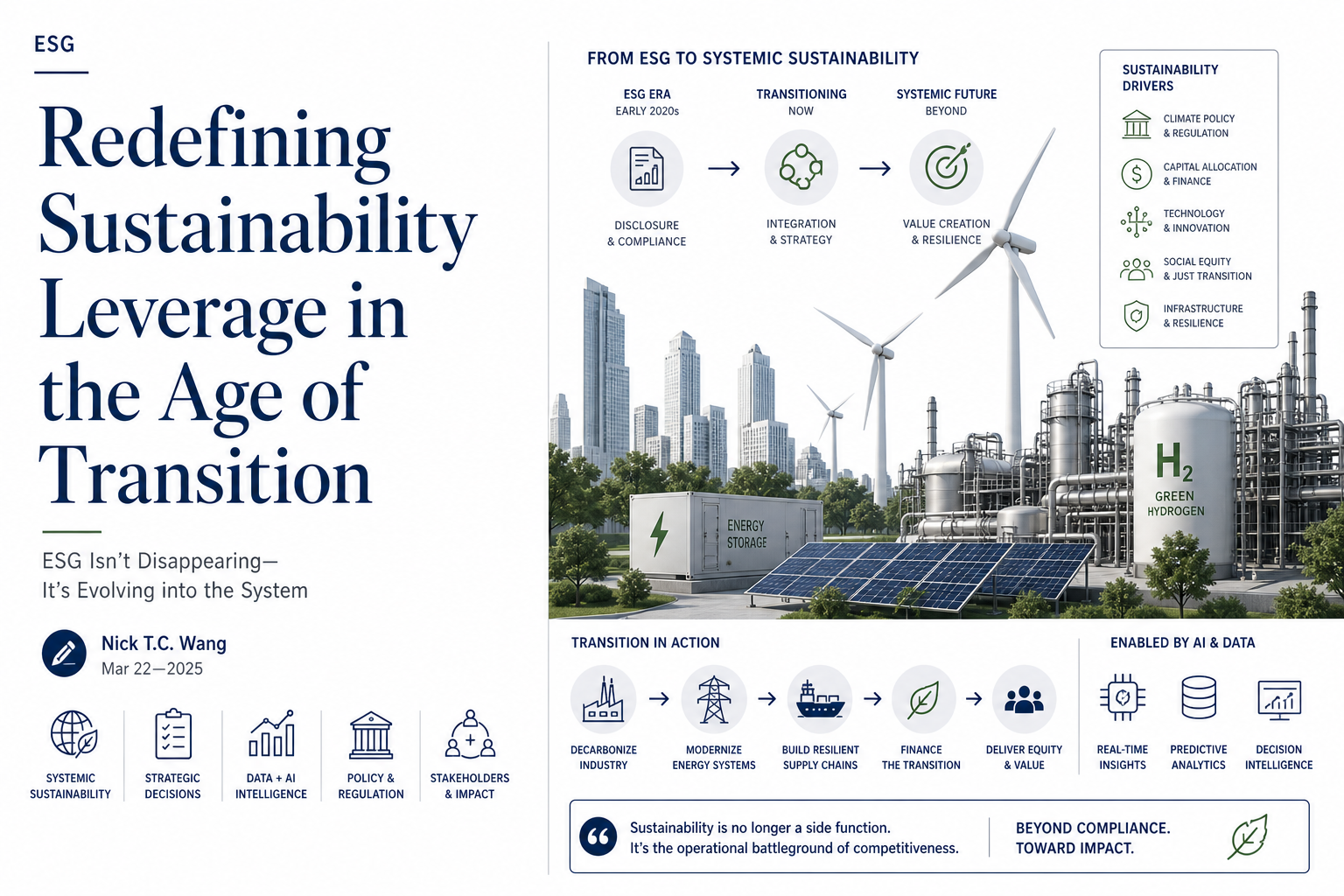
ESG Isn’t Disappearing—It’s Evolving into the System
In the early 2020s, ESG rose to prominence as the dominant language of corporate sustainability, a catch-all term that allowed environmental and social concerns to enter the boardroom. But that halo is now fading—not because sustainability has lost relevance, but because impactful, systemic sustainability has outgrown the label. ESG is no longer a symbolic add-on to corporate reports; it has become embedded across capital allocation, climate policy, public procurement, and infrastructure strategy.
The “S” and “G” dimensions are no longer vague declarations. In today’s interconnected systems, they manifest in real design and governance choices. In a net-zero grid, how do we ensure energy equity? In scaling hydrogen supply chains, what governance frameworks enable credibility and cross-border alignment? These are not just ethical questions—they are strategic ones. ESG isn’t the answer anymore; it has become the starting point for much deeper inquiry.
The buzzword may be fading. The transformation is not.
The Energy Transition Is Rewriting the the Sustainability Playbook
In my current research on Taiwan’s energy transition, I’ve seen ESG frameworks gradually replaced by more rigorous technical, policy, and financial constructs. Investors are no longer satisfied with a single score. Instead, they ask sharper, more consequential questions:
- Is your supply chain exposed to carbon leakage under the EU’s CBAM?
- How does your hydrogen roadmap align with Asia’s industrial policy trajectory?
- Can your renewable assets withstand volatility driven by El Niño?
This shift signals a deeper transformation. Sustainability has become quantifiable, verifiable, and integrated with capital decisions. And energy transition technologies—EVs, smart grids, energy storage, green hydrogen—are now the proving grounds where these values must perform under pressure.
The Market Is Correcting for Substance
Many ESG startups have hit growth plateaus or exited altogether. Not because sustainability is irrelevant, but because many of these tools were built for compliance, not competitiveness. They lacked real strategic value.
Consider the 10,000+ ESG SaaS platforms competing globally. How many can truly model marginal abatement costs or simulate the energy pricing impact of policy shifts? How many understand sectoral load curves? Most platforms collect and visualise data without converting it into insight. As freemium models compress margins and buyers demand more rigour, the market is entering a phase of inevitable consolidation and recalibration.
AI Is Not a Threat—It’s the Catalyst
AI, especially large language models, has turned ESG tools from data aggregators into decision-making platforms. Where analysts once needed weeks to compile a sustainability report, AI can now do it in hours—with far greater accuracy and contextual relevance.
The real scarcity is no longer data—it’s interpretive judgement. The winners in this new phase are those who can integrate satellite imagery, policy signals, and energy infrastructure data into real-time strategic intelligence. This is what clients increasingly expect: not a compliance checklist, but a live dashboard of the transition—complete with predictive capability and forward-looking risk mapping.
Regulation Is Becoming Strategy
A quiet regulatory revolution is underway. From Europe’s CSRD and the UK FCA’s anti-greenwashing rules to global standards like ISSB and TCFD, the bar for sustainability credibility is rising fast.
Disclosure is no longer optional. Lifecycle emissions for EV supply chains, third-party audits of battery materials, and taxonomy-aligned finance for offshore wind—these are becoming industry baselines, not aspirational goals.
Asia-Pacific is accelerating too. Taiwan, South Korea, and Japan are rolling out their own sustainable taxonomies, carbon fees, and hydrogen protocols. For corporates, regulation is no longer just a constraint—it’s a signal. Fail to align today, and you risk exclusion from tomorrow’s decarbonised economy.a constraint—it’s a forecast of where the economy is heading.
ESG Roles Are Shifting—So Are the Skills
The era of “ESG Generalists” is sunsetting. Corporations now demand domain fluency—whether it’s clean energy finance, grid modernisation, or material traceability. In 2021, “ESG” was a headline job title. Today, many companies have removed it from their org charts—not because the work is gone, but because it has matured. The demand is shifting from generalists to sector-specific experts who can translate sustainability into financial models, supply chain strategy, and geopolitical risk.
This is visible across boardrooms, budgets, and hiring practices. Deep domain expertise is now more valuable than broad labels. My own shift—from marine sustainability branding to infrastructure and energy systems analysis—reflects this evolution. As complexity rises, depth matters more than breadth, so does the need for technical credibility.
Sustainability is no longer a side function. It’s the operational battleground of competitiveness.
Energy and Climate aren’t Adjacent to ESG—They’re one of its Successors
What comes after ESG? Not a new acronym. What emerges is a reality in which performance matters more than posture, and action outweighs optics. Energy transition is the real testbed. It shows which models work, which are scalable, and which decisions deliver both economic and environmental value. For forward-looking firms and investors, future competitiveness depends on:
- Aligning infrastructure strategy with decarbonisation pathways
- Embedding sustainability into capex and procurement processes
- Using AI to translate risk into foresight—not just scores
Sustainability is no longer a market differentiator. It is the minimum expectation. Execution is now the true edge.
Final Thoughts: The Real Work Begins Now
The ESG era was never the destination—it was the on-ramp. We are now entering the execution phase and for me I am focusing on the energy and climate transition. The ESG spotlight may be dimming, but for those of us committed to sustainability, energy, and climate, this moment marks a new, more grounded phase. The age of buzzwords is over. What lies ahead is defined by integration—of data, policy, infrastructure, and strategy.
We are entering an era of harder questions, sharper tools, and more systemic thinking. And that’s not a problem—it’s progress. The path forward will demand rigour, vision, and collaboration. Let us not merely observe this transition. Let us shape it. This stage will demand new tools, sharper skills, and a deeper commitment to systems-level change. It will also reward those who move beyond compliance and into strategy, infrastructure, and impact.
What we’re witnessing isn’t the end of sustainability. It’s the start of a more intelligent, integrated, and investment-worthy future.
Leave a Reply