
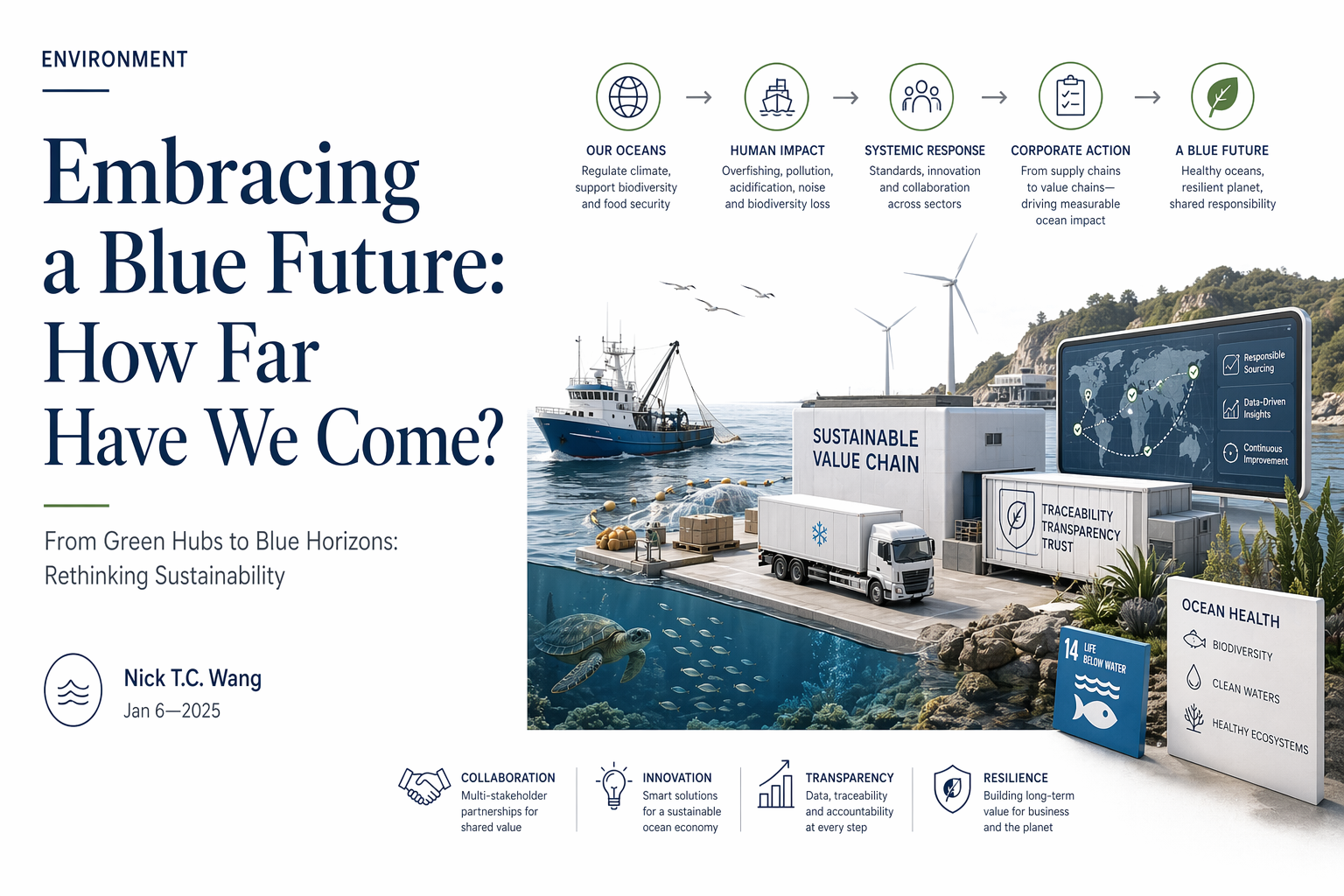
From Green Hubs to Blue Horizons: Rethinking Sustainability
When we talk about sustainable development, our minds often gravitate towards green cities, clean energy, or smart infrastructure—tangible efforts we encounter daily. Yet when we shift our gaze from land to sea, we uncover a critically overlooked frontier: ocean sustainability.
Throughout my career, I’ve journeyed from sustainable urban planning to ESG evaluation and supply chain management. This evolution has revealed a fundamental truth—sustainability doesn’t stop at the shoreline. Oceans cover more than 70% of our planet, regulate climate systems, and support biodiversity and food security. To overlook them is to ignore the very foundations of global sustainability.
Turning Theory into Practice at FCF Co., Ltd.
During my time at FCF Co., Ltd.—a global leader in seafood trading—I worked on embedding sustainability across the fishing supply chain. From drafting ESG reports and performing supply chain due diligence to executing strategies aligned with international standards, I saw firsthand how businesses can transform intent into impact.
My work ranged from evaluating ecosystem impacts of fishing to designing policies for bycatch reduction and transparency. These initiatives enhanced both environmental outcomes and corporate reputation. Sustainability, I learned, is not just a moral stance—it is a critical lever for long-term business viability. Through multi-stakeholder collaboration, we aligned ecological responsibility with economic resilience.
Challenges and Opportunities in Ocean Sustainability
Despite rising awareness, the ocean’s condition continues to deteriorate. As technology and global commerce push human activity into deeper waters, the resulting environmental pressure—overfishing, pollution, acidification, and biodiversity loss—is escalating.
The World Benchmarking Alliance’s 2026 Ocean Methodology is a direct response. It outlines seven system-level transformations, assessing 125 companies across sectors such as shipping, offshore wind, fisheries, and chemicals. What’s most valuable is not only the framework’s indicators, but its role as a practical roadmap for corporate ocean responsibility.
From Supply Chains to Value Chains: The Need for Systemic Change
As a sustainability and supply chain consultant, I understand how every corporate function touches the ocean. Pollution, overexploitation, and waste are downstream consequences of upstream decisions.
The shift from supply chain to value chain thinking—emphasised in the WBA’s methodology—asks companies to go beyond internal practices and engage upstream and downstream partners. From water pollution and plastics to waste management, the framework provides clear targets and reporting tools to catalyse holistic improvement.
Noise pollution, often ignored, is another key concern. Marine mammals suffer from disoriented communication due to sonar and industrial noise. Corporates involved in offshore operations must adopt noise reduction technologies and consider acoustic impacts as seriously as carbon emissions.
At FCF, I helped design a traceable supply chain system that enhanced legal compliance and product origin transparency. This digital framework not only reinforced brand credibility but also facilitated deeper stakeholder collaboration—a hallmark of resilient value chains.
Innovation and Long-Term Impact
True transformation requires more than compliance—it calls for innovation. Smart fishing gear, carbon-reducing logistics, and eco-packaging are no longer “nice-to-haves.” While these innovations may raise short-term costs, their long-term benefits in operational efficiency, investor confidence, and market access are significant.
Crucially, value chain thinking empowers firms to move from reactive compliance to proactive collaboration. I’ve seen this firsthand across sustainability projects: when businesses align on shared goals, entire industries shift. Collaboration fosters shared value—environmentally and economically.
Corporate Action Is Not Optional—It’s Strategic
In today’s world, companies are both economic drivers and environmental actors. Embracing sustainability is not just an ethical choice—it is a strategic imperative.
While some business leaders remain sceptical of sustainability’s ROI, market forces are evolving. More buyers now assess ESG performance as a precondition, not a bonus. Through responsible fishing policies and plastic reduction initiatives, we enhanced FCF’s international competitiveness. Our packaging reduction programme—with supplier cooperation—lowered environmental impacts while bolstering brand equity.
These actions were not just well received—they became differentiators at global exhibitions and negotiations. The market increasingly rewards ESG maturity. Sustainability has emerged as a strategic advantage, not just a social obligation.
Individual Impact: Building a Blue Future from the Ground Up
Sustainability is not reserved for corporations. Individuals have power too. Reducing single-use plastics, choosing certified seafood, and joining coastal clean-ups are meaningful acts.
As an outdoor enthusiast and backpacker, I’ve witnessed both breathtaking landscapes and heartbreaking damage. It convinced me: change must be collective. Every social post, every conversation, every purchase decision matters. Sharing sustainability knowledge, advocating for change in schools and workplaces, or volunteering with ocean NGOs—these grassroots actions ripple outward.
We are all stakeholders. Whether student, parent, or professional, everyone has a role to play. Collective awareness fuels cultural momentum. And cultural momentum drives policy and innovation.
Conclusion: A Shared Responsibility for a Blue Tomorrow
Faced with worsening marine degradation, despair is easy—but unwarranted. Each action matters. From policy research to supply chain reform, every step I’ve taken in my sustainability journey has strengthened my belief in actionable change.
From setting fishing standards with global bodies to enhancing packaging sustainability and stakeholder cooperation, I’ve seen that practical efforts drive industry-wide progress. My consulting work at Deloitte Taiwan has helped firms shape ESG strategies, evaluate risk, and push for systemic innovation. These experiences have shown me that transformation demands both strategic foresight and daily action.
So, I invite you—whether company or citizen—to start today. Every sustainable choice, no matter how small, is a step toward a healthier ocean and a thriving blue planet for generations to come.
Leave a Reply