
1. Introduction
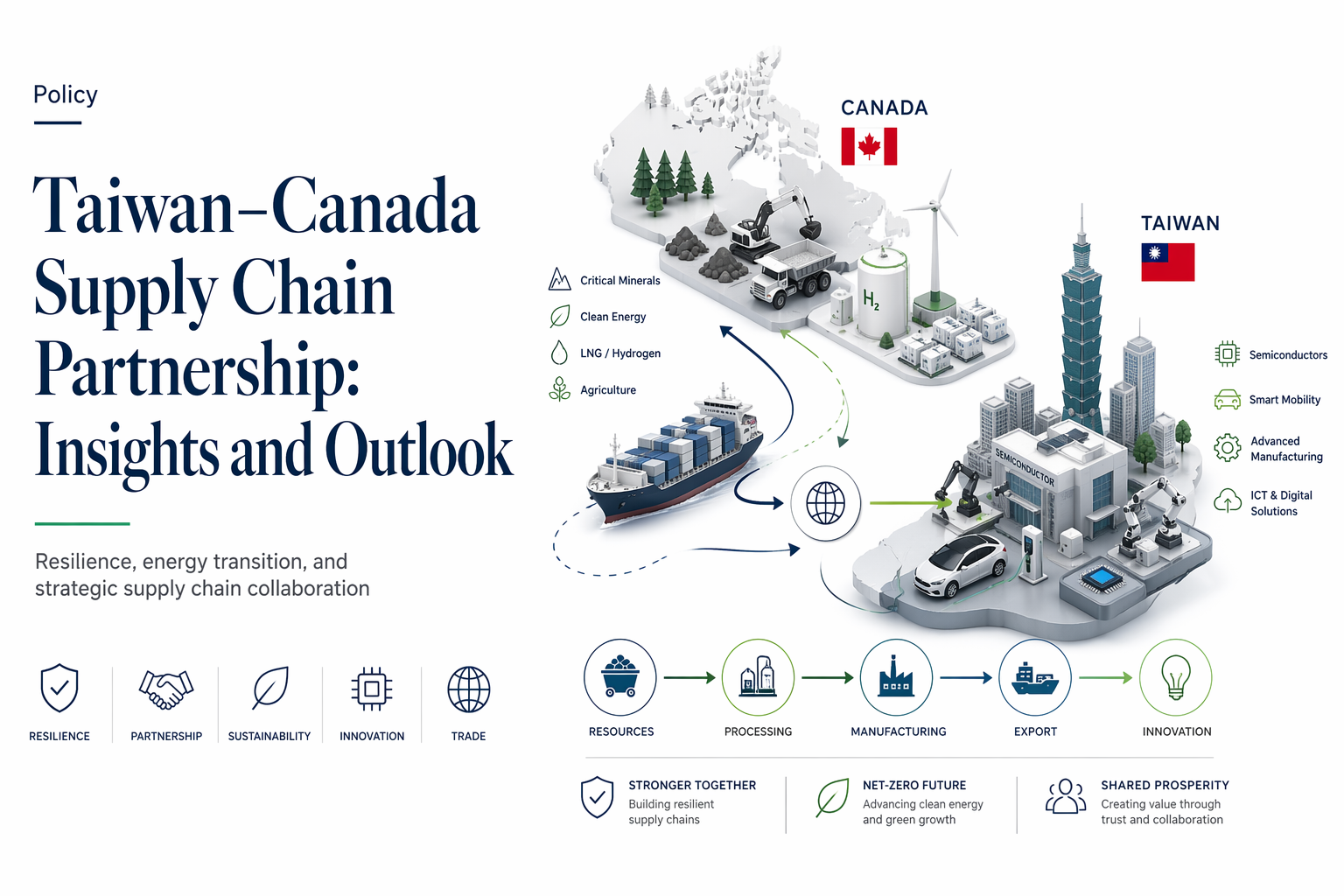
As leading economies in the Asia-Pacific and North American regions, Taiwan and Canada demonstrate strong complementarity in their supply chain partnership. Taiwan brings advanced manufacturing, R&D capabilities, and global supply chain expertise, while Canada offers abundant natural resources, clean energy technologies, and innovation potential.
In light of global supply chain restructuring, energy transition, and sustainability demands, the two nations have aligned their priorities on enhancing resilience and advancing sustainable supply chains.
According to Statistics Canada, bilateral trade between Taiwan and Canada has continued to grow steadily. In 2022, Taiwan ranked as Canada’s sixth-largest Asian trading partner, with total bilateral goods trade reaching approximately USD 5.8 billion. Canada’s exports to Taiwan largely consist of natural resources (e.g., coal, iron ore, soybeans), while Taiwan’s exports to Canada feature high-value manufacturing such as telecommunications equipment, electronic components, and auto parts—highlighting the high level of industrial complementarity that underpins further collaboration.
The 2023 signing of the Foreign Investment Promotion and Protection Agreement (FIPA) between both countries marks another milestone, aiming to enhance trade facilitation and investment. In parallel, a Supply Chain Resilience Cooperation Framework is being developed, focusing on four key sectors: critical minerals, clean fuels and renewables, green and resilient transport, and advanced manufacturing and innovation.
2. Reflections from the Networking Event
Held on 5 December 2024 in Taipei, the Taiwan–Canada Supply Chain Networking Reception gathered government officials, business leaders, and industry experts to discuss how to strengthen bilateral cooperation under mounting global economic uncertainty.
Canadian delegates emphasised Taiwan’s pivotal role in global electronics and semiconductor supply chains, while highlighting Canada’s capacity to support Taiwan through stable supplies of critical minerals and clean energy. Taiwanese representatives, on the other hand, showcased the nation’s competitive edge in electronics manufacturing, ICT, and smart mobility—and expressed strong interest in building resilient, sustainable partnerships.
Taiwanese firms from sectors like electronic components, smart energy systems, and manufacturing showed particular enthusiasm for Canadian raw materials and renewable energy technologies. Several concrete cooperation ideas were proposed, such as securing upstream materials for Taiwan’s electric vehicle (EV) and semiconductor industries.
The event clearly indicated a shift in supply chain dialogue—from efficiency to resilience and sustainability—with both sides seeking to leverage respective strengths for greater global competitiveness.
3. Real-World Collaboration Cases
I had the opportunity to connect with a Canadian hydrogen technology firm actively exploring partnerships in Asia. Recognising the rising demand for clean fuels, the company is seeking to co-develop hydrogen storage and transport solutions tailored to future market needs.
Another Canadian firm, focused on EV components, expressed strong interest in collaborating with Taiwan’s ICT industry to create next-generation smart electric vehicles—fusing technological innovation with the green mobility revolution.
Intriguingly, I also met venture capitalists specialising in cultural and entertainment sectors. They highlighted Taiwan’s creative and digital integration capabilities as a unique opportunity for content and platform innovation. From music and film to tech-enabled storytelling, they are eager to invest in Taiwanese startups leading the digital transformation of cultural industries.
This illustrates that Taiwan–Canada cooperation is expanding beyond manufacturing and energy—entering the “soft power” economy, and reflecting the diverse potential of cross-sectoral supply chain partnerships.
4. Supply Chain Resilience and Sustainability
Resilience:
In a world facing pandemic recovery, geopolitical tension, and energy shortages, resilient supply chains are paramount. Canada can provide reliable sources of critical minerals, strengthening Taiwan’s electronics production, while Taiwan’s advanced manufacturing and logistics can support integrated value chains.
Sustainability:
Both countries share a commitment to clean energy and green mobility. Canada’s strengths in hydrogen and wind power align with Taiwan’s net-zero 2050 goal. Their cooperation can drive the global transition toward sustainable supply chains.
5. Future Outlook and Recommendations
This event reinforced the promising outlook for Taiwan–Canada supply chain collaboration. To move forward, I recommend:
- Policy Dialogue: Establish a structured bilateral mechanism to coordinate trade and supply chain policies.
- Targeted Industrial Cooperation: Focus on EVs, hydrogen energy, and renewables to foster joint ventures.
- Tech and Talent Exchange: Enhance cross-border R&D and workforce mobility to jointly address global challenges.
6. Conclusion
Taiwan and Canada are forging a strong, complementary supply chain alliance—from traditional industries to clean energy, critical minerals, and even cultural innovation. As the global landscape grows more complex, resilience and sustainability will define economic success.
This networking event not only strengthened bilateral connections, but pointed to new frontiers. From smart transport to digital content, supply chain collaboration is expanding across sectors and geographies.
Looking ahead, Taiwan and Canada should seize the opportunities of supply chain realignment and energy transformation—jointly promoting green technology, smart mobility, and creative industries. Through policy alignment, integrated value chains, and investment partnerships, the two nations can build a globally competitive, sustainable economic alliance.
Taiwan–Canada supply chain cooperation represents more than just economic resilience. It embodies industrial upgrading, technological innovation, and soft power integration—defining a shared vision for long-term prosperity.
Leave a Reply