
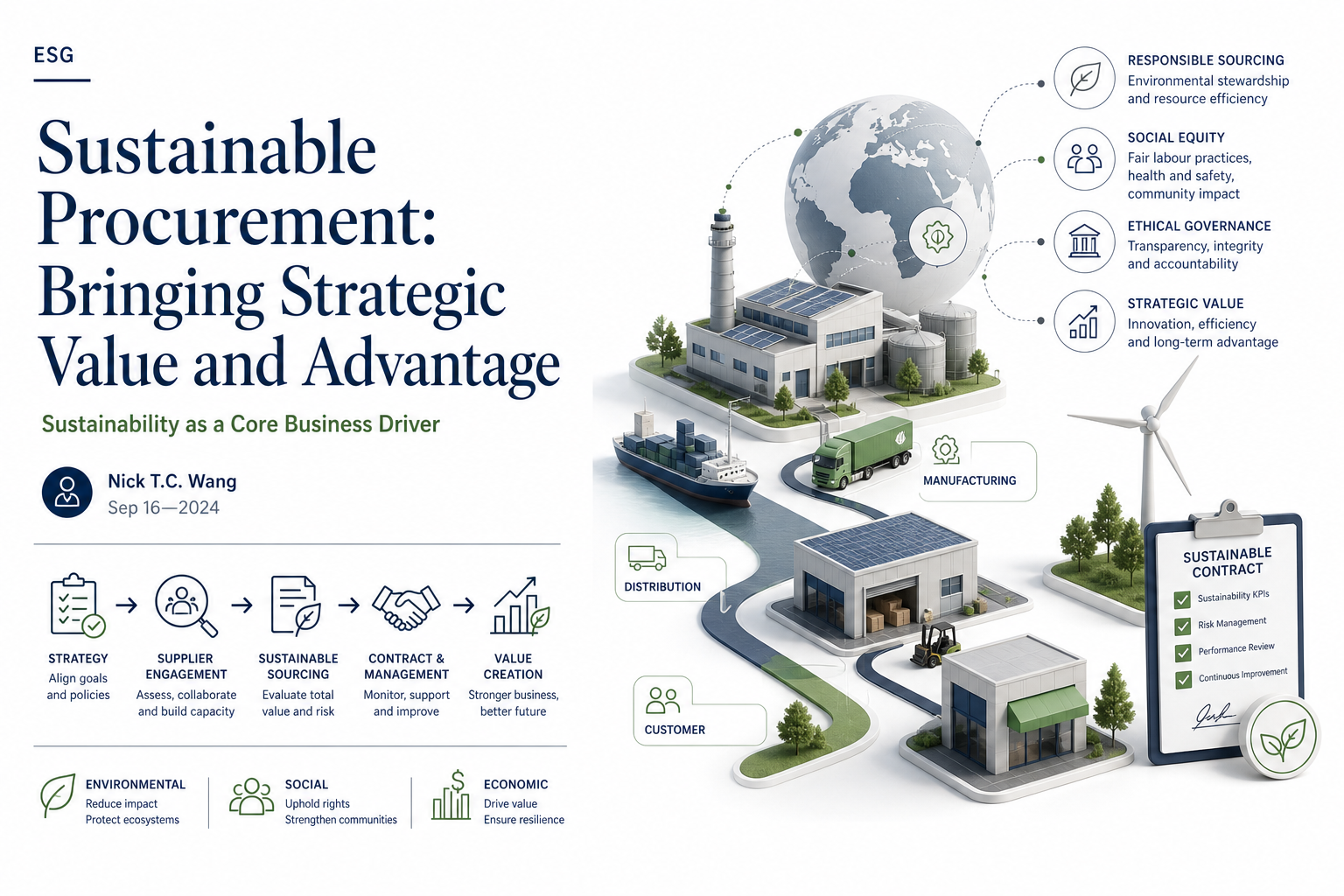
Sustainability as a Core Business Driver
In today’s rapidly evolving global market, corporate success is defined not only by profitability but also by the ability to operate responsibly across environmental, social and economic dimensions. Sustainability is no longer a secondary consideration—it is a strategic necessity and a key source of competitive advantage.
As supply chains become more global and interdependent, companies face increasing pressure to embed sustainability into procurement. This is not just the responsibility of procurement departments, but a company-wide transformation—requiring top-down leadership and cross-functional commitment from employees to suppliers.
Sustainable Procurement Is More Than Just Green Purchasing
Sustainable procurement goes beyond eco-friendly materials or emissions reductions. It reflects the triple bottom line—environmental integrity, social equity and economic viability—throughout a product or service’s lifecycle. Organisations must consider how procurement decisions impact all stakeholders, including workers, communities, and ecosystems.
This requires embedding sustainability into procurement strategies through clear policies, accountability, transparency, and ethical conduct. The starting point is to align sustainability objectives with corporate values and long-term goals—translating them into actionable procurement policies. Key performance indicators (KPIs) help track progress, while risk management frameworks ensure that material risks and opportunities are addressed efficiently.
Supplier Engagement: Collaboration for Mutual Gain
Sustainable procurement cannot succeed in isolation—it hinges on supplier collaboration. Organisations must map the sustainability profile of their supply chain, identify key risk areas, and pre-screen suppliers based on defined sustainability criteria.
Beyond audits, companies should establish partnerships that encourage co-innovation and shared responsibility. This builds supplier capacity, enhances transparency, and creates mutual value. Suppliers that embrace sustainability often contribute to improved product quality, reduced costs, and stronger competitive positioning.
Embedding Sustainability Across the Procurement Lifecycle
Sustainability must be applied consistently across all procurement stages—from tendering and evaluation to contract execution. This includes defining sustainability specifications that address physical, functional or performance requirements, and ensuring lifecycle cost assessments are part of the selection process.
Organisations should also proactively consider alternative solutions that may reduce environmental impact or better meet future needs. This forward-looking approach strengthens competitive advantage while aligning with long-term sustainability objectives.
Fostering Culture and Driving Internal Commitment
Sustainable procurement is not only a strategy—it is a shift in organisational culture. It requires leadership commitment and the cultivation of an internal environment that supports collaboration, innovation, and continuous improvement.
Embedding sustainability into employee performance frameworks and development plans ensures that all teams understand their role in this transition. Establishing a robust performance management system—one that benchmarks against peers and facilitates corrective action—further ensures continuous progress.
Incentivising and Supporting Suppliers
In some cases, suppliers may perceive sustainability improvements as a threat to short-term profits. For example, waste processors paid by weight may resist waste reduction initiatives. Companies can overcome this by designing incentive schemes—rewarding suppliers who exceed expectations or offering fixed-price contracts that promote efficiency.
Moreover, investing in supplier capability-building—through customised development programmes—empowers partners to meet and exceed sustainability standards, enhancing mutual resilience and long-term cooperation.
Contract Management: A Key Enabler of Sustainable Outcomes
Contract management is critical to success. Businesses should establish sustainability-oriented contract plans with embedded KPIs and review mechanisms. Regular supplier engagement on risks and opportunities ensures accountability and alignment throughout the contract period.
Termination should remain a last resort. Priority must be given to supplier development and support—only disengaging where improvement is unviable or non-compliance persists.
Long-Term Value Creation Through Sustainable Procurement
Sustainable procurement is not a one-time initiative—it’s a continuous journey that requires adaptability and strategic foresight. Organisations that embed sustainability into every decision point, cultivate deep supplier relationships, and monitor performance with rigour will not only remain competitive but also deliver broader environmental and social value.
Ultimately, sustainable procurement enhances financial performance, strengthens brand reputation, and fosters resilience across supply chains. Companies that lead this transformation will be best positioned to shape a more sustainable global economy and secure their place in the future.
Leave a Reply