
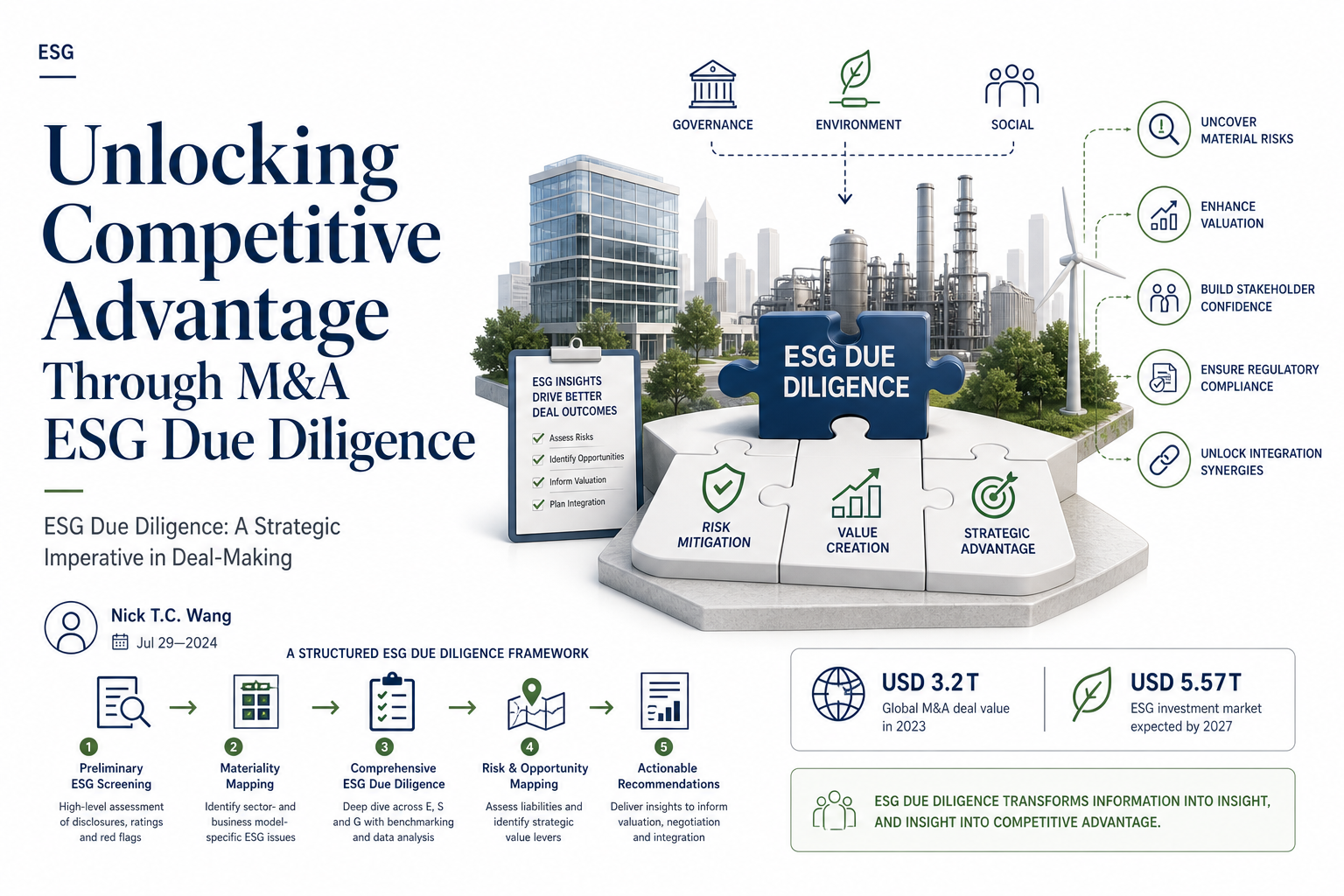
ESG Due Diligence: A Strategic Imperative in Deal-Making
In a fast-evolving business landscape, environmental, social and governance (ESG) factors are now foundational to value creation. Far from being ancillary considerations, ESG dimensions are emerging as key indicators of a target’s long-term viability and resilience. Leading acquirers increasingly embed ESG insights into transaction analysis—not only to mitigate post-deal risks but to unlock long-term competitive advantage.
This article outlines a structured ESG due diligence framework I’ve developed to support acquirers through pre-transaction screening, risk mapping, and post-deal integration planning. It also highlights the commercial potential of ESG due diligence services and proposes viable monetisation models. Feedback from ESG and M&A professionals is welcome.
Framework: Structuring an ESG Due Diligence Offering
A comprehensive ESG due diligence service must be more than a compliance exercise. It should offer a strategic view of risk and opportunity. The following methodology underpins a structured and value-oriented approach:
- Preliminary ESG Screening
Begin with a high-level assessment of the target’s ESG disclosures, third-party ratings, and any red flags. This provides early visibility into reputational or regulatory exposure. - Materiality Mapping
Identify ESG issues most material to the target’s sector and business model. For example, carbon intensity may dominate in heavy industry, while supply chain transparency and labour practices are critical in consumer goods. - Comprehensive ESG Due Diligence
Conduct an in-depth analysis covering governance structures, environmental performance, social practices and compliance history. Leverage external advisors and datasets to benchmark the target’s performance against peers and regulatory expectations. - Risk & Opportunity Mapping
Translate findings into a clear view of potential liabilities (e.g., environmental legacy risks, governance gaps) and strategic levers (e.g., market access, ESG branding benefits, investor appeal). - Actionable Recommendations
Deliver a consolidated report outlining ESG risks, mitigation strategies and value-creation opportunities. Insights should inform deal valuation, negotiation parameters and post-deal integration plans.
Market Opportunity: Riding the ESG Wave
Global M&A deal value stood at approximately USD 3.2 trillion in 2023, with ESG now featuring prominently in cross-border transactions. The ESG investment market is expected to reach USD 5.57 trillion by 2027. As jurisdictions tighten disclosure requirements—especially in Europe and North America—ESG due diligence is no longer optional in complex deals.
This creates a sizeable addressable market for advisory firms capable of delivering data-driven, actionable ESG insights. Acquirers are increasingly aware that ESG misalignment can result in post-deal value erosion, regulatory scrutiny, or reputational damage.
Strategic Value Creation: Beyond Compliance
ESG due diligence is not just about de-risking. It is also a forward-looking tool for identifying growth levers and synergies:
- Risk Mitigation
Uncover hidden liabilities—such as pollution risks, labour disputes, or governance failures—that could derail integration or expose the acquirer to post-deal surprises. - Valuation Enhancement
Strong ESG performers often trade at premium valuations. Conversely, ESG underperformance may offer a basis for repricing or renegotiation. - Reputation & Stakeholder Confidence
Embedding ESG into M&A signals credibility to investors, regulators and customers. It also aligns with the growing expectations of ESG-conscious shareholders. - Regulatory Compliance
ESG scrutiny is intensifying globally. Due diligence helps ensure alignment with evolving ESG disclosure and performance mandates, reducing legal exposure. - Integration Synergies
ESG insights can inform post-deal value capture, including target operating models, supply chain harmonisation, and ESG disclosure alignment.
Monetisation Models: Structuring a Scalable ESG DD Service
There are two primary commercial models for ESG due diligence services—project-based and retainer-based. Each serves distinct client segments and use cases:
| Model | Project-Based Engagements | Retainer/Subscription-Based Engagements |
|---|---|---|
| Best for | One-off or ad hoc M&A transactions | Frequent acquirers or ESG-conscious corporates |
| Revenue Basis | Fixed or tiered fee per transaction | Monthly or quarterly advisory retainer |
| Advantages | Customisable pricing, discrete scope, high-margin | Recurring revenue, long-term client relationships |
| Risks | Forecasting variability, price competition | Scope creep, resource constraints in high-demand periods |
Each model can be complemented by value-added services such as ESG integration planning, portfolio-level ESG benchmarking, or custom ESG toolkits.
Conclusion: ESG Due Diligence as a Competitive Differentiator
As ESG considerations reshape global deal-making, due diligence providers must evolve. This service line is not just about compliance—it is a strategic enabler. ESG due diligence allows acquirers to anticipate and respond to material non-financial factors that influence long-term value creation.
For consulting firms, the opportunity is twofold: support clients in building resilient, future-proof portfolios and build a scalable ESG advisory business rooted in credibility, insight and impact.
Leave a Reply