
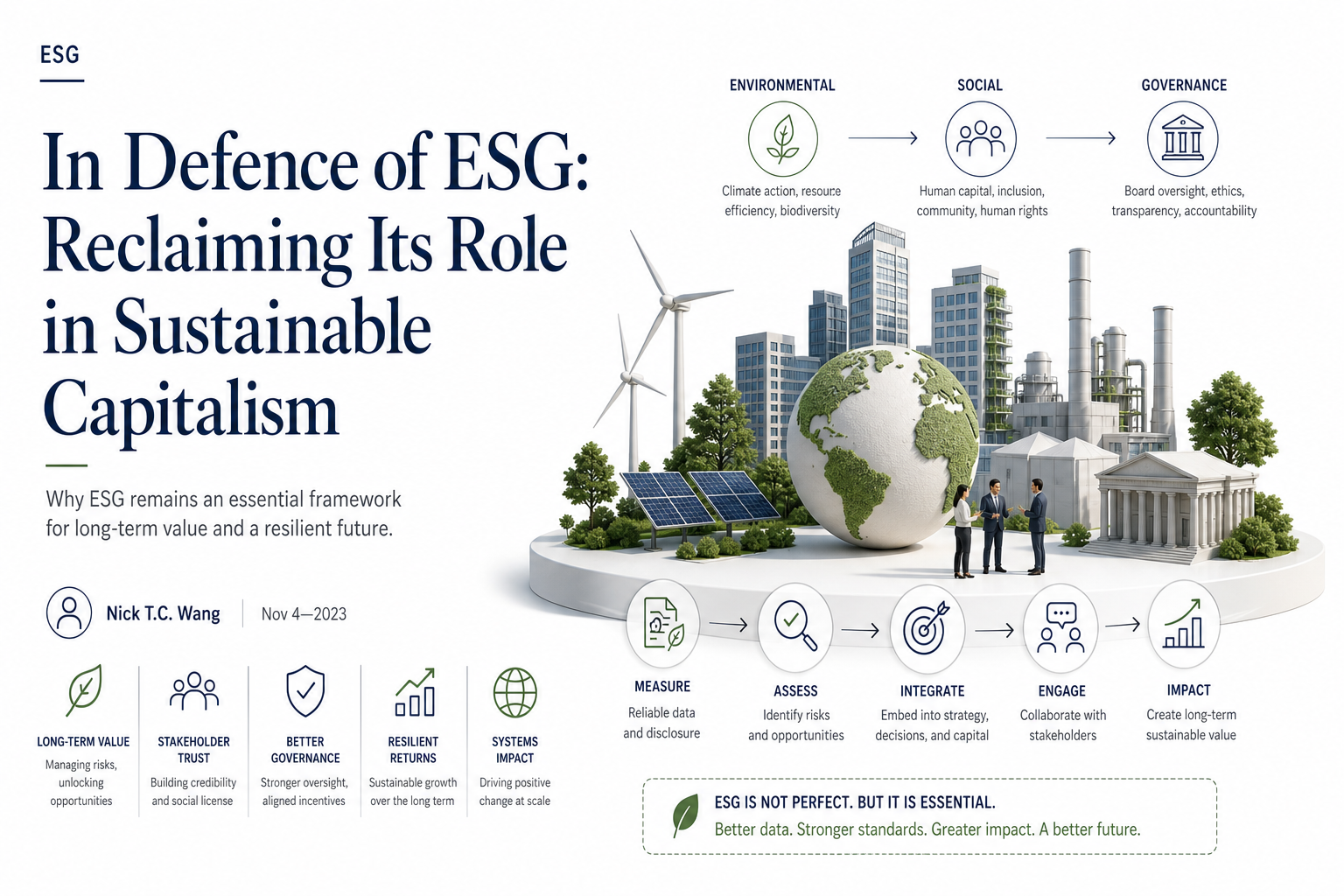
In recent years, Environmental, Social, and Governance (ESG) investing has faced a rising tide of criticism. High-profile voices—including Bloomberg’s Merryn Somerset Webb and the Financial Times’ Aswath Damodaran—have challenged the coherence, consistency, and impact of ESG as both an investment strategy and a corporate responsibility framework. As someone who has worked extensively in the ESG space, I welcome healthy scepticism. In fact, I have long been a critical voice within the ESG community. However, my aim has always been constructive: to refine and elevate the practice, not to dismantle it.
Critics argue that ESG has drifted too far from its original purpose, becoming a malleable label exploited by financial marketing and virtue-signalling. They point to definitional inconsistencies, limited impact on returns, and corporate greenwashing. But we must not confuse imperfection with irrelevance. ESG is not a panacea, nor was it ever meant to be. Rather, it is a toolset—a conceptual framework evolving alongside the complexity of global capitalism.
ESG as a Living System, Not a Static Doctrine
To understand ESG’s real value, we must recognise it as a dynamic ecosystem, not a monolithic standard. ESG has never been about moral purity. From its inception, it has been grounded in the belief that environmental and social performance can enhance long-term shareholder value. The landmark 2004 UN report Who Cares Wins laid this out clearly: companies that proactively manage ESG risks and opportunities are more likely to thrive in a future shaped by regulation, stakeholder expectations, and environmental constraints.
It is therefore incorrect to suggest, as Damodaran does, that ESG was initially conceived solely as an ethical initiative, and only later morphed into a returns-driven strategy. On the contrary, ESG has always aimed to fuse financial performance with responsible business practices.
ESG’s Impact Is Tangible—If Imperfect
Despite its shortcomings, ESG has had a transformative effect on corporate governance and investor expectations. Boards, executives, and asset managers are increasingly pressured to measure, disclose, and improve their performance across environmental and social dimensions. Entire industries have reoriented their innovation pipelines to align with decarbonisation goals, resource efficiency, and ethical labour practices. In emerging markets, ESG criteria have pushed companies to improve compliance with international norms and foster stakeholder engagement.
Are there bad actors? Undoubtedly. Some firms have gamed ESG ratings, exaggerated sustainability claims, or conflated short-term branding with long-term impact. Yet this does not invalidate the framework—it simply highlights the urgent need for better metrics, third-party verification, and standardised disclosure. Just as we continue to refine financial accounting standards, we must do the same for ESG.
From Compliance to Value Creation
The most promising evolution in ESG today is its shift from compliance to strategy. Leading companies are no longer satisfied with ticking boxes. They are integrating ESG into enterprise risk management, product development, and capital allocation. The frontier of ESG is now systems-level thinking: embedding sustainability into core operations, leveraging climate risk as a driver of resilience, and aligning incentives with long-term value.
For example, ESG has played a catalytic role in sectors ranging from clean energy to sustainable agriculture, accelerating investment flows into areas with both impact and returns. It has also informed stewardship practices, with investors using proxy votes and shareholder engagement to drive governance reforms.
Toward a More Credible Future
Rather than discarding ESG, we must commit to its maturation. That means tightening definitions, improving data quality, enhancing transparency, and holding companies accountable—not for perfection, but for measurable progress. Regulatory efforts like the EU Sustainable Finance Disclosure Regulation (SFDR) and the ISSB’s global reporting standards are steps in the right direction.
It also means rejecting the false dichotomy between “doing good” and “doing well.” ESG is not a binary choice. It is a strategic lens for managing complexity in an era where the health of the planet, the stability of societies, and the resilience of business are increasingly interdependent.
Final Reflection
The ESG movement is not without flaws, but it is undeniably impactful. Its greatest strength lies in its adaptability—the ability to evolve in response to new risks, stakeholder demands, and scientific insight. The answer to ESG’s critics is not abandonment, but ambition: to build a more credible, accountable, and integrated framework for sustainable capitalism.
If we are serious about solving the climate crisis, protecting human rights, and safeguarding long-term prosperity, ESG remains one of the most important instruments we have. But it is only as strong as our collective will to make it better.
Leave a Reply