
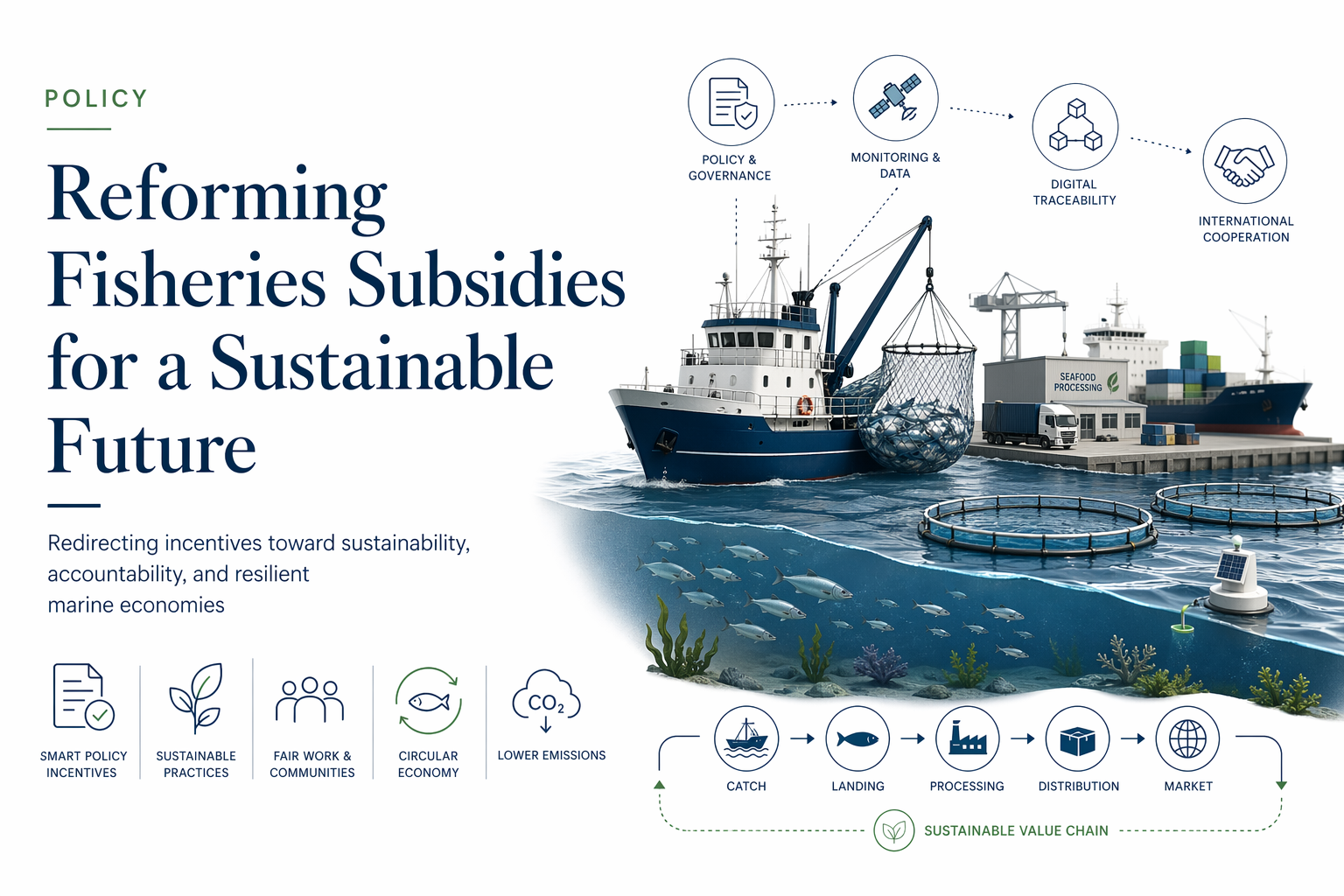
Fisheries play a pivotal role in global food security, providing vital protein and livelihoods to millions. As early as 2012, the sector directly employed around 56 million people worldwide. However, it continues to grapple with significant challenges such as overfishing, ecosystem degradation, and labour rights violations. To ensure the long-term sustainability of this critical industry, government subsidies must shift away from incentivising volume and fuel consumption and instead target responsible supply chain actors—those investing in sustainable practices, human rights protections, emissions reduction, and circular economic models.
Historically, fisheries subsidies have prioritised output maximisation, often resulting in overexploitation and marine ecosystem degradation. Fuel subsidies, in particular, exacerbate environmental damage and increase carbon emissions. A growing consensus now urges a realignment of government funding to reward sustainability across the value chain. Instead of incentivising higher catch volumes, subsidies should be channelled toward those committed to certified responsible practices, such as achieving Marine Stewardship Council (MSC) certification, which recognises well-managed, sustainable fisheries. This approach encourages compliance with catch limits and reduction of bycatch, supporting a more resilient marine economy.
Fostering International Cooperation and Local Engagement
Effective fisheries governance requires both transboundary collaboration and grassroots participation. Many commercial species are migratory, demanding coordinated management across nations, regional fishery management organisations (RFMOs), and international frameworks like the FAO Code of Conduct for Responsible Fisheries. Through joint quota setting, enforcement, and data sharing, countries can tackle illegal, unreported, and unregulated (IUU) fishing. Government subsidies should support these efforts while empowering local communities and fishing cooperatives to co-manage resources and monitor compliance—ensuring policy alignment with on-the-ground realities.
Advancing Social Responsibility and Human Rights
Labour exploitation—including forced labour and poor working conditions—remains widespread across global fisheries. Public subsidies should be used to safeguard the rights of all stakeholders along the value chain. Governments can offer financial incentives to encourage adherence to international labour standards, fair wages, and workplace safety. Simultaneously, subsidies must accelerate the sector’s environmental transition by supporting cleaner technologies and low-emission operations. This includes backing fuel-efficient vessels and promoting energy conservation, thereby reducing the industry’s carbon footprint.
Furthermore, subsidies should catalyse the shift toward a circular economy. This entails funding innovations that reduce wastewater discharge and upcycle fishery by-products into high-value goods such as fish oil, collagen, and animal feed—minimising waste and maximising value creation.
Strengthening Science-Based Management
Data scarcity and underutilisation of scientific recommendations are root causes of fishery mismanagement. Governments must invest in marine research, stock assessments, and digital monitoring systems such as satellite tracking and onboard surveillance. By enhancing real-time data flows, regulatory authorities can develop dynamic, science-based quotas and adaptive seasonal restrictions. Training and capacity-building programmes for fisheries professionals will further embed evidence-based decision-making across the sector.
Scaling Technology and Digital Traceability
Governments should also prioritise the development and deployment of advanced fishing gear and digital tools. This includes sonar-based fish detection, selective nets, electronic logbooks, and blockchain-enabled traceability systems. Such technologies improve operational efficiency, reduce bycatch, and enable end-to-end supply chain transparency. While promising, their upfront costs remain prohibitive—strategic subsidies can lower the adoption barrier and spur industry-wide modernisation.
Supporting Aquaculture and Marine Diversification
With wild stocks under pressure, aquaculture has emerged as a crucial solution for global protein supply. Yet if poorly managed, it can harm water quality and biodiversity. Targeted subsidies should promote sustainable models like recirculating aquaculture systems (RAS) and integrated multi-trophic aquaculture (IMTA). Policymakers can also encourage diversification into blue economy sectors such as marine ecotourism, seaweed cultivation, and blue carbon credit markets. These alternatives can stabilise incomes, mitigate overfishing risks, and foster local economic resilience.
Investing in Social Safety Nets and Training
For a just transition, governments must ensure that fisheries workers and communities are not left behind. Beyond improving labour conditions, subsidies should also fund social safety programmes—vocational training, health insurance, and occupational risk protection. These measures build adaptive capacity, reduce job displacement risks during policy shifts, and attract younger talent into the sector.
Conclusion
In the face of climate change and resource depletion, rethinking the structure and intent of fisheries subsidies is not only environmentally necessary but socially imperative. Governments must redirect funding toward responsible fishing practices, inclusive labour conditions, technological innovation, and circular economic models. Only by doing so can we safeguard the future of fisheries and ensure sustainable livelihoods for the communities that depend on them.
Leave a Reply