
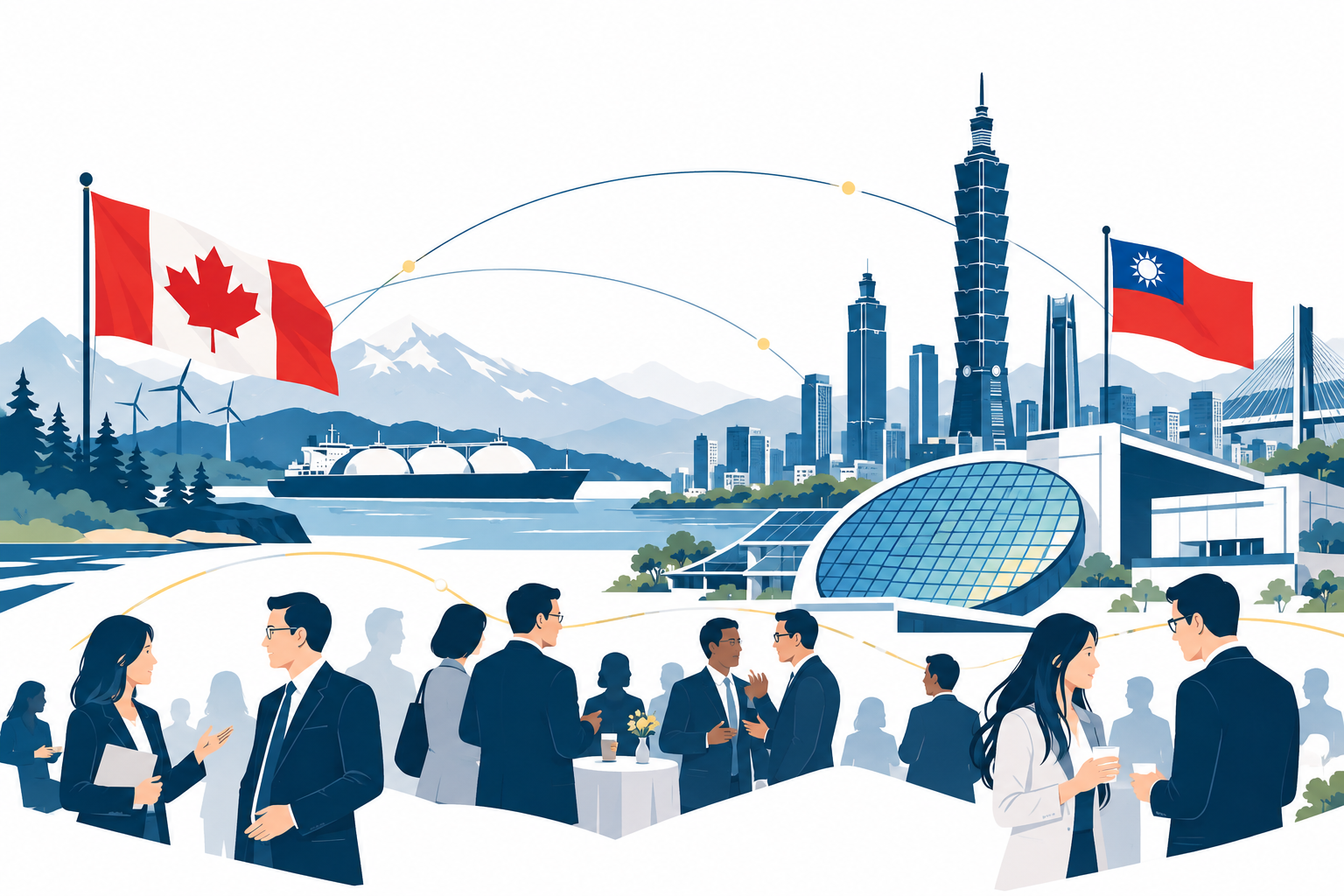
On October 14 2026, stakeholders from both Canada and Taiwan gathered in Taipei for Canada-in-Asia: Momentum Taipei, an event focused on the energy and materials foundations of Taiwan’s technology ecosystem. Part of the Asia Pacific Foundation of Canada’s (APFC) wider Momentum series, the programme explored opportunities to deepen bilateral cooperation in energy security, critical minerals and advanced manufacturing, ahead of the Canada-in-Asia Conference 2027 in Singapore.

Thanking the people behind the initiative
Momentum Taipei depended on many people and organisations. I want to first acknowledge those who helped turn the idea into a programme and contributed their time, expertise and support.
My sincere thanks go to Barrett Bingley, Nur Nadhirah Binte Rohani, and Mohammed Jahafar for recognising the value of bringing the Momentum Series to Taipei and helping make the case for the initiative. Their support was important in moving the idea from possibility towards a concrete programme.
I am equally grateful to Erin Chen, Justin Kao, and Solomon Chang for their contributions during the initial planning stage and for helping build the groundwork needed to move the initiative forward. Bringing together people with different professional backgrounds and networks strengthened the effort, and I valued their willingness to contribute their time and perspectives.
And Erin Chen deserves a little extra thank-you. From the very beginning, she brought thoughtful ideas, a lovely sense of perspective, and a kind of warmth that made the whole process feel a little brighter. Even in the middle of planning details and endless coordination, she had a way of making things feel easier and reminding me that the people you get to work alongside can be one of the best parts of taking on something ambitious. I’m especially glad this project gave me an excuse to spend time thinking things through with her. Some people leave their mark on a project through what they contribute; others also leave you smiling a little after the meeting has ended. Erin, somehow, managed both, and I’m very grateful for that.
Thank you as well to the board members of the Canadian Chamber of Commerce in Taiwan for helping bring the vision to life, and to the Canadian Trade Office in Taipei, APFC, and GTMA Canada for their collaboration and support. Each organisation brought its own relationships, expertise and mandate to the effort. The initiative benefited from those complementary contributions, and from the people who worked across institutional boundaries to make the programme possible.
The work begins long before the event
Regarding the event, the discussions were timed remarkably well. Taiwan’s semiconductor and advanced manufacturing industries are central to the global economy, yet their continued growth relies upon reliable and stable electricity, diversified energy supplies, and the materials necessary to manufacture increasingly sophisticated products. Canada, meanwhile, possesses substantial energy resources, critical mineral potential, and expertise in engineering, infrastructure, and emerging clean technologies. The question was not merely whether these two economies had complementary strengths, but how those strengths could be translated into commercially viable and strategically meaningful partnerships.
The significance of Momentum Taipei reached well beyond the program itself. For me, the journey began months prior at the Canada-in-Asia Conference in Singapore in February 2026. Attending this event provided me with a unique perspective on the relationship between Canada and Taiwan. I wished to contribute to an initiative that viewed Taiwan not merely through the immediate requirements of Canadian businesses or local residents, but within the broader context of Canada’s international engagement and its role in the Indo-Pacific. I left with a desire to help foster greater room for Canada-Taiwan relations within that larger dialogue.
I have since learned that the most visible aspect of international collaboration is often merely the final stage of a much longer process. Before a panel can take place, stakeholders must recognize a shared opportunity. Before institutions can collaborate, relationships must be established. Furthermore, before a promising idea becomes a tangible initiative, someone must facilitate the connection between the right people and ensure the dialogue continues. This preparatory work rarely appears in event photographs or post-event summaries, yet it is often where the foundations of meaningful cooperation are laid. I wished to reflect on that aspect of the experience, considering not only our discussions in October but also the relationships, coordination, and collective effort that helped bring the dialogue to Taipei.
From Singapore to Taipei
The February conference did not provide me with a predefined plan. Instead, it prompted me to consider the potential for a more sustained Canada-Taiwan dialogue and its role within Canada’s broader engagement across Asia. My perspective became more defined following the Canada-Taiwan Track 1.5 Dialogue on economic security in March, as well as a subsequent private meeting. These discussions addressed the relationship from a comprehensive strategic viewpoint, covering economic security, supply-chain resilience, critical minerals, clean technology, and industrial cooperation. They helped me recognize both the merit of this wider dialogue and the importance of focusing on an area with significant implications for Taiwan’s economic future: energy.


The Track 1.5 dialogue proved particularly influential by bridging strategic inquiries with the practical challenges of implementation. While Canada and Taiwan possess complementary strengths, complementarity alone is insufficient to foster cooperation; it necessitates the identification of concrete connections, an understanding of institutional constraints, and the engagement of appropriate public- and private-sector stakeholders. For Taiwan, energy security is inextricably linked to the resilience of its technology and manufacturing sectors, whereas for Canada, energy resources and clean-technology expertise represent vital components of its economic engagement with Asia. Consequently, I began to view a focused energy dialogue as an effective method to explore one of the broader relationship’s most significant themes in greater depth.
On 16 April, I met with the Canadian Trade Office in Taipei to discuss the potential for deeper Canada-Taiwan energy and bilateral engagement. The conversation helped clarify that different institutions have different mandates and measures of success. A trade office is naturally focused on concrete trade outcomes and support for Canadian companies, while a wider policy dialogue can require a different mix of partners. That was not a reason to abandon the idea. It was a reminder that the initiative needed a structure that matched its broader purpose and respected the roles of the organisations involved.
A further planning discussion on 12 May helped turn the concept into a more defined proposal: a Canada-Taiwan Energy Dialogue in Taipei in October, connected to the wider Canada-in-Asia agenda. APFC’s Momentum platform offered a way to connect a Taiwan-focused discussion with a broader regional conversation. The Canadian Trade Office could potentially contribute through participation and stakeholder connections, while APFC, GTMA Canada, the Chamber and other partners could help bring the initiative together. Looking back, the progression from Singapore, through the March strategic discussions and the early Taipei meetings, to the August dinner and October programme, is what gives the initiative its meaning for me. The energy focus was not arbitrary. It emerged from a broader conversation about economic security and bilateral co-operation, then became a deliberate effort to examine one critical dimension in greater depth.
An idea takes shape through relationships
My involvement grew out of my work with the Canadian Chamber of Commerce in Taiwan, alongside my professional engagement with energy transition and industrial development. These different perspectives have made me increasingly interested in the intersection between energy security, industrial competitiveness and international economic cooperation.
Canada and Taiwan have a compelling basis for collaboration, but identifying an opportunity and acting on it are two different things. Energy companies, technology manufacturers, government agencies, research institutions and business associations approach the same issue from different perspectives. They operate with different mandates, incentives and time horizons. Bringing them into a productive conversation requires more than a shared interest in the subject matter; it requires an understanding of what each party can contribute and where their priorities intersect.
I wanted to help advance that conversation. Momentum Taipei provided a platform through which these shared interests could be explored more systematically. APFC’s Canada-in-Asia: Momentum series connects stakeholders across the Indo-Pacific with the wider Canada-in-Asia agenda. Taipei’s programme focused on a particularly important intersection: the relationship between energy and materials security and the future of advanced technology manufacturing.
My contribution was to help champion the Taipei initiative, work across institutional relationships, and mobilise people who could support its development. This was not a case of building an entirely new network from scratch. The relevant organisations and individuals already had relationships, expertise and institutional mandates. The opportunity lay in connecting those existing networks around a concrete objective. In practice, that meant conversations, coordination and persistence. It meant recognising that an initiative of this nature could not be delivered by one person or one organisation alone. It required a broader group of people who understood the opportunity and were willing to contribute their time and capabilities.
A task force and the value of shared ownership
An initiative of this nature also requires people willing to take responsibility for the work behind the scenes. Alongside the institutional coordination, I assembled a task force to help support the initiative, bringing together colleagues with complementary professional backgrounds. The team included Justin Kao, Vice President of GTMA Canada and Managing Director of Bio-Helix LLC; Erin Chen of Pacific Forum; and Solomon Chang, Chief Executive Officer of ASJ Capital.
What mattered was not simply the number of people involved, but the principle behind the arrangement. A cross-border initiative involving multiple institutions and sectors benefits from a team capable of approaching the work from different angles. The energy transition is not an isolated technical challenge. It intersects with investment, industrial strategy, infrastructure, supply chains and the commercial realities of doing business across jurisdictions.
Justin’s involvement also reflected the interconnected nature of the institutional landscape. GTMA Canada was a co-organiser of Momentum Taipei, and his role within the organisation connected the initiative with another part of the Canada-Taiwan business network. That relationship illustrates how professional networks and institutional affiliations can overlap in ways that help an initiative move forward.
At the same time, I do not see collaborative work as a matter of claiming ownership over every contribution. The purpose of assembling a team is to distribute responsibility, draw on complementary capabilities and create the conditions for others to contribute meaningfully. Leadership, in this context, is less about being the sole person responsible for every task than about helping establish a direction, maintaining momentum and enabling a group of people to work towards a shared objective.
I am grateful to the colleagues and partners who contributed to the preparation and delivery of this initiative. Their involvement was an important part of turning an ambition into a programme that could bring people together around substantive questions.
Private Dinner: 2026/08/20
One important milestone was a welcome dinner held on 20 August 2026 at the Shangri-La Far Eastern, Taipei, for the APFC delegation. Convened under the banner of the Canada-Taiwan Energy Dialogue, the dinner brought together representatives from government, business, industry and policy institutions.

The guest list brought together policymakers, energy and industrial companies, researchers, business leaders and organisations involved in international engagement. The value of the dinner was not that it could resolve complex commercial questions, but that it gave participants space to understand one another’s priorities and identify topics for further discussion. It was one part of the groundwork for October.
A dinner is not a substitute for formal negotiations or a mechanism for resolving complex commercial questions. Its value lies elsewhere. In a more informal setting, participants can establish context, understand one another’s priorities and identify areas worth exploring further. These conversations can make subsequent engagement more informed and productive.
The evening also illustrated something important about bilateral relationships: institutions are sustained by people. Organisations provide mandates, resources and continuity, but individuals build trust, recognise opportunities and create the connections through which cooperation becomes possible. The August dinner was part of the groundwork leading into the October engagement, and one expression of the broader effort to bring Canada’s and Taiwan’s energy and industrial communities into closer conversation.


Understanding the institutional ecosystem
The institutional roles became clearer as the initiative developed. APFC provided the overarching Canada-in-Asia: Momentum platform; the Canadian Trade Office in Taipei brought its official trade and economic engagement perspective; the Canadian Chamber of Commerce in Taiwan connected the effort with its business network; and GTMA Canada contributed another link to the Canada-Taiwan business community. These organisations do not have identical mandates, nor should they. Their differences are precisely what can make collaboration useful.

A policy research institution, a trade office and a business association each see different parts of the same economic relationship. One may help frame the strategic question, another may facilitate official engagement, and another may connect the discussion with the commercial interests of businesses operating across the two markets. These organisations have different mandates, and that is a strength when their contributions are coordinated. No single organisation can represent the entirety of a bilateral relationship, and no one event can resolve every barrier to co-operation.
Momentum Taipei worked through an existing ecosystem of relationships, activating them around a shared opportunity rather than attempting to replace what was already there. For me, Momentum Taipei was a practical illustration of this principle. The initiative was made possible within an existing ecosystem of relationships, but those relationships still needed to be activated around a concrete opportunity. The task was not to replace what already existed; it was to help bring different capabilities together.
That distinction matters because international collaboration is often discussed in broad terms, as though shared strategic interests automatically lead to joint action. In reality, the connections between institutions need to be cultivated. Common interests are a starting point, not a guarantee of cooperation.
From energy security to industrial competitiveness
The substance of the October programme was equally important. Energy and materials security are increasingly inseparable from the future of advanced manufacturing, particularly in economies whose competitiveness depends on sophisticated, energy-intensive industrial ecosystems. Taiwan’s semiconductor industry provides a clear example. Semiconductor manufacturing requires reliable electricity, extensive supporting infrastructure and complex global supply chains. As demand for advanced chips and AI-related hardware grows, questions about energy availability, cost and resilience become increasingly relevant to industrial competitiveness.


This creates a natural point of engagement with Canada, but the opportunity should not be reduced to a simple exchange of Canadian resources for Taiwanese technology. The more interesting question is how the two economies might participate in each other’s industrial development. Could Canadian energy suppliers and Taiwanese industrial users develop more durable commercial relationships? Could Canadian expertise in power systems, engineering and emerging energy technologies complement Taiwan’s capabilities in manufacturing and technology deployment? Could cooperation in critical minerals and energy storage create new links between resource development, processing, industrial applications and investment?
The deeper opportunity is to build industrial partnerships, not simply increase the volume of trade.
Momentum Taipei: 2026/10/14
Panel #1: Reliable energy is part of the technology value proposition

The first panel, Firm Power for the Fab, Exploring Canada-Taiwan Partnerships in LNG and Hydrogen, examined the relationship between Taiwan’s growing industrial electricity demand and opportunities for cooperation across LNG and hydrogen. Canada’s emerging LNG export capacity creates opportunities to discuss supply diversification and longer-term commercial partnerships. Yet energy cooperation depends on much more than the availability of a resource. Infrastructure, pricing, contractual structures, investment requirements, delivery timelines and the needs of prospective buyers all matter.
Hydrogen presents a different set of considerations. Its potential role in future energy systems depends on production pathways, costs, infrastructure and the applications for which it may be technically and economically appropriate. It is important to distinguish between areas where cooperation could develop in the near term and opportunities that remain contingent on technological and commercial progress. Discussing these issues together helped move the conversation beyond broad statements of intent. The practical questions are whether there are viable buyers and suppliers, which projects warrant further examination, and what financing, infrastructure, regulatory or technical conditions would make collaboration possible.
Panel #2: Materials security extends beyond extraction

The second panel, which I had the opportunity to moderate, was titled Canadian Energy and Materials Complementarity for Taiwan’s Technology Success. The discussion brought together Pierre Poulain, Chief Executive Officer of Powertech Labs; Chia-Wei Jui, Director of the Research Center for Science and Engineering at the CTCI Foundation; Ming-Shan Jeng, Deputy General Director of the Industrial Technology Research Institute; and Gareth Jones, Director and Advisory Services Leader at Arup.
Our discussion examined how Canadian capabilities could complement Taiwan’s strengths in semiconductors, AI hardware and advanced manufacturing, including through clean energy, energy storage, grid modernisation, critical minerals and enabling technologies. One important consideration is that critical mineral security cannot be understood solely through the availability of resources in the ground. Mining is only one part of a much longer value chain. Processing, refining, component manufacturing, technology development, infrastructure and commercial offtake arrangements all influence whether a resource can support a reliable industrial supply chain.
Canada’s resource base and Taiwan’s manufacturing capabilities therefore represent potentially complementary assets, but complementarity does not automatically translate into a successful partnership. The two sides still need to identify commercially viable projects, align investment incentives, manage technical and regulatory requirements, and establish relationships that can withstand changes in market conditions. Energy storage and grid modernisation raise similar questions. The availability of new energy resources is only one part of the challenge; the electricity system must also be capable of integrating those resources while delivering reliable power to industrial users. Engineering, system integration, testing and deployment capabilities can be as important as the underlying technology.
This is where I believe the discussion becomes particularly relevant. The opportunity is not simply to connect Canadian resources with Taiwanese demand. It is to explore how the capabilities of both economies can contribute to a more resilient industrial ecosystem. For Canada, that could mean moving beyond the traditional role of a resource supplier towards deeper participation in technology-enabled industrial development. For Taiwan, it could mean diversifying energy and materials relationships while drawing on complementary expertise to support the next phase of its manufacturing economy.
Moving beyond trade towards partnerships
A recurring theme throughout the initiative was the distinction between having a trade relationship and building an industrial partnership. Trade is essential. Imports and exports connect producers with consumers, create commercial opportunities and support economic activity. But a deeper partnership involves a different level of coordination. It may require joint investment, long-term supply arrangements, technical collaboration, shared infrastructure, research cooperation or the development of capabilities that benefit both sides.
For Canada and Taiwan, this distinction matters because the two economies bring different but potentially complementary strengths to the table. Canada’s resources and energy capabilities can support Taiwan’s industrial needs, while Taiwan’s advanced manufacturing expertise can create opportunities for Canadian companies seeking to participate further downstream in technology and industrial supply chains.


The most promising opportunities may therefore sit at the intersections between sectors rather than within them. Energy suppliers need industrial customers. Technology manufacturers need reliable power and secure materials. Investors need credible projects and predictable commercial frameworks. Policymakers need to understand the practical barriers that prevent otherwise complementary economies from working together. A dialogue that brings these perspectives into the same room can help identify where the connections might be made.
The next challenge is converting that understanding into action. Which projects warrant further examination? Which businesses have a genuine commercial interest in working together? What financing, infrastructure or regulatory conditions would need to be in place? Where can existing institutions facilitate introductions, information-sharing and follow-up? These are less glamorous questions than the announcement of a new partnership, but they are essential to making one possible.
What I took away from the experience
The experience reinforced three lessons for me.
- Shared interests still require deliberate coordination. Organisations can agree on the value of closer economic relations and still need to align expectations, responsibilities and next steps.
- Relationships are a form of connective infrastructure. They cannot replace electricity grids, ports, pipelines or sound commercial arrangements, but they help people identify where those investments and arrangements might be developed.
- A useful dialogue moves beyond the easy statement that two economies should work together. It asks where cooperation is technically feasible, commercially viable and capable of creating value for both sides.
Leadership can also begin without a formal mandate: by recognising an opportunity, making the case for it, bringing people together and continuing to push when the outcome is uncertain. My role was to help champion the effort, while recognising that the programme depended on APFC, the Canadian Trade Office, the Chamber, GTMA Canada and many individual contributors. I am particularly conscious that this work is collaborative by nature. The initiative depended on APFC’s platform, the engagement of the Canadian Trade Office in Taipei, the participation of the Canadian Chamber of Commerce in Taiwan and GTMA Canada, and the contributions of colleagues and other stakeholders. My own role was to help champion the effort, mobilise relationships and support the work required to bring the dialogue to Taipei. For me, that is the balance: being
The conversation continues
Momentum Taipei was one step in APFC’s wider Canada-in-Asia: Momentum series, leading towards the Canada-in-Asia Conference 2027 in Singapore. The questions raised in Taipei now need to be carried into follow-up conversations: which connections can become substantive business discussions, which opportunities are commercially viable, and what practical steps can move them forward?
The important question now is what happens after the conversations. Which connections will develop into substantive business discussions? Which areas of complementarity will prove commercially viable? Which organisations will continue working together, and what practical steps can they take to turn shared interests into lasting cooperation? A successful dialogue is not proof that partnerships have been secured. Its value is that it creates conditions for those outcomes to become possible.
The experience reminded me that international co-operation is built incrementally, through institutions willing to engage, businesses prepared to explore opportunities and individuals willing to do the often-unseen work of connecting them. Canada and Taiwan already have important economic connections. The opportunity is to build on them with greater intention, moving from parallel strengths towards partnerships that create tangible value for both economies.
The event has concluded, but the work of building those connections continues. This reflection is the first of two pieces arising from the dialogue. A separate briefing, focused on the substantive issues raised and their implications for government and policy stakeholders, will follow.
Leave a Reply