
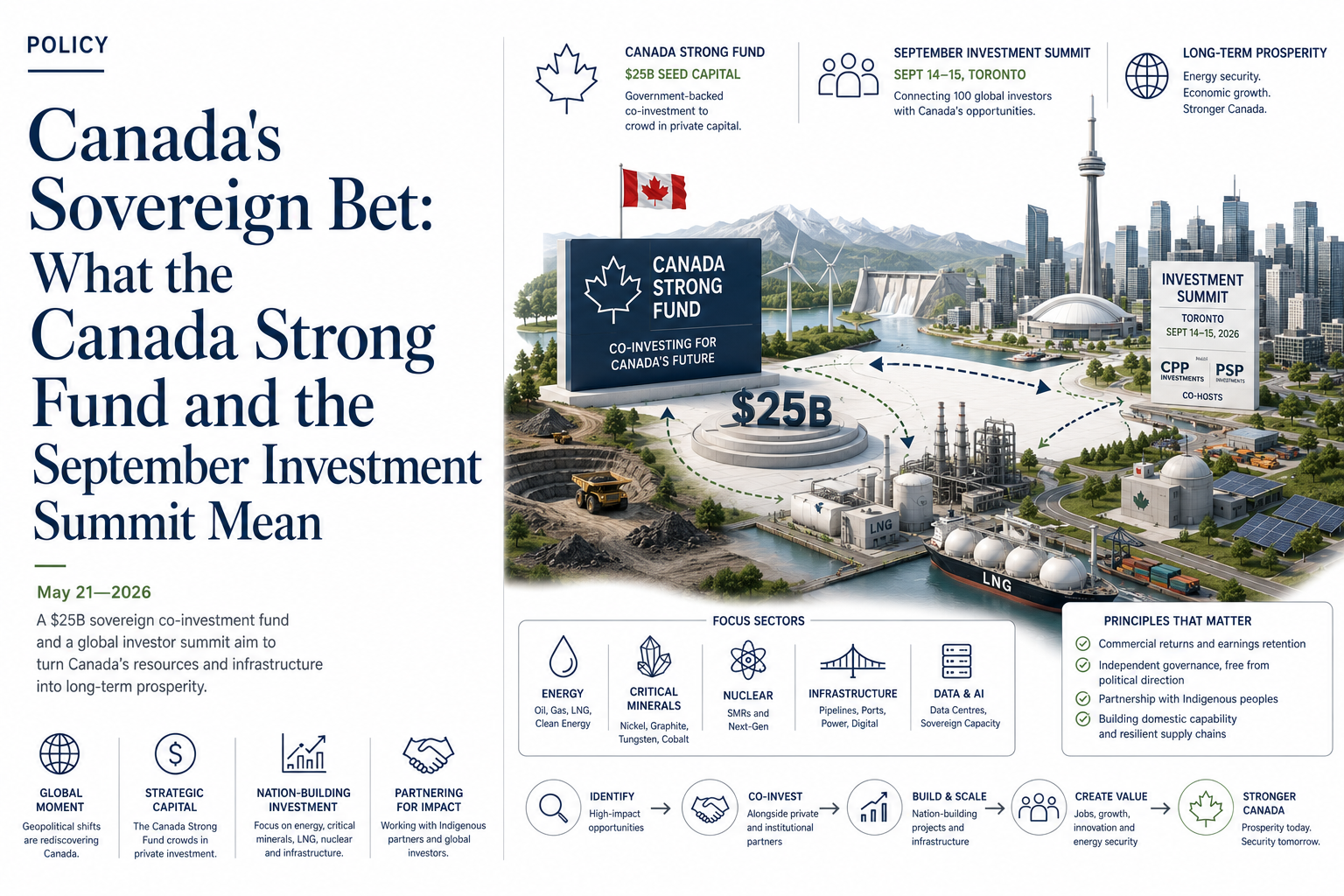
There is a version of the Canada Strong Fund that becomes one of the most consequential energy security instruments Canada has ever built. There is also a version that becomes the seventh overlapping federal investment vehicle in a decade, quietly hollowed out by political direction, underpowered by a $25 billion seed that cannot move the needle on a trillion-dollar infrastructure gap, and remembered mainly as a rebranding exercise for a development bank Ottawa already needed to build better. Which version materialises depends almost entirely on decisions that have not yet been made. That ambiguity is both the fund’s greatest risk and, counterintuitively, its most honest feature.
Carney unveiled the Canada Strong Fund (CSF) on April 27, 2026, framing it as a 21st-century echo of the Canadian Pacific Railway: nation-building infrastructure catalysed by public intent and private capital in equal measure. The September 14-15 Canada Investment Summit in Toronto, co-hosted with CPP Investments and PSP Investments, is the demand-generation complement: a room of 100 global investors, including BlackRock and Singapore’s GIC, who will be pitched on the same projects the CSF hopes to co-finance. Together, these two instruments represent the most serious attempt Canada has made in a generation to deploy state capital in a directional, strategic way. Whether the direction is right, and whether the capital is adequate, are separate questions that deserve separate answers.
What Carney Is Getting Right
The diagnosis is correct. Between 2015 and 2024, more than $1 trillion in foreign capital exited the Canadian economy in what RBC has called the largest capital exodus in modern Canadian history. Canada consistently ranked near the top of global FDI confidence surveys while simultaneously watching actual investment flows deteriorate. The gap between perception and reality pointed to something structural: regulatory uncertainty, prolonged approvals, and a market-sending signal that Canada would not build. The CSF and the Investment Summit are Carney’s attempt to correct that signal, and the diagnosis underlying them is sound.
The sector focus is strategically defensible. The fund’s named priority sectors — clean and conventional energy, critical minerals (nickel, graphite, tungsten), LNG, nuclear, infrastructure — are precisely the areas where Canada’s comparative advantage is clearest and where the global demand signal is strongest. The Iran-US-Israel conflict has disrupted Strait of Hormuz tanker traffic since February 2026, creating acute global energy supply anxiety that Finance Minister Champagne has correctly identified as a structural opening: “Investors are rediscovering Canada as an energy superpower.” Canada holds the world’s third-largest proven oil reserves, is among the top global producers of nickel, cobalt, potash and uranium, and sits on mineral deposits critical to battery supply chains that both the EU and Japan are actively seeking to de-risk from Chinese supply. If the CSF and the Investment Summit can translate that resource endowment into bankable equity structures, the timing is genuinely favourable.
The co-investment model is the right architecture for this mandate. By taking minority equity stakes alongside private capital rather than acting as a lender or grant-maker, the CSF is designed to crowd in, not crowd out. This is exactly how Quebec’s La Caisse de dépôt has operated in major Quebec infrastructure projects for sixty years, and it is how Singapore’s Temasek catalysed domestic industrial investment before expanding globally. A state-backed minority co-investor lowers perceived risk for private capital, provides a credible signal of government commitment, and generates a financial return that compounds the fund’s capacity over time. The Canada Growth Fund and the Canada Infrastructure Bank have both struggled with mandate ambiguity and concessional-finance optics; the CSF’s commercial return mandate, if maintained under legislative pressure, avoids at least one of those failure modes.
The September Investment Summit’s guest list is strategically astute. Inviting Singapore’s GIC specifically, the world’s largest sovereign wealth fund by some estimates, to Toronto sends a precise message: Canada is not merely competing for portfolio capital, it is asking the world’s long-horizon institutional investors to treat Canadian energy, minerals and infrastructure as a strategic asset class. CPP and PSP as co-hosts lend domestic institutional credibility. The framing around Canada as an “energy superpower” with “sovereign AI and data centre” capabilities covers both the traditional resource extraction thesis and the emerging digital infrastructure demand story. For a two-day event, the agenda is well-constructed.
What Carney Is Getting Wrong
The funding structure undermines the instrument’s credibility. The CSF’s $25 billion seed will be financed by federal borrowing, not resource surpluses. This is the single most important structural difference from every classical sovereign wealth fund, and critics who call it a “sovereign debt fund” are making a legitimate point, not a partisan one. The C.D. Howe Institute’s Alex Laurin is right: if the fund borrows at Government of Canada bond rates and deploys into domestic infrastructure equity, the return hurdle just to break even is meaningful. At current 10-year GoC yields of roughly 3.2-3.5%, and with a fund invested in illiquid infrastructure equity generating perhaps 7-9% unlevered returns over a 15-year horizon, the spread exists — but it is narrow, sensitive to project selection quality, and entirely eliminated if political direction degrades deal quality. Norway’s GPFG was funded from petroleum surpluses generated before the money was spent; Canada is proposing to spend the money before generating the returns. That sequencing matters.
$25 billion is the right concept at the wrong scale. The 15 nation-building projects already referred to the Major Projects Office represent over $126 billion in announced investment. LNG Canada Phase 2 alone is a $14 billion project. A single SMR cluster at Darlington could absorb $20 billion. The CSF seed is roughly equivalent to Alberta’s Heritage Fund — a fund widely cited as a cautionary tale for its failure to grow. By contrast, Norway’s GPFG is worth approximately US$2 trillion. Even the Irish Strategic Investment Fund, Canada’s closest functional twin, manages roughly €14 billion for a country with one-eighth of Canada’s population. The $25 billion will not be a co-investor in everything; it will be forced to pick two or three transformative projects and stand pat. That concentration risk is real, and the government has not yet been transparent about how it will be managed.
The absence of statutory independence protections is dangerous. As of May 19, 2026, no enabling legislation for the CSF Crown corporation has been tabled. The fund will report through the Minister of Finance and National Revenue. Without a statutory prohibition on ministerial direction of individual investment decisions — equivalent to the operational independence of the Norges Bank Investment Management mandate — the CSF is one election cycle away from becoming what Saskatchewan Premier Scott Moe already called it: “loan money” directed at politically convenient projects. Alberta’s Heritage Fund lost its growth trajectory not because its original design was wrong, but because successive governments treated the earnings as an operating budget supplement. That precedent is Canada’s most important domestic lesson, and the Carney government has not yet demonstrated it has internalised it.
The Indigenous consultation deficit is both an ethical and a practical problem. AFN National Chief Cindy Woodhouse Nepinak and UBCIC Grand Chief Stewart Phillip have both warned that the CSF, as currently designed, risks deploying capital into resource projects without free, prior and informed consent. This is not merely a values objection. From an energy security and critical minerals standpoint, it is a project-execution risk of the first order. Northern Ontario’s Ring of Fire, British Columbia’s critical minerals corridor, and Saskatchewan’s uranium and potash expansions all involve Indigenous title. A fund that accelerates investment without resolving consent creates litigation exposure, project delays, and reputational damage that undermines the very investment case it is trying to make to global investors. The September Investment Summit will struggle to credibly pitch the Ring of Fire to Singapore’s GIC while Indigenous consultation processes remain unresolved.
What Still Needs to Happen
Three changes would materially improve the CSF’s probability of success as a genuine energy security and critical minerals instrument.
- First, the enabling legislation must include a statutory earnings-retention rule and a prohibition on ministerial investment direction. These two provisions, modelled on the Norwegian NBIM framework and the Australian Future Fund Act, are not optional governance improvements: they are the load-bearing walls of institutional credibility. Without them, the CSF will not compound; it will be spent.
- Second, the government should establish a formal co-investment protocol with the major Canadian pension funds — CPP Investments, PSP, OMERS, and the Ontario Teachers’ Pension Plan — before the September Investment Summit. The Maple Eight collectively manage approximately CA$2.4 trillion in assets as of early 2025. Even a 1% allocation to CSF-catalysed projects would dwarf the $25 billion seed. The Summit is the right moment to announce that framework, not merely to invite the world’s investors to look at Canada.
- Third, the critical minerals mandate needs a specific supply-chain logic, not just a sector list. Nickel, graphite, tungsten and cobalt appear in the fund’s announced priority list. But the strategic question is not which minerals Canada has; it is which processing and refining steps Canada should capture domestically versus export as concentrate. Japan, South Korea and the EU are all seeking to diversify battery-grade processing away from China’s dominance; Canada’s opportunity is in the midstream steps, battery-grade nickel sulphate, refined graphite anode material, not merely mining royalties. A CSF that funds mine development without a domestic processing thesis is repeating the pattern of the last resource boom.
The September Investment Summit has the potential to be Canada’s most consequential economic gathering in a decade. The geopolitical conditions — US tariffs, Middle East energy disruption, Western supply-chain anxiety about China — have handed Canada a strategic opening that arrives perhaps once in a generation. Carney, as a former central banker with a genuine understanding of capital allocation at scale, is the most credible architect Canada has had for this kind of institutional ambition. The diagnosis is right. The architecture has promise. What remains missing is the governance spine that would turn a political announcement into a durable national institution.
Canada has what the world wants. Whether it can also build what Canada needs is the question the next six months will begin to answer.
Leave a Reply