
Earlier this week, I sat down in Taipei with Jonathan Berkshire Miller, one of Canada’s most prominent voices on Indo-Pacific security and geo-economics. Jonathan is a Senior Fellow at the Macdonald-Laurier Institute, co-founder of Pendulum Geopolitical Advisory, and a Senior Fellow at the Japan Institute of International Affairs. He was visiting Taiwan to explore pathways for Canada-Taiwan co-operation, a mission that included meetings and conversations with stakeholders across the security and industry landscape.

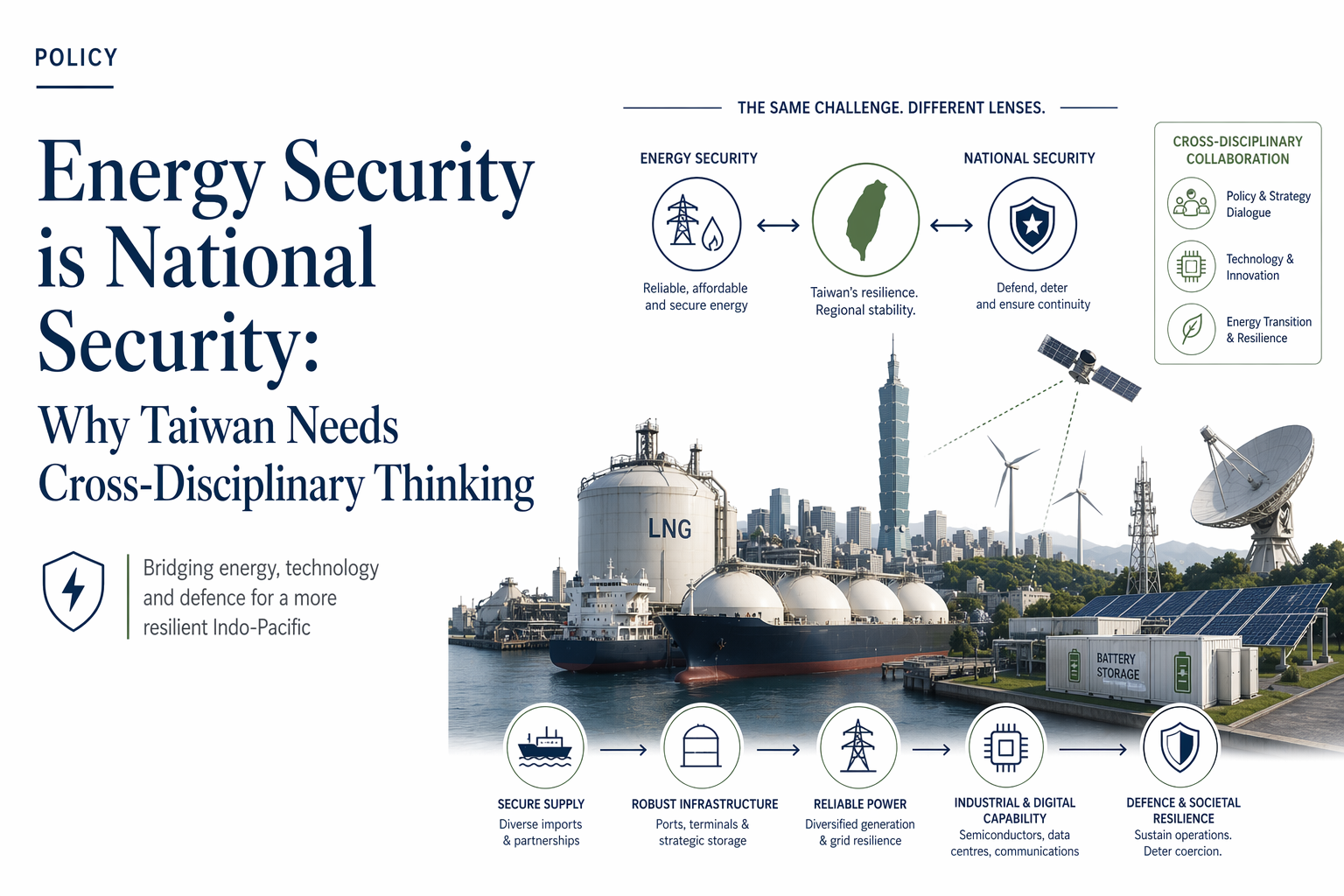
On the surface, our professional worlds look quite different. Jonathan’s career has been built at the intersection of defence policy, intelligence, and strategic diplomacy across the the Indo-Pacific. Mine sits in energy transition analysis at BloombergNEF, covering hydrogen, transport, and the broader decarbonisation landscape in Taiwan. But the conversation that unfolded over coffee made one thing unmistakably clear: the line between energy security and national security is not a line at all. It is the same question, examined from different angles, and the failure to integrate these perspectives is one of the most consequential blind spots in contemporary strategic thinking.
Taiwan’s energy vulnerability is a national security problem
Taiwan imports approximately 97% of its energy. Its domestic production is negligible, and a 2016 decision to phase out nuclear power and complete decommission in 2025 has made the island even more dependent on imported LNG, coal, and oil. The overwhelming majority of these imports transit through maritime chokepoints, including the South China Sea and the Taiwan Strait, that are subject to escalating contestation. Taiwan’s LNG receiving terminals and oil-importing ports, concentrated at Keelung and Kaohsiung, represent a small number of high-value targets. In 2022, China conducted military exercises that explicitly simulated targeting these facilities.
This is not an abstract risk. It is a structural vulnerability with direct implications for every dimension of Taiwan’s security posture. The semiconductor fabrication plants that anchor global technology supply chains consume vast quantities of energy and water. The data centres and communication infrastructure that would be essential in any contingency scenario depend on uninterrupted power supply. The industrial base that any defence partnership, whether with the United States, Japan, or Canada, would seek to leverage is only as resilient as the energy system that powers it.
For an energy analyst, this is not a peripheral concern. It is the central analytical question. And yet, in most policy discussions about Taiwan’s security, energy is treated as a background assumption rather than a front-line variable.
Defence innovation requires energy resilience
Jonathan’s recent essay in the Asia Pacific Foundation of Canada’s Indo-Pacific Outlook 2026, co-authored with Nanae Baldauff, maps out a compelling vision for Canada-Japan defence technology and innovation co-operation. The essay traces multiple institutional pathways, through the EU, NATO, the Japan-U.S. alliance, and bilateral mechanisms, for integrating commercial technologies into military applications. It highlights Canadian strengths in AI and machine learning, space-based surveillance, quantum technologies, Arctic-tested autonomous systems, and critical mineral supply chains as natural complements to Japan’s industrial scale and rapid prototyping culture.

What struck me in our conversation, however, was the degree to which this entire architecture depends on assumptions about energy systems that are rarely examined explicitly. Defence innovation is not an abstraction. It is built on physical infrastructure: fabs that produce the chips, data centres that train the models, manufacturing facilities that assemble the platforms. All of these require reliable, affordable, and secure energy supply. In Taiwan’s case, that supply is precarious in ways that most defence strategists do not fully appreciate, and that most energy analysts do not frame in security terms.
This is the gap that our conversation exposed, and that I believe represents one of the most important areas for cross-disciplinary collaboration in the Indo-Pacific.
Building the infrastructure for cross-disciplinary dialogue
One of the most encouraging aspects of the conversation was the recognition, from both sides, that the institutional infrastructure for this kind of cross-disciplinary thinking is underdeveloped but buildable. Jonathan described the roundtable he is organising; I described the bilateral energy dialogue platform I am building through the Canadian Chamber of Commerce in Taiwan to connect Canadian capabilities in energy transition with Taiwan’s strategic energy needs.
These are different initiatives with different institutional anchors, but they share a common thesis: that Canada-Taiwan co-operation needs to move beyond transactional trade relationships toward strategic partnerships that integrate economic, energy, and security dimensions. The fact that a defence strategist visiting Taipei and an energy analyst based here arrived at the same conclusion independently suggests that the demand signal for this kind of integrated thinking is real.
The challenge is institutional. Government trade offices measure success in trade volumes and foreign direct investment. Defence establishments think in terms of capabilities and interoperability. Energy agencies focus on supply, demand, and price. Each of these perspectives is necessary, but none is sufficient. The most consequential questions in the Indo-Pacific today sit at the intersection of all three, and our institutional architecture has not caught up.
Resilience as the organising principle
If there is a single word that captures the shared agenda between energy security and national security, it is resilience. In energy terms, resilience means diversified supply, distributed generation, strategic storage, and the capacity to maintain critical functions under disruption. In security terms, resilience means the ability to absorb, adapt to, and recover from adversarial action. In both cases, the underlying logic is the same: you cannot deter what you cannot survive, and you cannot survive what you have not prepared for.
For Taiwan, this means that investments in offshore wind, infrastructure, distributed energy storage, and indigenous satellite communications are not merely climate policy or industrial policy. They are national security investments. A Taiwan that can sustain its semiconductor manufacturing, maintain its digital communications, and keep its critical infrastructure operational under a blockade scenario is a Taiwan that is fundamentally harder to coerce. And a Canada that helps build that resilience is not just a trade partner but a strategic ally.
This is the thesis I intend to carry into the bilateral energy dialogue we are building and into every conversation I have with Canadian, Taiwanese, Japanese, and Singaporean stakeholders in the months ahead. Energy security is national security. The sooner our institutions reflect that reality, the more resilient we will all be.
Leave a Reply