
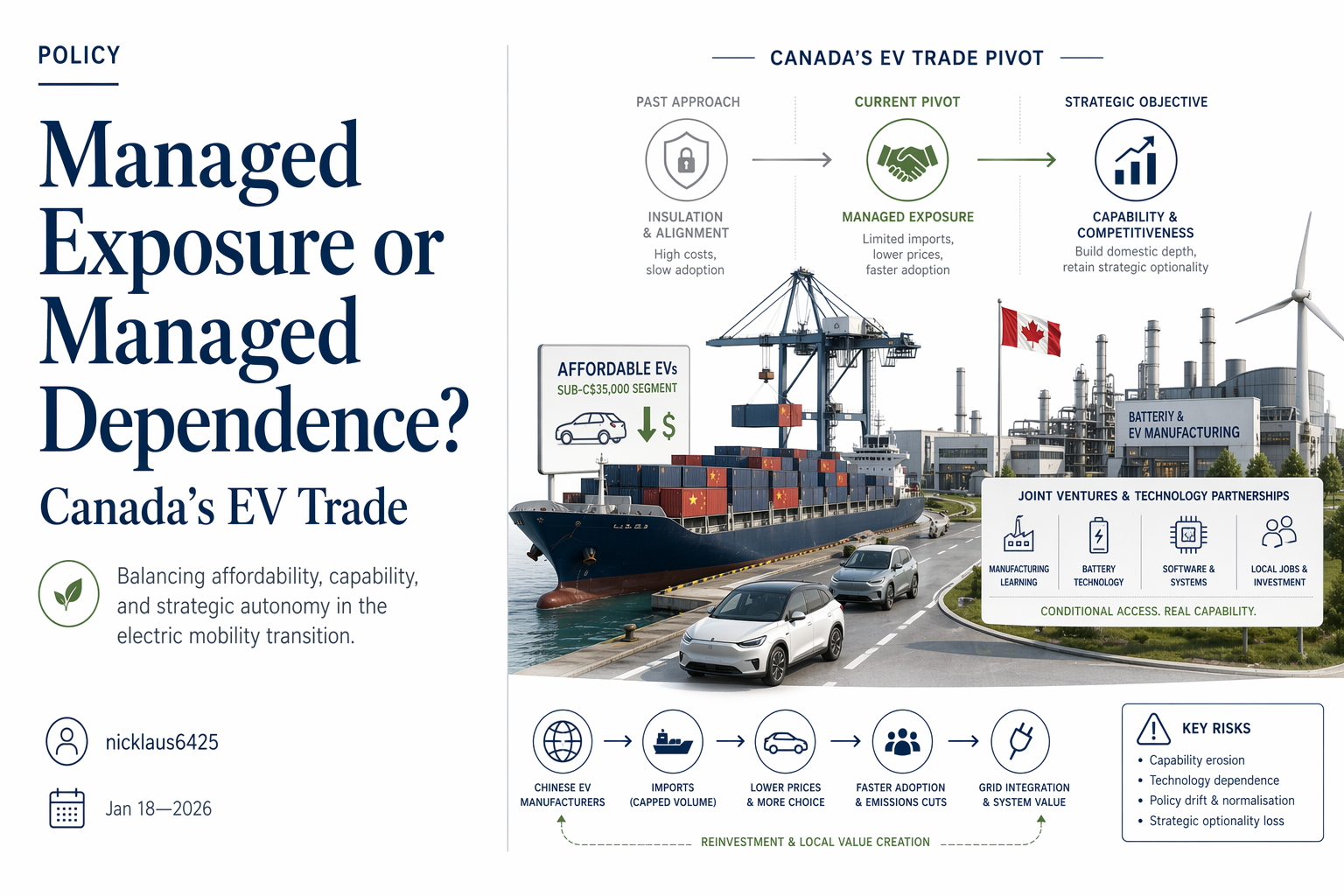
China’s electric-vehicle (EV) industry has become a structural variable in global energy transition planning rather than a marginal trade issue. Over the past decade, sustained scale deployment, vertically integrated supply chains, and cost-focused battery chemistry choices have pushed Chinese manufacturers to the global cost frontier in mass-market EVs. For Canada, this reality collided with an EV strategy built around North American industrial alignment rather than independent cost leadership. The trade pivot modelled under Prime Minister Mark Carney reflects an acknowledgement that insulation alone failed to deliver affordability or adoption momentum. However, acknowledging cost asymmetry does not resolve the underlying policy dilemma. EVs are not simply consumer durables; they are system assets embedded in battery supply chains, grid interaction, software architectures, and long-cycle capital investment. Trade policy therefore shapes not only near-term adoption outcomes, but the distribution of learning, capability, and optionality across the transition. The central question is whether Canada’s shift toward managed exposure treats EV affordability as a tactical correction, or as a strategic redefinition of its role in the electrified mobility ecosystem.
When “America First” Stops Being Mutual
Any assessment of Canada’s pivot must account for the changing posture of the United States. The post-2020 resurgence of “America First” industrial policy did not merely target Chinese imports; it also narrowed effective policy space for allies. Section 301 tariffs and the Inflation Reduction Act were designed to onshore value creation, often through eligibility criteria and content thresholds that privileged US-based production. For Canada, alignment delivered limited reciprocal benefit. Canadian producers faced higher vehicle costs, constrained supply options, and increasing uncertainty over subsidy eligibility, despite political alignment and integrated supply chains. From Ottawa’s perspective, protectionism increasingly appeared asymmetric; raising domestic prices while reinforcing US industrial objectives. This experience matters because it reframes Canada’s trade recalibration less as geopolitical deviation and more as economic risk management. Managed trade with China can be interpreted as a response to the realisation that North American alignment alone does not guarantee affordability, investment security, or policy influence for mid-sized economies.
The immediate logic of the Carney approach is straightforward. EV adoption in Canada proved highly price-sensitive once incentives were reduced and low-cost imports excluded. Transport electrification remains the most material lever for near-term emissions reduction, and delayed uptake compounds cumulative emissions. Allowing a limited volume of lower-priced Chinese EVs directly addresses the affordability bottleneck in the sub-C$35,000 segment, where domestic and European manufacturers have struggled to compete. From a deployment perspective, the argument is robust: adoption accelerates when price thresholds are crossed. Yet EV markets respond not only to realised volumes, but to reference prices. Even capped access establishes new affordability benchmarks that ripple across consumer expectations, supplier negotiations, and financing assumptions. From a systems perspective, these signals matter as much as physical imports, because they shape investment behaviour long before capacity adjustments materialise.
Proponents of managed exposure often argue that Canada lacks a globally competitive EV brand and therefore faces limited downside risk. This view understates where value accumulates in the EV economy. Manufacturing learning, battery process optimisation, supplier coordination, and quality-control systems are independent of brand ownership, yet central to long-term competitiveness. Canada’s recent battery and materials investments were predicated on policy signals that implied a protected scale-up period. A rapid shift toward managed exposure introduces ambiguity into those signals. Investors respond less to static policy statements than to expectations of future drift. Once exposure is normalised, capital discipline tightens, risk premiums rise, and marginal projects are deferred. The consequence is rarely immediate contraction, but a gradual narrowing of ambition, lessening of expansions, slowing of localisation, and weakening of spillovers. Over time, ecosystem depth erodes without visible failure, making course correction increasingly costly.
Affordability Solves Adoption But Not Capability
Joint ventures are positioned as the mechanism that reconciles exposure with capability formation. In theory, conditional access can accelerate learning and shorten development cycles by embedding foreign expertise domestically. China’s own industrial ascent provides a historical precedent. However, EV competitiveness today is increasingly defined by software integration, battery management algorithms, manufacturing data, and upstream material orchestration. These capabilities are difficult to transfer through joint ventures and easy to retain offshore. Assembly and module integration can be localised quickly; system control cannot. From a supply-chain perspective, there is a material risk that joint ventures anchor Canada as a downstream integrator within foreign-controlled technology stacks. Employment and output may increase, but strategic autonomy remains limited. The distinction matters as EVs become more tightly coupled with digital mobility platforms and energy systems.
From a climate-transition standpoint, the strongest defence of the Carney pivot remains emissions performance. Affordable EVs accelerate adoption, and adoption drives emissions reductions. However, deployment and capability formation are not separable trajectories. EVs are evolving into grid-interactive assets, interacting with charging infrastructure, storage, and demand management. A transition driven primarily by imported platforms risks externalising system learning alongside manufacturing value. Over time, this constrains domestic flexibility in vehicle-to-grid services, charging optimisation, and software-enabled mobility. Speed achieved through dependence can reduce emissions in the short term while limiting strategic adaptability in the long term. The trade-off is not abstract; it affects how much of the transition’s value chain remains domestically anchored.
Managed Trade Is a Timing Bet, Not a Strategy
Comparative experience underscores the fragility of managed trade as a stable equilibrium. Europe pursued calibrated tariffs and found itself squeezed between retaliation and persistent cost disadvantage, ultimately moving toward Chinese partnerships under commercial pressure. The United States opted for exclusion backed by subsidies, accepting higher costs in exchange for industrial control—an approach enabled by market scale and fiscal capacity that Canada does not possess. Canada’s middle path appears rational by comparison, but middle paths are often transitional rather than durable. EV markets adapt faster than trade regimes, and once low-cost benchmarks enter the market, political pressure typically favours expansion over retrenchment. Normalisation, not sudden market flooding, is the structural risk.
Viewed through an EV-systems and industrial-competitiveness lens, the Carney trade pivot is pragmatic but incomplete. It reflects an accurate diagnosis of affordability constraints and a realistic reassessment of US-centric protectionism. Its weakness lies in sequencing. Trading exposure in a sector still undergoing capability formation for gains in mature export sectors monetises future optionality for present relief. Managed trade can buy time, but time only matters if it is converted into learning, scale, and control. Without strict rules of origin, reinvestment in supply chains and infrastructure, and durable policy credibility, Canada risks achieving faster EV adoption while narrowing its long-term strategic room for manoeuvre. Affordability addresses today’s constraint; capability determines tomorrow’s competitiveness.
Leave a Reply