
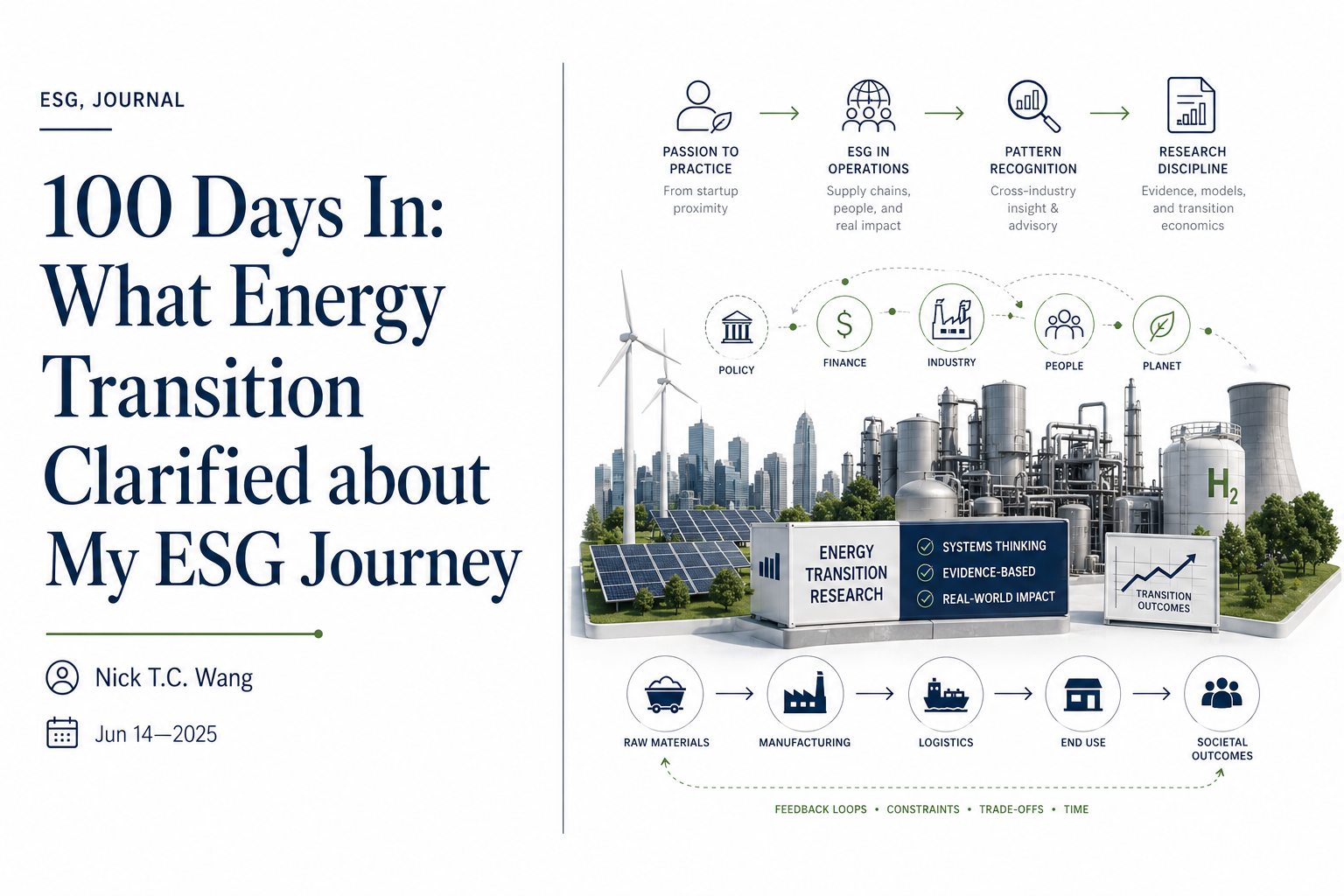
The first hundred days since March 3rd in a new role rarely deliver clarity through answers. Instead, they test which assumptions survive when viewed from a greater distance. After one hundred days working in BloombergNEF energy transition research, what has become most apparent is not how unfamiliar this role feels, but how decisively it reframes everything that came before it. What once appeared as a series of career moves now reads as a steady expansion in scope. The progression from founding an urban tech startup focused on sustainability, to corporate ESG work at FCF Co., Ltd., to consulting, and finally into system level research reflects a widening engagement with increasingly complex systems. Each transition forced a shift in scale, moving from individual behaviour, to global supply chains, to cross sector organisational dynamics, and ultimately to transition economics constrained by infrastructure, capital allocation, and physical reality. From this vantage point, sustainability appears less as a collection of initiatives and more as a discipline shaped by limits. Limits of coordination, limits of incentives, limits of institutional capacity, and limits imposed by time. The first hundred days at Bloomberg have therefore felt less like entering a new field and more like consolidating earlier lessons under a more exacting analytical lens.
Learning Sustainability Through Proximity
Founding an urban tech startup with the explicit aim of making cities more sustainable meant that sustainability was never treated as a separate objective or function. It was embedded in every idea and every decision because the business itself existed to improve how urban systems operated. Product design, pricing, partnerships, and go to market choices were all sustainability decisions by default. Early on, that alignment created a sense of moral clarity. Passion felt sufficient because intent and identity were aligned. There was a belief that better ideas and stronger conviction would naturally translate into better outcomes. Operating inside real cities quickly challenged that assumption. Urban systems are shaped by legacy infrastructure, regulatory complexity, behavioural inertia, and fragmented governance. Decisions that appeared sustainable in isolation often produced unintended consequences once they interacted with existing constraints. Trade offs surfaced everywhere, forcing choices between ideal outcomes and viable ones.
That proximity changed how I understood sustainability. When sustainability is embedded in every decision, it stops being an aspiration and becomes a set of practical judgments made under pressure. Impact is shaped less by conviction and more by incentives, timing, and execution capacity. Adoption slowed when costs mattered more than values. Partnerships moved slowly because alignment was harder than anticipated. What this phase ultimately revealed is that sustainability is not advanced by passion alone. It advances when ideas survive contact with operational reality. This shift from belief to practice was formative. It replaced the desire to be right with the need to be effective, and it established a lasting respect for the constraints that govern whether sustainability ambitions translate into real change.
When ESG Becomes Operational
Corporate ESG work introduced a more complex and sobering reality. At FCF, sustainability was embedded in a global seafood supply chain where environmental outcomes, social responsibility, and commercial survival were inseparable. Ocean sustainability was not an abstract objective. It was governed by fish stock health, regulatory fragmentation, vessel behaviour, and investment cycles that extended far beyond reporting horizons. Improving traceability or supporting fisheries management required coordination across actors operating under uneven incentives and legal regimes. Seafarer social responsibility added another layer of complexity that resisted standardisation. Labour conditions unfolded across jurisdictions, shaped by recruitment systems, flag state enforcement, cultural norms, and limited oversight. These challenges could not be resolved through disclosure alone. They were governance problems embedded in real operations and real human lives.
This experience fundamentally reshaped my understanding of ESG reporting. Reporting can illuminate systems, but it cannot substitute for operational change. Metrics describe reality, they do not transform it. One of the persistent risks in sustainability discourse is mistaking transparency for progress. At the corporate level, meaningful ESG outcomes depended on changes to procurement criteria, supplier engagement, contract structures, internal incentives, and monitoring mechanisms. Reporting followed action rather than leading it. Supply chain management emerged as one of the most powerful tools for sustainability precisely because it sits at the intersection of these levers. Decisions about sourcing, supplier standards, auditing, and long term partnerships shape environmental impact and social outcomes far more directly than policy statements. In seafood, sustainability advanced not through better narratives, but through disciplined supply chain governance. That lesson carries directly into energy transition work, where decarbonisation is increasingly determined by upstream materials, manufacturing capacity, logistics resilience, and permitting timelines rather than headline targets.
Pattern Recognition at Scale
Consulting compressed these lessons into pattern recognition. Exposure to multiple sectors made it clear that the constraints observed in seafood were not anomalies. Across industries, ESG strategies struggled with similar dynamics. Ambition routinely outpaced organisational readiness. Frameworks evolved faster than implementation capacity. Reporting requirements multiplied while execution remained constrained by incentives, internal fragmentation, and supply chain opacity. Consulting sharpened my understanding of ESG at a systems level, but it also clarified its limits. Advisory work rewards generalists who can move quickly across sectors, frameworks, and stakeholder agendas. That capability is valuable, particularly in a field that spent its early years establishing common language and norms. Over time, however, it became clear to me that the centre of gravity in sustainability is shifting. Impact is increasingly driven not by those who can speak broadly across ESG, but by those who possess deep domain specific expertise and can still connect that expertise to adjacent systems.
This shift was not theoretical. It was visible in client engagements where execution risk stemmed less from lack of intent and more from insufficient technical depth in areas such as energy systems, supply chains, and infrastructure deployment. That realisation was the primary reason I moved from Deloitte to Bloomberg. The transition was not about leaving consulting, but about narrowing focus deliberately. Energy transition is no longer a conceptual challenge. It is an engineering, financial, and institutional one. Understanding it requires fluency in cost curves, deployment constraints, policy mechanics, and supply chain dependencies that cannot be developed at arm’s length. Moving into energy transition research was a conscious decision to move from breadth to depth, while retaining the ability to interconnect with policy, finance, and corporate strategy. The value of generalist training was not discarded. It became a foundation. But at this stage of the transition, credibility increasingly comes from specialist discipline.
Discipline Over Narrative
The move into energy transition research completed this evolution. Research imposes discipline in a way few other roles do. Assumptions must be explicit. Models must be internally consistent. Conclusions must withstand scrutiny without narrative cushioning. After one hundred days, what stands out most is how clarifying this environment is. Research does not reward optimism. It rewards coherence. It exposes where policy ambition is not matched by capital flows, where infrastructure bottlenecks dominate outcomes, and where supply chain constraints shape deployment timelines more decisively than stated targets. What surprised me is how familiar many of these challenges feel. The coordination problems observed in seafood sustainability and labour governance reappear in energy transition analysis as permitting delays, grid constraints, equipment shortages, and uneven regional capacity. Different sectors, same mechanics.
Viewed across this journey, ESG capability reveals itself as cumulative rather than linear. Early proximity builds instinct and respect for constraint. Corporate sustainability builds sensitivity to human consequence and operational complexity. Consulting builds synthesis and pattern recognition. Research builds discipline and restraint. What binds these together is judgment. Judgment is knowing when incremental improvement is rational and when it is insufficient. It is recognising when data is robust enough to act and when uncertainty must be stated openly. It is accepting that some transitions will be slower and more expensive than public discourse suggests. After one hundred days in research, this quality feels more valuable than any single technical skill.
A Note to My Earlier Self
If I were writing to my earlier self, the message would not be to become more idealistic or more visible, but to become more useful and to never assume that what I know at any given moment is sufficient. Sustainability is not a field that rewards static competence. It is defined by constant change in technology, regulation, markets, and expectations. What feels rigorous today becomes foundation of tomorrow Early on, it is tempting to treat sustainability as an identity rather than a capability, and to believe that once a certain level of fluency is achieved, it can be relied upon. That assumption is dangerous. Systems do not pause, and neither does the work. Those who stop learning do not simply slow down. They become misaligned with reality.
I would remind myself that sustainability is credible only when it is operational and current. Learn how decisions are actually made, but also recognise that those decision processes evolve. Learn where budgets are approved and where trade offs are negotiated, but revisit those assumptions as organisations, technologies, and incentives shift. Spend time in supply chains, not just strategies, because this is where environmental and social outcomes are often determined long before they appear in reports or policies. At the same time, continue to deepen technical understanding. Read beyond your immediate role. Update your mental models. Accept that expertise decays unless it is actively maintained.
I would also caution against complacency. Sustainability rewards those who continue to grow uncomfortable. Early exposure rewards generalism, but long term relevance requires depth that must be constantly renewed. Choose systems to understand deeply, but revisit them as they change. Energy, food, labour, and finance do not stand still. Neither can those who work within them. The field will continue to professionalise and specialise. Those who adapt and deepen their capability will shape outcomes. Those who do not will not necessarily fail loudly. They will simply be left behind.
Most importantly, I would remind myself that sustainability is not a performance or a credential. It is a long exposure to constraint in systems that evolve faster than individual careers. Progress often feels slow because it is slow. Outcomes lag intent. Recognition lags effort. This is not a signal to stop learning or settle into certainty. It is a signal to keep moving. After one hundred days in energy transition research, this feels less like pressure and more like clarity. Sustainability does not need people who arrive and stay. It needs people who continue to change as the system does.
Leave a Reply