
Cities are responsible for most of humanity’s consumption, and retailers are the interface through which that material appetite is expressed. Recent studies estimate that the retail value chain drives roughly a quarter of global greenhouse-gas emissions—almost all of it upstream or downstream from the shop floor. With e-commerce volumes and urban populations still rising, the sector’s environmental bill is poised to grow unless the vast datasets retailers already collect are redeployed as tools for decarbonisation rather than just merchandising.
Traditional retail analytics told managers what sold and when; carbon-conscious analytics add the question of how products were made, moved, stored and ultimately disposed of. Cloud platforms such as Sweep and Normative now plug directly into enterprise resource-planning systems and point-of-sale terminals, tagging every SKU with an emissions factor drawn from life-cycle databases. In practical terms, this means a fashion chain can see—in near real time—whether today’s basket nudged the company’s Scope 3 footprint up or down, and route replenishment orders to suppliers with the lowest marginal carbon intensity.
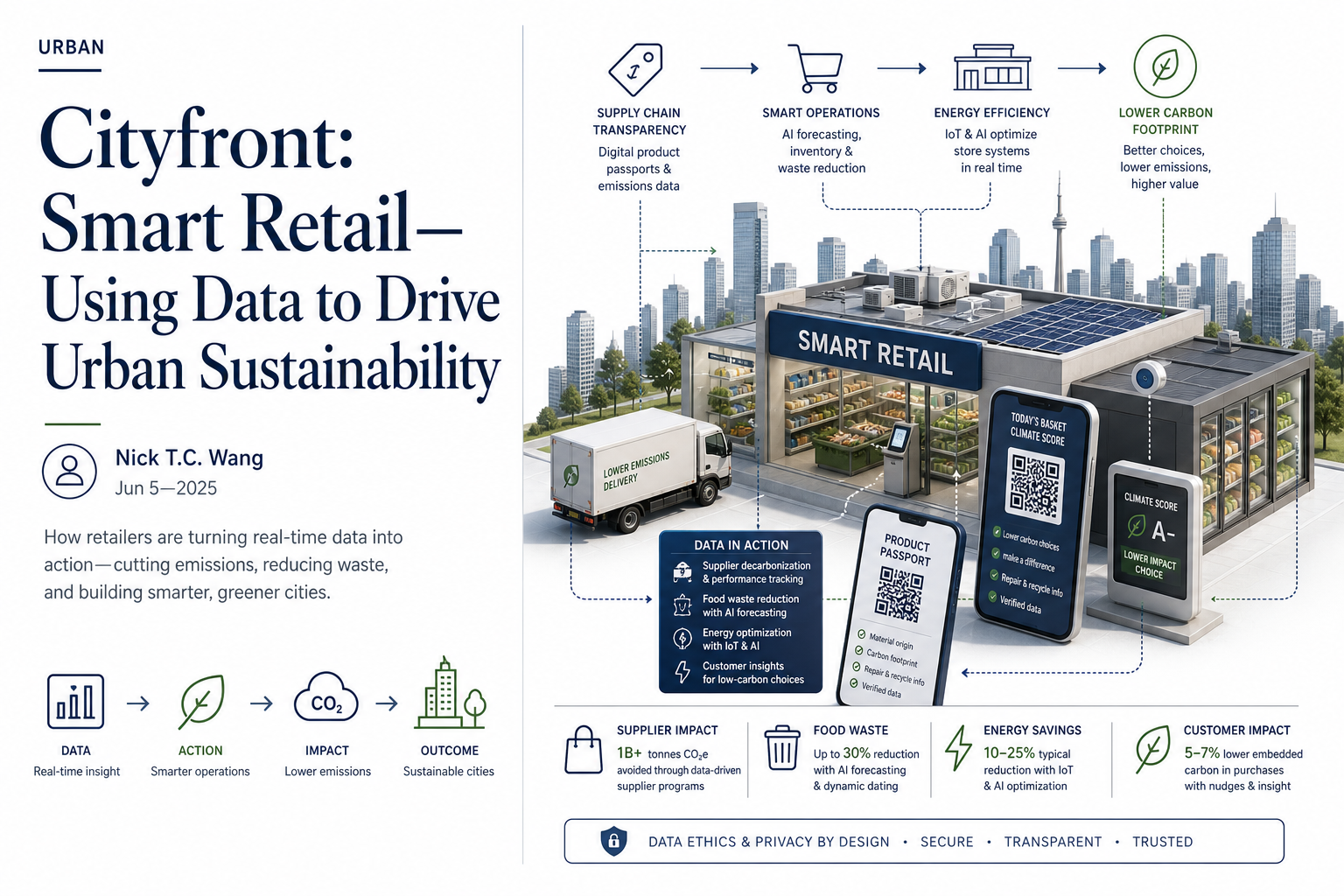
Nowhere is data leverage clearer than in the race for supplier decarbonisation. Walmart’s Project Gigaton—a programme that mines sales and logistics data to rank vendors by climate performance and then coaches them on reductions—has already surpassed its original goal of avoiding one billion tonnes of CO₂ six years ahead of schedule. The initiative illustrates a simple truth: once emissions data become a performance metric visible to both buyers and the C-suite, behaviour changes faster than any stand-alone audit. Europe is about to institutionalise that dynamic. The 2024 Ecodesign for Sustainable Products Regulation mandates a Digital Product Passport for all goods sold in the EU by 2030, accessible through next-generation 2-D barcodes that replace today’s black-and-white stripes. Every scan at warehouse, checkout or resale point will surface material origin, repair manuals and carbon scores—turning transparency from a marketing choice into a market entry ticket.
If supply-chain data address the start of a product’s life, inventory analytics tackle its premature end. Global grocers dump an estimated 10 per cent of their food before it leaves the shelf; algorithms trained on local demand, weather and social-media signals are cutting that figure sharply. Tesco now publishes store-level waste dashboards and credits an AI forecasting tool with diverting the equivalent of 1.5 million meals a year from the bin. A peer-reviewed study of dynamic shelf-life labelling—sensors that adjust best-before dates based on temperature history—projects retail waste reductions of up to 30 per cent. The same logic applies to non-perishables. Alibaba’s Hema supermarkets track each head of lettuce or packet of prawns from farm to counter in fifteen-minute increments; real-time sell-through rates trigger price markdowns or kitchen repurposing well before spoilage. The group credits data-driven optimisation with a 12.9 per cent cut in operational emissions year-on-year.
Even when the right product is on the right shelf, the store itself can be a carbon sinkhole. Heating, lighting and especially refrigeration push retail energy intensity far above average commercial real estate. IoT retrofits are changing that calculus. A 2024 field trial of smart refrigeration controls in Australian supermarkets logged a 19 per cent drop in annual energy use and a 37 per cent reduction in peak-demand spikes. AI-enabled HVAC optimisation at 45 Broadway in Manhattan shaved nearly 16 per cent off electricity consumption, saving US $42 000 and 37 tonnes of CO₂ in one year. BrainBox AI, now deployed across 14 000 buildings in 20 countries, points to similar results: energy savings of a quarter and emissions cuts of roughly 10–15 per cent, achieved by predicting occupancy, weather and utility signals five minutes into the future and adjusting equipment pre-emptively. tFor retailers, the capital payback is measured in months rather than years, especially as many jurisdictions introduce performance-based building codes that penalise inefficient square metres.
City governments are beginning to stitch these private gains into public climate strategies. Toronto’s 2024 Circular Economy Road Map calls for “transaction-level carbon insight” across retail sectors and offers grants to small merchants that connect cloud tills and environmental dashboards to a voluntary citywide data lake. The Lake aggregates anonymised emissions, waste and energy figures at neighbourhood scale, giving planners empirical support for zoning tweaks or micro-depot placements and giving residents a clear read on local progress. Tokyo, for its part, is folding retail data into its cap-and-trade scheme. Start-ups certified by the metropolitan government are piloting software-as-a-service layers that ingest point-of-sale feeds, translate them into embodied-carbon metrics and issue blockchain-based offset tokens when reductions exceed baselines. Early trials in Suginami Ward suggest that convenience-store chains can earn more from avoided emissions credits than they spend on IoT subscriptions within two fiscal years.
All this data is moot unless it influences customer choice. Here the industry is experimenting with frictionless engagement. Amazon’s Just Walk Out stores flood ceilings with cameras and sensors so visitors can pick up items and leave, their accounts charged automatically. While criticism over energy intensity and human data labelling persists, Amazon reports that third-party deployments of the platform will more than double in 2024, suggesting retailers see value in the granular consumption maps it generates. Those maps can, in theory, surface low-carbon substitutions at the moment of intent—an oat milk placed at eye level when a shopper reaches for dairy, or a prompt to repair rather than replace a broken gadget. In Europe, where digital receipts already dominate, several supermarket apps now append a personalised climate score to the day’s basket. Behavioural-economics pilots indicate that even symbolic feedback nudges can cut embedded-carbon purchase volumes by five to seven per cent over a six-month period, although long-term persistence remains under study.
Smart-retail infrastructure is not cheap, but financiers increasingly price risk through a sustainability lens. Canadian credit unions have launched loans whose interest rates ratchet down as retailers meet per-transaction emissions thresholds verified by POS data. Tokyo’s Green Finance Organisation offers “transaction-linked” debentures with coupons pegged to kilogrammes of CO₂ avoided, effectively turning a building’s energy meter into a revenue stream. These instruments mimic the rise of green mortgages in housing: a lower cost of capital in exchange for verifiable climate performance.
More data also means new responsibilities. Retail datasets combine location, health and consumption attributes that can reveal intimate patterns. Regulators are watching. Europe’s Digital Services Act and Japan’s amended Act on the Protection of Personal Information both impose stricter consent and localisation rules on high-resolution consumer data. Future-proof systems should therefore adopt privacy-by-design principles—federated learning, edge processing and zero-knowledge proofs—to ensure that carbon intelligence does not morph into surveillance capitalism.
Challenges remain. Data standards across retail, logistics and utilities are still patchy, leaving many integration projects stuck in bespoke middleware purgatory. The GS1 “Sunrise 2027” shift to 2-D barcodes will help, but only if smaller brands can afford the upgrade. AI models hungry for historical transactions risk embedding past biases—stocking home-repair tools in predominantly male districts or under-indexing fresh produce in lower-income neighbourhoods—unless retailers pair algorithms with deliberate equity targets. On the upside, emergent technologies promise step-changes. Dynamic pricing engines already factor in carbon intensity alongside time-of-day demand and ageing inventory. Digital twins of entire store estates let managers A/B-test refrigeration set-points against energy tariffs and local grid carbon factors before touching actual thermostats. And as 5G and edge computing mature, sensor data that once took hours to sync can now feed optimisation loops in milliseconds.
In the 1980s a barcode revolutionised inventory control; in the 2020s a QR-linked product passport may revolutionise climate control. When the point of sale becomes the point of purpose—an interface where operational, environmental and social signals converge—every checkout scan turns into a governance act. Cities gain granular emissions inventories. Retailers gain credible brand equity and less volatile supply chains. Consumers gain information sovereignty and lower-footprint choices without sacrificing convenience.
The transition will not be uniform or painless. Yet the early data from Toronto’s food-waste dashboards, Tokyo’s cap-and-trade blockchain pilots and Walmart’s supplier league tables show an unmistakable direction of travel: where data flows, carbon ebbs. The retail sector’s sprawling footprint makes it a daunting climate challenge, but the very richness of its information streams also makes it an unparalleled climate lever. Turning tills, fridges and loyalty apps into instruments of urban sustainability is less a technical leap than an act of managerial will—and one whose dividends, measured in cleaner air and stabler margins, compound daily.
When future historians trace the moment commerce went from carbon problem to climate solution, they may pinpoint something as unglamorous as a POS software update. For retailers, city planners and investors deciding where to place their next bet, the message is equally prosaic and profound: in a data-rich world, ignorance is the biggest externality, and insight is the new competitive advantage.
Leave a Reply