
The Next Great Human Wager: Degrowth, Innovation, and the Future of Food and Water Security
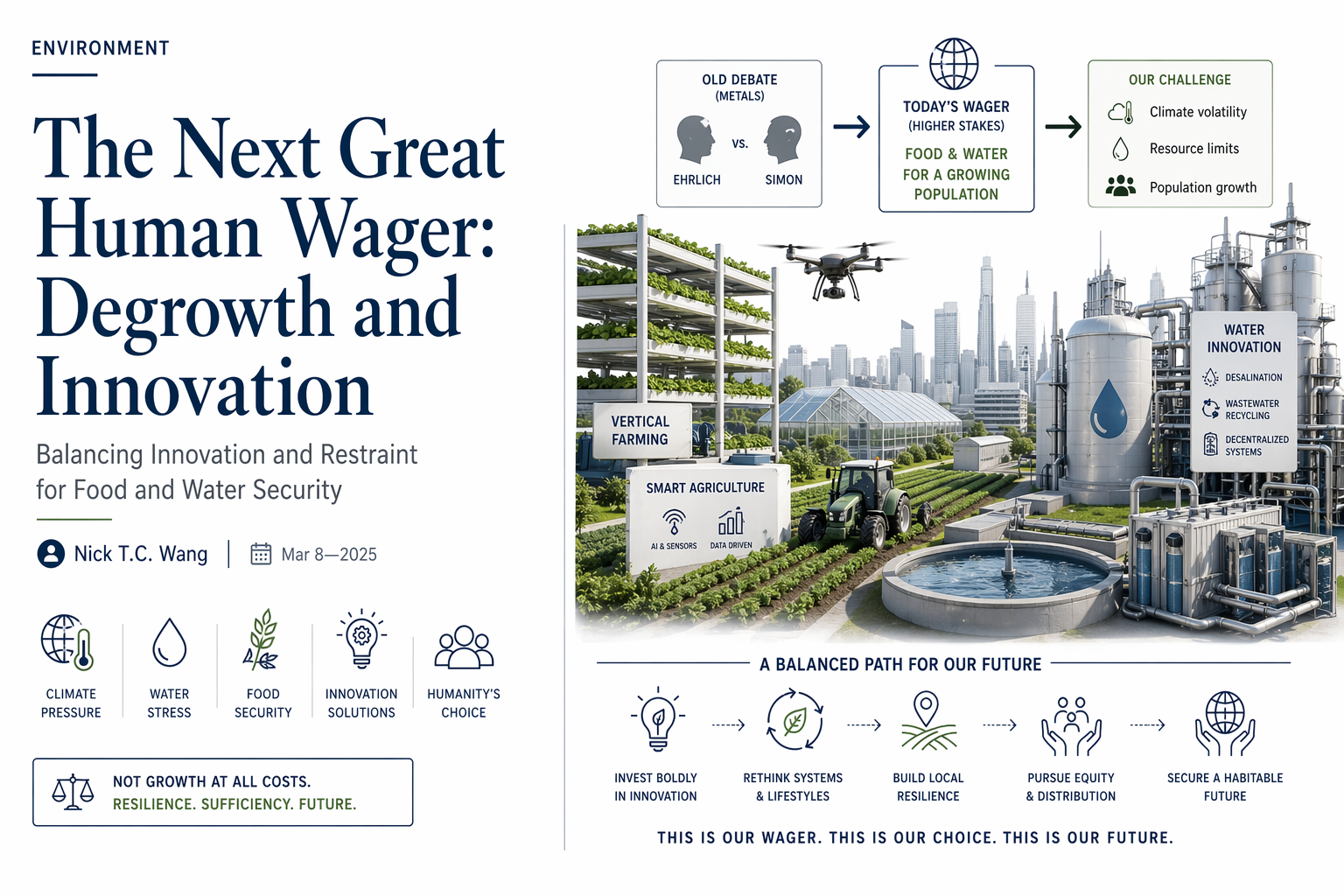
In the late 20th century, a deceptively simple bet sent shockwaves through academia and policymaking circles. Biologist Paul Ehrlich warned of a population-driven collapse of natural resources, while economist Julian Simon countered that human ingenuity would ultimately overcome resource constraints. They agreed to settle their disagreement with a bet on the prices of metals over a decade. Simon won. Metal prices declined, reinforcing his belief that innovation trumps scarcity.
Today, history is rhyming once again—but with far higher stakes. The question is no longer about metals. It’s about whether the Earth can continue to produce enough food and clean water to sustain life. This time, the timeline is shorter, the risks more acute, and every one of us is already, willingly or not, part of the wager.
The Gap Between Degrowth Ideals and Political Realities
The increasingly frequent alarms of climate change, ecosystem collapse, and biodiversity loss have pushed a growing number of thinkers and activists to question the logic of perpetual economic growth. The “degrowth” movement challenges GDP-centric models, advocating for a deliberate reduction in excessive production and consumption. The goal: long-term environmental stability and a society based on sufficiency rather than excess.
Yet, as compelling as the vision is, it often collapses under the weight of geopolitical and economic realities. No nation wants to be the first to slow down in the global race for competitiveness. In a world where emerging economies like China and India continue to surge, early adopters of degrowth risk falling behind—technologically, diplomatically, and economically. This creates a classic prisoners’ dilemma: every country knows unrestrained growth is unsustainable, but none dares to apply the brakes first. As a result, degrowth remains more of a philosophical proposition than a policy reality.
Food and Water: The Non-Negotiables of Civilization
Unlike the last Ehrlich-Simon debate, today’s focal point is concrete and urgent: Can we reliably produce enough food and clean water to support a growing population? Climate volatility is redrawing agricultural maps. Droughts in the Horn of Africa, floods in Asia, heatwaves in Southern Europe, and soil degradation in Latin America are no longer hypothetical—they’re happening now.
Agriculture, which has always depended on climatic stability, now faces unprecedented disruption. Water stress is equally alarming. Major cities are issuing “Day Zero” warnings, aquifers are drying up, rivers are shrinking, and international water conflicts are emerging. When freshwater becomes scarce, agriculture suffers first, but the ripple effects hit energy, industry, and urban life. Food and water are not just environmental issues—they are the foundation of human civilization. Without them, economic growth and technological progress are meaningless.
Can Technology Save Us—Again?
Ironically, just as natural systems are approaching collapse, human technological capability has reached new heights. Vertical farming enables dense, water-efficient crop production in cities. AI and sensor technologies are transforming agriculture into a data-driven industry. Gene editing is making crops heat- and drought-resistant. Alternative proteins—from lab-grown meat to precision fermentation—are redefining what food means.
On the water front, next-generation low-energy desalination, wastewater recycling, and decentralized micro-treatment systems are becoming viable solutions for water-scarce regions. If these technologies are effectively integrated, we might be able to establish decoupled food and water systems that don’t rely on traditional ecosystems. It sounds like science fiction—but it’s our emerging reality. With no country willing to abandon growth, innovation remains our final card to play.
A Wager Without a Gambler, But No Bystanders
Unlike the Ehrlich-Simon bet, this new wager lacks symbolic protagonists. Perhaps we need a “modern Ehrlich” to articulate the pathways of collapse, and a “modern Simon” to bet on the scale and speed of innovation. But even in their absence, the wager is underway. Every spike in food prices, every drought warning, every tech breakthrough is a round in this unfolding game.
Governments, businesses, and citizens alike are being drawn in, forced to choose: Should we double down on innovation? Or pivot toward restraint and risk mitigation?
Blending Innovation and Restraint: A Narrow but Navigable Path
This isn’t a binary choice. We don’t need to choose between techno-optimism and doomsday fatalism. The most viable path forward may be to balance the two: invest boldly in innovation while simultaneously rethinking systems, values, and lifestyles.
We can localize food and water resilience, reducing reliance on fragile global supply chains. We can shift from maximizing output to designing robust systems. And within the bounds of realpolitik, we can start introducing new indicators focused on sufficiency, redistribution, and equity.
This road may not boost GDP headlines, but it offers stability—and perhaps the only sustainable route for human survival.
Conclusion: The Future Wager Is a Choice, Not a Prediction
Will innovation once again defy ecological limits? Can we retain humanity’s warmth while embracing technological power? These are not questions for future historians—they are decisions for us to make now.
This is no longer a private wager between two academics. It is a global gamble on the continuity of civilization. The stakes are the rights and possibilities of future generations.
This time, we simply cannot afford to lose.
Leave a Reply