
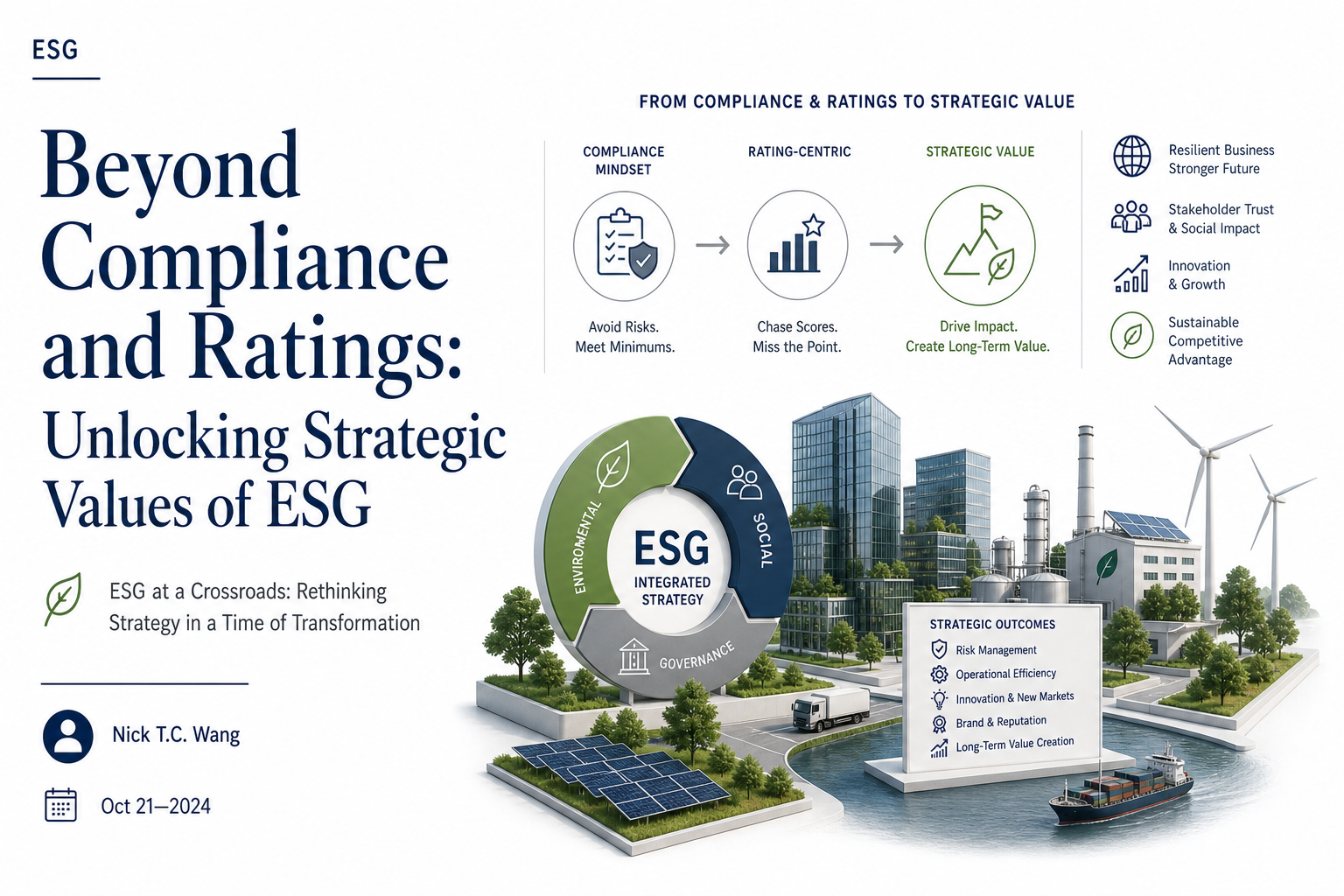
ESG at a Crossroads: Rethinking Strategy in a Time of Transformation
The global business landscape is undergoing a profound transformation. Environmental, Social, and Governance (ESG) performance has emerged as a defining metric for corporate competitiveness and long-term viability. As climate change accelerates and social inequalities deepen, stakeholders—investors, regulators, and consumers alike—increasingly expect businesses to be problem solvers, not just profit makers.
Yet despite rising interest in ESG, many companies adopt narrow approaches: treating ESG merely as a compliance tool, or overinvesting in rating performance for indices like the Dow Jones Sustainability Index (DJSI). While seemingly sound, these strategies often overlook ESG’s strategic potential—and may undermine long-term competitiveness and reputation.
The Limits of ESG as a Compliance Exercise
For many firms, ESG initiatives are primarily driven by regulatory requirements. This compliance-oriented mindset reflects a reactive culture—one that aims to avoid penalties rather than pursue opportunity. As a result, actions tend to be minimal, transactional, and detached from the company’s broader strategic goals.
Take, for example, efforts to reduce emissions or improve employee benefits solely to meet legal thresholds. These initiatives may achieve short-term compliance but rarely drive meaningful innovation or systemic change. Worse still, this mindset can obscure ESG’s value as a tool for value creation. Environmentally sustainable supply chains, for instance, can reduce emissions and cut costs—yet firms focused only on legal compliance often miss these benefits.
Crucially, stakeholders today demand more. They expect leadership on global issues, not box-ticking. By limiting ESG to the bare minimum, companies risk reputational damage—particularly as ethical consumption and ESG investing gain momentum. This can erode brand loyalty, deter long-term capital, and hinder talent attraction.
The Pitfalls of Rating-Centric ESG Strategies
At the opposite end of the spectrum are firms obsessed with ESG ratings. They equate high scores on indices like DJSI with ESG success. But this fixation poses risks of its own.
A ratings-driven approach often leads to superficial efforts. Firms might publish glossy ESG reports or launch PR campaigns without addressing underlying structural issues. This opens the door to accusations of greenwashing—which can invite regulatory scrutiny, legal exposure, and reputational harm.
Moreover, ESG rating systems vary widely in scope and methodology. A company might rank well in one system while underperforming in another, creating confusion and frustration among stakeholders. This inconsistency increases administrative burdens without necessarily improving actual ESG outcomes.
Worst of all, when ESG efforts are dictated by rating criteria, companies risk losing sight of their material priorities. Energy might be spent on metrics that boost scores but do little to address core sustainability challenges.
Reframing ESG as Core Strategy
Instead of oscillating between compliance and ratings, companies should embed ESG into their core business strategy. This means identifying the ESG issues most relevant to their industry and stakeholders—and addressing them with focus, ambition, and accountability.
For instance:
- A manufacturing firm may prioritise decarbonisation and resource efficiency.
- A tech company might focus on data ethics, inclusion, and supply chain transparency.
Integrating ESG at a strategic level also requires a shift from reactive to proactive thinking. This includes setting long-term ESG goals, aligning them with the company’s vision, and operationalising them across departments and decision-making structures.
Leading companies are already doing this—investing in renewables, adopting circular economy models, and enhancing end-to-end supply chain traceability. These actions create competitive advantage by unlocking innovation, reducing risk, and opening new revenue streams.
When ESG aligns with purpose and long-term vision, it becomes a reputational asset—strengthening stakeholder trust and securing a licence to operate in volatile markets.
Conclusion: ESG as a Long-Term Asset, Not a Box to Tick
Ultimately, reducing ESG to a compliance task or a ratings game dramatically underestimates its potential. In an era of heightened expectations and systemic risk, ESG must be reframed as a strategic enabler—a driver of innovation, resilience, and sustainable growth.
True ESG leadership goes beyond appearance. It demands substance, alignment with business purpose, and a willingness to challenge the status quo. By embedding ESG in business models, corporate culture, and governance, companies not only mitigate risks but also unlock future-facing value.
Those that view ESG as a long-term strategic asset will be the ones who thrive—resilient in uncertainty, relevant in global discourse, and ready for the sustainable economy ahead.
Leave a Reply