
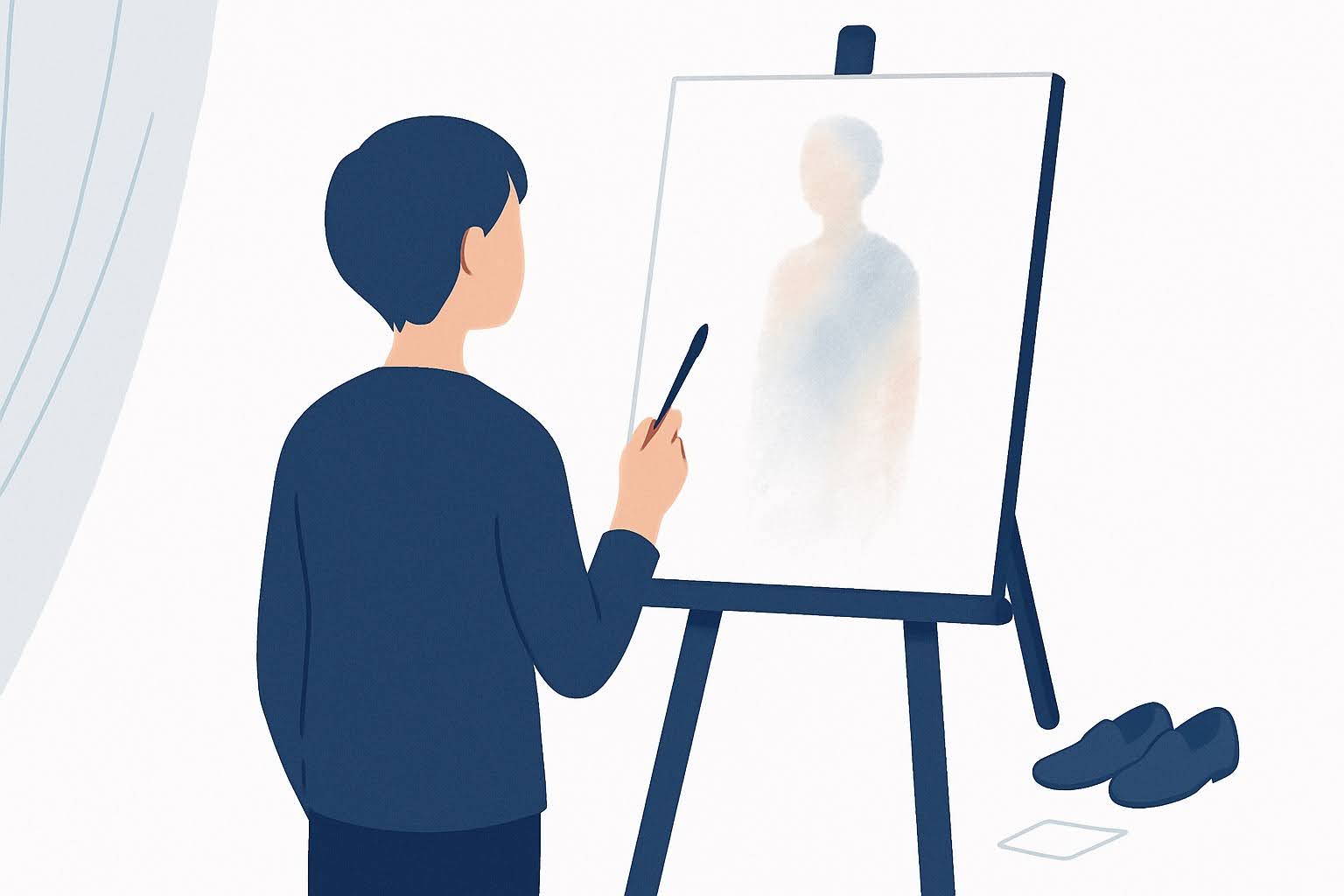
Time lays its brush softly, yet fate stops suddenly. The person is gone, like a canvas just brushed with a first layer of paint—no contours drawn, no features revealed—abruptly left incomplete. The pigments still shimmer faintly in the wind, holding onto warmth that once was, but you know the hand that painted will never return. That figure now belongs to the other side of time, a chapter left half-written, a story without an ending. You stand before this unfinished work, flooded with a silence words cannot touch. The voice that whispered in your ear just yesterday now seems like an echo from a distant dream; the warmth that danced in your palm has faded into a chill in the air.
You reach out, trying to trace the remnants of his presence, but every outline has blurred like wet paint smudged by time—spilled into an indecipherable haze.
So, you turn to memory to fill the blankness. You close your eyes, drawing his brows again and again in your mind, repeating his name so that the colours won’t fade into the fog of forgetting. His belongings remain untouched, as if they still breathe him in. His handwriting, you touch softly—hoping the strokes still carry a whisper of warmth. But no matter how tightly you hold on, reality continues to remind you: some people, once they leave, are gone forever. No echoes. No returns.
You distract yourself with busy hours, hoping the gaps in your chest go unnoticed. You drown in chatter, praying the silence doesn’t seep into your bones. But when night falls, and the wind brushes against your window frame, that silence always finds you again—like unfinished pigment, soaked with the imprint of the past.
Yet time is not a cruel painter. It does not erase sorrow, but softens it.
You think you will forever be trapped in this void, until one day you pass a street corner where an old song is playing. Your heart stirs—not with pain, but with something gentler. On an idle afternoon, light filters through the dust at your windowsill, and you glimpse his outline—not as a ghost, but as an old friend. And you smile.
You begin to understand: those memories never left you. They have simply changed form. His voice becomes a resonance deep within your soul. His shadow, a quiet companion in every step you take. His words—the ones you thought you’d forgotten—become the unspoken counsel guiding your choices. His warmth lingers in your hands when you embrace others. He never truly left. He became a hidden colour—layered beneath your canvas—adding depth to your life’s unfolding masterpiece.
At last, you realise: the blank space on your canvas isn’t brokenness. It is resonance. It is yearning. It is tenderness born of light and shadow. The most beautiful paintings are never fully filled—they leave room for breath, for echoes, for what remains unsaid. You no longer try to cover the blankness. You allow it to exist. You let it be part of your art.
And so, gently, you lift the brush again—layer by layer, not to overwrite what was, but to build upon it. Letting memory seep into each stroke. Letting love, once vivid, become the softest, truest foundation. One day, when you look back on this canvas, you will see that the grief that once crushed you now rests in the darkest, most luminous corner of your painting—still there, still alive—shimmering with light, moving with the wind.
Leave a Reply