
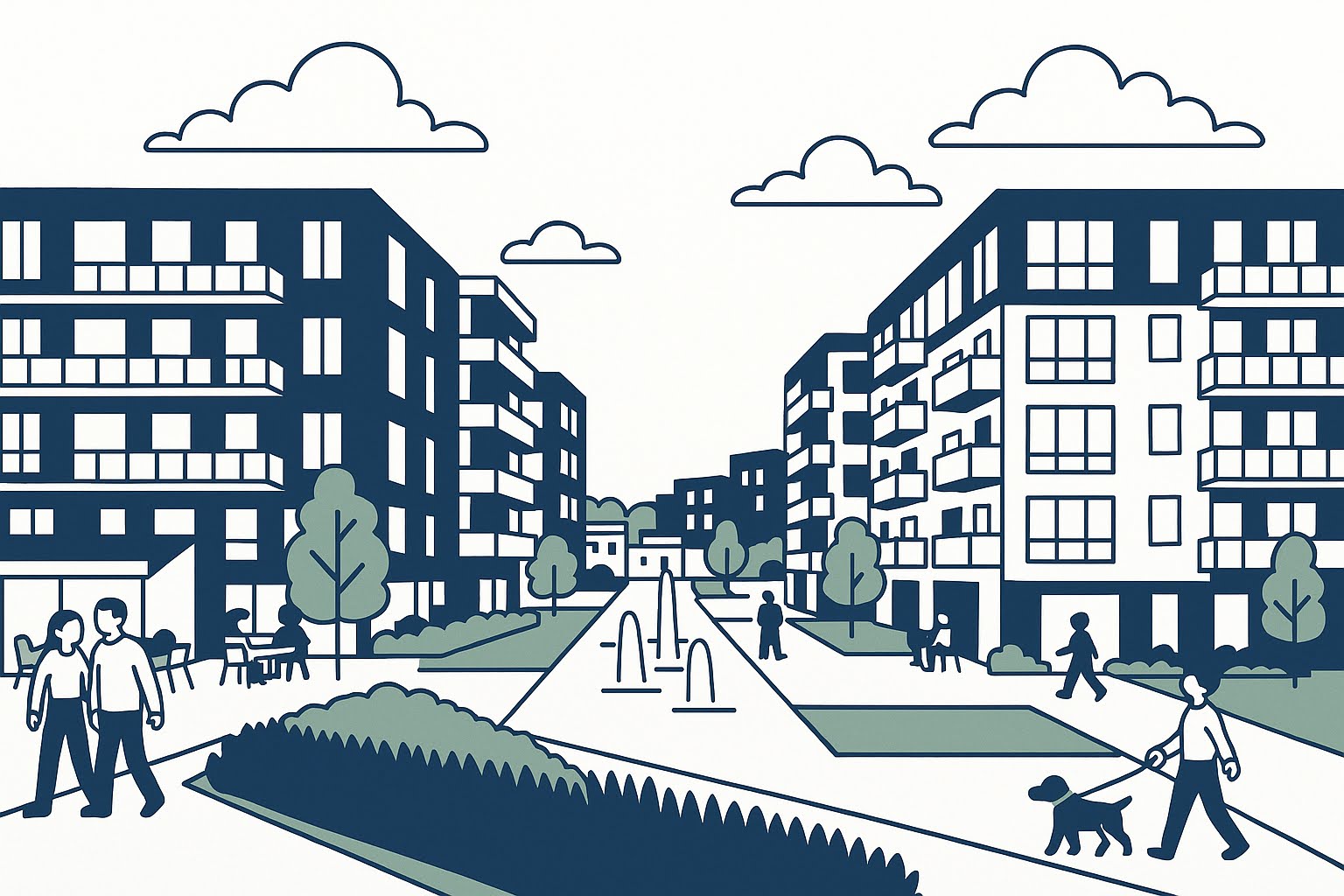
Urban sprawl has long been a subject of debate, but in recent years—and especially amid the pandemic—it has taken on renewed urgency. Importantly, urban sprawl is not the “end” of the city. Cities and downtowns will return. But they will not look the same. Forces like public health crises and social upheaval have reshaped our understanding of what it means to live, work, and thrive in cities. A simple recovery to the past is no longer sufficient. The cities that will lead in the next era will be those that can anticipate evolving needs and respond with agility and inclusion.
Urban theorist Richard Florida calls this a “Great Urban Reset.” It is not caused solely by COVID-19, but by overlapping structural crises—climate, inequality, housing, and labour—that have converged to reconfigure our cities. COVID-19 merely accelerated this transition, providing a window to rebuild with more efficiency, equity, and foresight.
The Push and Pull of Urban Life
Rather than viewing the urban exodus as permanent, it’s more accurate to understand it through the twin lenses of “push” and “pull” factors. Families with young children, elderly residents, and vulnerable populations were among those most affected, often seeking space, safety, or proximity to extended care. Yet, these shifts are rarely irreversible.
Zoom fatigue, declining productivity in isolation, and the enduring value of in-person mentorship and collaboration are now driving many—particularly younger cohorts—back to urban cores. As economies stabilise, central cities will regain their magnetism, driven by employment opportunities, higher wages, cultural dynamism, and the promise of human connection.
Moreover, not all sectors can be digitised. Workers in healthcare, media production, logistics, and hospitality still require physical proximity. Their return to urban environments reflects both structural necessity and social desire.
Workplace Transformation: From Office Cubes to Collaboration Hubs
One of the most significant disruptions has been to our collective relationship with work. The pre-pandemic norm—only 10% of the workforce operating remotely—has been upended. Today, hybrid work is not only common but preferred by over 70% of employees.
This new preference demands radical redesign. Offices must evolve from task-oriented workstations to social infrastructure—spaces for collaboration, creativity, and community. Cubicles are obsolete. In their place, we see rooftop lounges, terrace cafes, and open-floor plans built for dialogue rather than isolation. Architectural firms and workplace strategists now speak not of “workplaces” but of “interaction places.”
Flexibility has become the new currency in talent attraction and retention. To remain competitive, cities and employers must offer dynamic environments that reflect the distributed nature of 21st-century labour.
Sustainable Retail and Local Revitalisation
As a co-founder of Tenatch, a startup committed to empowering small businesses through urban tech, I have witnessed firsthand how retail is being reshaped. Traditional footfall-driven models are giving way to experience-based commerce. Consumers no longer just buy products—they seek meaningful encounters.
Contrary to some predictions, not all retail will move outdoors. But central districts are indeed being reimagined as hubs of independent culture—filled with cafés, galleries, and community-first ventures. With work increasingly mobile, these spaces will also serve as informal extensions of the workplace.
The shift also democratises opportunity. Where once prime real estate was dominated by chains, now small brands have an opening to reclaim urban relevance—if cities are intentional about zoning, rents, and public support.
Green Infrastructure: A New Urban Imperative
One of the most hopeful shifts is the prioritisation of green public space. In Toronto, over 8,000 hectares of public parks already account for 13% of the city. But this is just the beginning.
Post-pandemic urbanism must ensure that every neighbourhood—not just the affluent ones—has access to walkable, inclusive, and family-friendly greenspace. This is a matter of both mental health and urban justice. Imagine a community park where elders play chess in the shade, parents jog alongside prams, and students gather for open-air study sessions. These are not utopian images; they are essential to a resilient, inclusive future.
Such green investments support not only health and biodiversity but also social cohesion—an often overlooked but critical pillar of sustainable development.
Urban Recovery and Equity: A Call to Action
To rebuild our cities is not merely to reconstruct infrastructure, but to reimagine our social contract. Mixed-use neighbourhoods must be more than a blend of commercial and residential zones—they must also reflect diversity, accessibility, and economic justice.
History reminds us that recovery periods often reinforce privilege. After the 1918–1919 Spanish flu pandemic, urban improvements primarily benefited already advantaged groups. Without a deliberate strategy for equity, COVID-19 recovery efforts risk repeating that mistake.
This moment demands more than aesthetic transformation. It requires a shift in governance, in metrics of success, and in the values we encode into the fabric of the city. Who we build for, and who we build with, must take centre stage.
Conclusion: Toward a More Human-Centred Urban Future
The post-pandemic city is not a retreat from the past—it is a bridge to a more inclusive, resilient, and purposeful urban future. From hybrid workspaces to rewilded parks and retail reinvention, the transformation is underway. But whether we create cities that serve all, or merely a few, depends on the choices we make now.
For entrepreneurs, planners, and citizens alike, this is the time to imagine boldly and act wisely. Cities are more than buildings—they are reflections of who we are, and what we dare to become.
Leave a Reply